


Getting cat urine out of a car isn't as simple as grabbing a bottle of all-purpose cleaner. The real secret is a professional-grade enzymatic cleaner. This isn't just a fancy term; these cleaners contain special enzymes that literally break down and digest the uric acid crystals responsible for that lingering, awful smell.
While regular cleaners might mask the odor for a little while, an enzymatic solution is the only industry-approved method to get rid of it for good. It tackles the source, ensuring the smell doesn't make a comeback the next time it gets humid. We've built our reputation here in Central PA by using the right tools for the job, and you can see what our customers have to say on The Mobile Buff on our Google Business Profile.
Why That Cat Pee Smell Is So Hard to Remove
If you've ever dealt with a cat accident in your car, you know that sharp, ammonia-like odor is in a league of its own. It’s a uniquely stubborn stench. You might scrub the spot, think you’ve won, only to have the smell reappear with a vengeance a few days later. Trust me, you're not alone in that frustration.

It’s no wonder this is such a common headache for car owners. Roughly 85 million homes in the U.S. have a pet, and nearly half of those are cat households. Accidents happen, especially during stressful vet visits or moves. If you want to dive deeper, you can read more about the rise in pet-related car cleaning needs and see why so many people end up calling a pro.
The Science Behind the Stubborn Stench
So, what makes cat urine so different from a spilled soda? The culprit is a little chemical compound called uric acid.
Unlike the other stuff in urine, uric acid forms insoluble crystals that don't just dissolve in water. When you try to clean the spot with a basic household cleaner, you might get rid of the liquid and the surface stain, but you’re leaving those microscopic crystals behind, embedded deep in your car's upholstery or carpet fibers.
Here’s why those little crystals are such a nightmare:
- They’re water-resistant. You can't just flush them out. They latch onto fibers in the seat, padding, and foam like tiny, smelly barnacles.
- They reactivate with moisture. On a humid day, or if you spill something else on the spot, those dormant uric acid crystals wake up and release a fresh wave of that signature odor. This is the "ghost smell" that keeps coming back.
- They need a targeted solution. Your average cleaner, no matter how fragrant, just papers over the problem. It doesn’t do a thing to the underlying chemical structure of the uric acid.
The only way to permanently destroy the odor is with a true enzymatic cleaner. These products contain beneficial bacteria that produce enzymes designed to literally eat the uric acid, breaking it down into harmless, odorless gases that simply evaporate. It doesn’t mask the smell—it eliminates the source.
This is exactly why we, as professional detailers, strongly advise against common DIY fixes like vinegar and baking soda. They might give you a few hours of relief, but they can't touch the uric acid. Understanding the chemistry here is the key to getting your car smelling fresh for good.
Here’s a quick look at how a professional detailer's first moves compare to common DIY mistakes when tackling cat urine in a car.
Initial Response Professional vs DIY
Seeing the difference in the initial approach makes it clear why professional methods get lasting results. The goal is to eliminate, not just cover up.
What to Do the Moment You Discover the Accident
Okay, it happened. That sinking feeling hits you the second you open the car door and smell it. Your cat has had an accident, and now your car is the crime scene. Before you panic, just take a breath. What you do right now, in these first few minutes, is a huge deal. It can be the difference between a minor cleanup and a permanent, eye-watering problem.
Your first impulse will probably be to scrub the spot like crazy. Don't do it. This is hands-down the biggest mistake people make. When you scrub, you’re just grinding the urine deeper into the foam of your seats or the padding of your carpet. You're effectively helping the mess penetrate further, which makes it a nightmare to remove later.
First, Blot. Never, Ever Rub.
Your one and only job right now is to soak up as much of the liquid as you possibly can. Grab a stack of paper towels or a couple of thick, clean microfiber cloths.
- Get a dry towel and lay it over the wet spot.
- Push down with firm, steady pressure. Think of it like you're trying to press the liquid up into the towel.
- Lift the towel, find a fresh, dry spot on it (or grab a new one), and repeat.
Keep doing this over and over until the towel is barely picking up any moisture. You’re trying to pull out every last drop before it has a chance to settle deep into the upholstery. Getting this part right makes everything that comes next so much easier.
Steer Clear of Heat and Standard Cleaners
After you've blotted the area dry, you might think about hitting it with a hairdryer or a steam cleaner to speed things up. Please, step away from the heat. Heat is the absolute worst thing for a protein stain like urine. It will literally cook the uric acid crystals, permanently bonding them to the fibers of your seats or carpet. Once that happens, the stain and that horrible smell are locked in for good. It's a mistake you can't undo.
Likewise, common household cleaners won't cut it. The real villain in cat urine is uric acid, which doesn't dissolve in water and is the reason the smell keeps coming back, especially on humid days. As explained on Simple Green's blog about uric acid, the only thing that truly works is an enzymatic cleaner that uses live bacteria to consume the acid and eliminate the source of the smell. This is the only type of product professional detailers will use.
My Two Cents: Your mission is simple: get the liquid out and don't make it worse. Blot until you can't blot anymore, and avoid heat and the wrong chemicals at all costs. This initial damage control is your best shot at preventing a long-term stink.
Dealing with a fresh spot is one thing. But what if it's an older stain, or you're not sure how far the urine has seeped? That's when things get tricky. We use special tools like UV blacklights to pinpoint every single contaminated spot, even those invisible to the naked eye. If you’ve done the immediate cleanup but you're still worried about that lingering smell, it’s probably time to call in a professional.
Tackling Different Surfaces in Your Car
Cat urine doesn't treat all car surfaces the same, and neither should you. A common mistake we see is people trying the same aggressive cleaning method on delicate leather that they'd use on a rugged floor mat. That's a surefire way to cause some serious, and often permanent, damage.
As professional detailers, we’ve learned that the secret to truly getting cat urine out of a car is all about tailoring your attack to the specific material you're dealing with. The game plan for porous fabric seats and carpets is a world away from the careful touch needed for non-porous leather or vinyl. Let's break down the right way to handle each one.
Cleaning Fabric Seats and Carpets
When a cat has an accident on fabric or carpet, the urine doesn't just hang out on the surface. It immediately starts wicking its way down, soaking deep into the fibers and, more importantly, into the thick foam cushion or carpet padding underneath. That’s where the real problem takes root.
Simply spraying a cleaner on top is like trying to put out a house fire with a squirt gun. It's just not going to reach the source.
The professional approach is a non-negotiable, two-part process: enzymatic saturation followed by hot water extraction.
First, you have to completely saturate the area with a high-quality enzymatic cleaner. And I mean saturate. The cleaner needs to follow the exact path the urine took, soaking all the way down into that foam padding. The enzymes then go to work, literally breaking down and digesting the uric acid crystals that cause the lingering smell. This isn't instant; you have to give the product time to do its job.
Next comes the knockout punch: extraction. We use a professional hot water extractor—which is way more powerful than a consumer-grade carpet shampooer—to blast the area with clean, hot water and immediately vacuum it all back out. The powerful suction yanks the dissolved urine, the cleaner, and all the deeply embedded gunk right out of the foam and fabric. It's the only way to physically remove the source of the odor.
Professional Takeaway: If you don't use a hot water extractor, you're leaving the source of the smell behind. Blotting and spraying might make things seem better for a little while, but those urine crystals are still buried deep in the foam, and the smell will come back.
For a deeper dive into this technique, check out our full guide on how to clean cloth car seats, which really breaks down the extraction process.
Handling Leather and Vinyl Surfaces
Leather is a completely different beast. While it’s less absorbent than fabric, its finish is surprisingly delicate and can be easily ruined by the wrong chemicals. Using an aggressive, high-alkaline cleaner or a standard enzyme product not specifically made for leather can strip its protective topcoat, leading to discoloration and making the material dry and brittle.
Your immediate reaction to a fresh stain can make all the difference. This simple flowchart gives you a quick visual on what to do the moment you spot it.

As you can see, blotting right away is crucial for fresh spots. But for anything that’s had time to set, calling in a pro is the smartest move to avoid causing expensive damage.
To clean leather safely and effectively, you need to be methodical:
- Start with a pH-Neutral Cleaner: Grab a cleaner made specifically for automotive leather. These are formulated to be gentle on the finish. Apply a little bit to a microfiber towel, never directly onto the seat itself.
- Wipe Gently: Carefully wipe the affected spot. If urine has gotten into the seams or perforated holes, use a soft-bristled interior brush to gently work the cleaner in and lift the grime without scratching the surface.
- Rinse and Dry: Use a second, clean microfiber towel dampened with water to wipe away the cleaner and any residue. Immediately follow up with a dry towel to get rid of all the moisture.
- Always Condition After: Cleaning strips essential oils from the leather. Applying a high-quality leather conditioner is a must. This step rehydrates the material, keeping it soft, flexible, and protected from future cracking.
To make it even clearer, here’s a quick-reference table outlining the professional approach for each common interior surface.
Surface-Specific Cleaning Guide
Ultimately, whether you're dealing with fabric, carpet, or leather, success comes down to using the right tools and products for the job. Guesswork and home remedies often just make things worse, leading to set-in stains and smells that are even harder to remove.
Eliminating Odors That Have Spread
So, you've scrubbed the spot and saturated it with enzymatic cleaner. But the next time you open your car door, that unmistakable, foul odor of cat pee hits you all over again.
What gives?
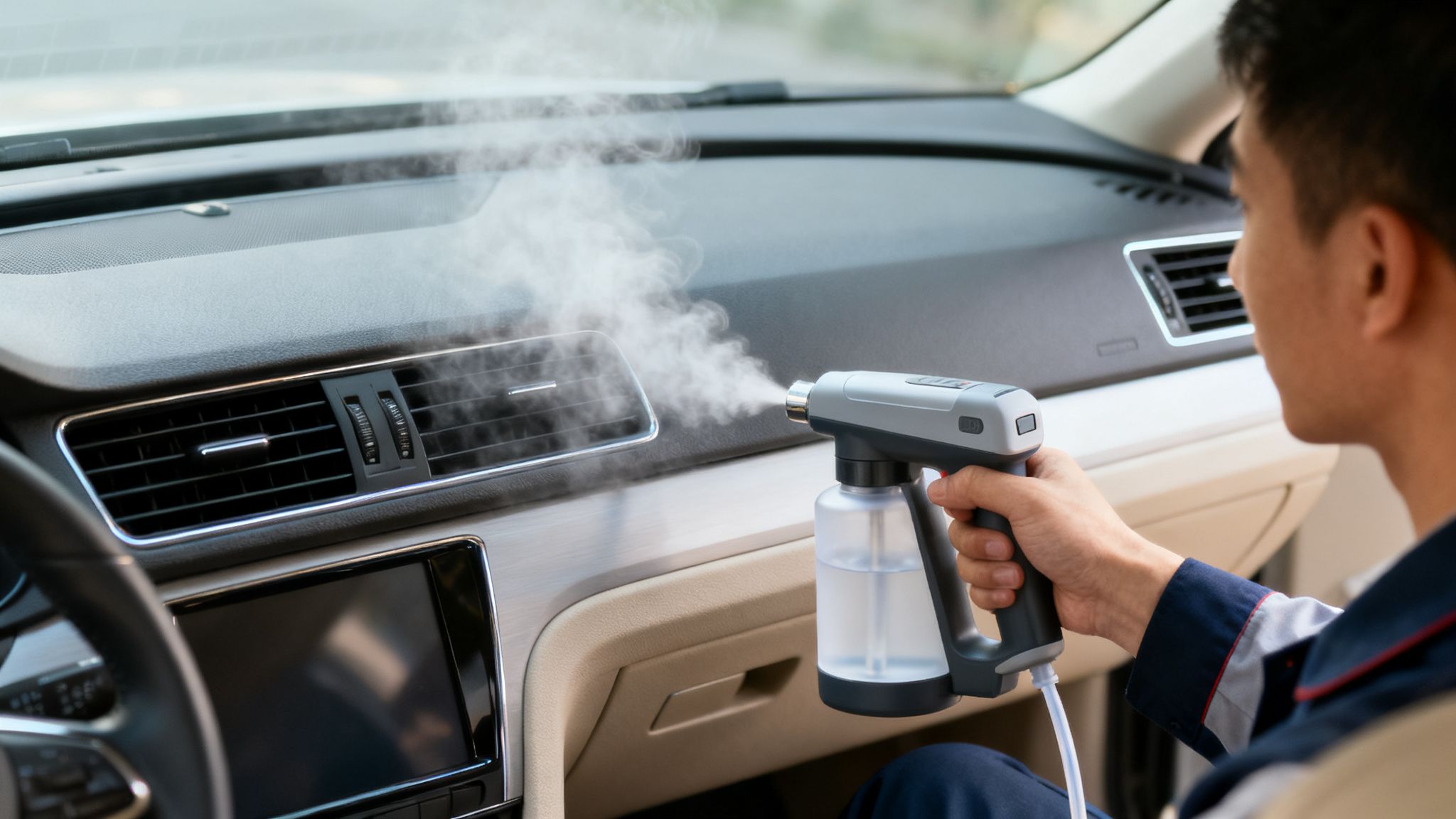
This is a frustratingly common problem we see all the time. The issue is no longer just in the carpet or the seat cushion; the smell has gone airborne. Those tiny, potent odor molecules have drifted through your car and latched onto literally every surface they can find.
We're talking the headliner, door panels, dashboard—and the real kicker—deep inside your car’s HVAC system. Spot cleaning just won't cut it anymore. At this stage, you have to shift from treating one area to decontaminating the entire cabin. This is where professional-grade, whole-vehicle treatments become the only real answer for how to get cat urine out of your car for good.
Beyond Spot Cleaning: The Whole-Car Solution
When an odor has spread, you need a solution that can get everywhere the air can. This is where advanced systems like a Bio Bomb or similar chlorine dioxide (ClO2) vapor treatments are a game-changer. This isn't just a spray or a liquid. It's a gas-based approach that basically performs a hard reset on your car's interior.
Here’s the simple breakdown of how it works:
- Total Permeation: The system releases an ultra-fine, odor-destroying vapor that completely fills the cabin.
- Deep Neutralization: This vapor penetrates porous surfaces like your headliner and fabric seats, and it gets pulled deep into the HVAC system when we run the fan.
- Molecular Breakdown: As the vapor contacts the uric acid and odor-causing bacteria, it oxidizes and dismantles them on a molecular level. It doesn't just cover the smell—it chemically destroys the source.
Think of it like fumigating your car. But instead of pests, you’re targeting microscopic odor molecules. It's a comprehensive attack that leaves nowhere for that lingering cat pee smell to hide.
The technology behind these powerful odor-fighting tools can get pretty interesting. If you'd like to dive deeper, we have an article that explains what ozone treatment for cars is and how it stacks up against other professional solutions.
The Problem Lurking in Your Vents
One of the most overlooked hiding spots for cat urine odor is the HVAC system. Every time you turn on your air conditioning or heat, the system circulates air throughout the entire cabin. If odor molecules got sucked into the vents, you're just re-blasting that foul smell back into your car every time you run the fan.
It's a vicious cycle that can make you feel like you’re losing your mind. You clean the seats, and the smell comes back. You shampoo the carpets, and it still comes back. The source is now buried deep within the ventilation network, a place no amount of scrubbing or spraying can ever reach.
A professional vapor treatment is the only method that effectively cleans and deodorizes the HVAC system from the inside out. By circulating the vapor through the vents, we ensure every last trace of the odor is eliminated, finally breaking the cycle and leaving your car smelling genuinely fresh.
We insist on these industry-approved methods because we’ve seen the results. Too many clients come to us after trying everything—air freshener trees and those consumer "odor bombs" that just mask the problem. These are temporary fixes. The uric acid crystals are still there, waiting for the perfume to wear off before making their smelly return.
Don't settle for a cover-up. If the smell of cat urine has taken over your vehicle, you need a professional solution that gets the job done right. For drivers in Harrisburg, Mechanicsburg, and across Central PA, we have the tools and expertise to make it happen.
Know When It’s Time to Call a Professional
So, you’ve done everything right. You blotted and you sprayed. You thought you won the battle, but then a warm, humid day rolls around, and that faint, unmistakable smell of cat urine creeps back into your car.
It’s a frustratingly common story.
This "ghost smell" is the classic sign that the problem is way bigger than a simple surface stain. The uric acid has soaked deep into your seat foam or carpet padding, far beyond the reach of any DIY tool or off-the-shelf cleaner. At this point, you're just wasting time and money with surface treatments. You need to bring in the heavy hitters.
The Limits of DIY Solutions
Look, taking immediate action is always the right move, but we have to be honest about where DIY methods hit a wall. Professional detailers have equipment and products that are in a completely different league from what you can buy at a store. If you’re nodding along to any of the situations below, it’s a pretty clear sign you’ve reached that wall.
It's probably time to call an expert if:
- You don’t own a hot water extractor. Consumer-grade carpet shampooers just don't have the suction power or heat to pull liquid from deep inside dense automotive foam. A professional hot water extractor is the non-negotiable, industry-standard tool for truly flushing out the urine, not just pushing it around.
- The stain is old or you've blasted it with heat. If the urine sat for weeks or, oops, you tried a steam cleaner on it, those uric acid crystals have basically super-glued themselves to the fibers. Breaking those chemical bonds without permanently setting the stain takes professional-grade products and a bit of know-how.
- The smell seems to be coming from everywhere. This is the big one. If the odor isn't just in one spot and you get a whiff when the heat or AC kicks on, you’ve got a much bigger problem. Odor molecules have found their way into the HVAC system, and only a whole-car vapor treatment can get into all those hidden nooks and crannies.
When the source of the smell is buried deep in your car's cushioning, you're no longer just cleaning a stain—you're performing a deep extraction. Without the right gear, you're just leaving the odor-causing bacteria behind to come back and haunt you later.
Why Professional Detailing Is the Surefire Fix
When you call in a pro, you’re not just paying for a car wash. You're investing in a permanent fix. We use the exact high-powered methods we've been talking about—commercial-grade enzymatic cleaners, brutally effective hot water extractors, and advanced Bio Bomb treatments that get into every single inch of your car's interior, including the entire ventilation system.
This isn’t about spraying some air freshener and calling it a day. It’s about total annihilation of the odor at a molecular level, making sure it never, ever comes back. If you want to see what this process looks like, you can learn more about our professional odor removal services and how we tackle the jobs that make other people give up.
We get how maddening a persistent pet odor can be. For drivers all over Harrisburg, Mechanicsburg, Carlisle, and the rest of Central PA, The Mobile Buff brings the right tools and expertise straight to your driveway. But don't just take our word for it—see the results for yourself and read what your neighbors are saying by checking out The Mobile Buff on our Google Business Profile.
Your Top Cat Urine Questions, Answered
Look, we get it. Dealing with cat pee in your car is a uniquely frustrating problem, and it always brings up a ton of questions. We hear them all the time from frantic car owners. Here are the straight-up, professional answers to the most common ones we encounter.
Can I Really Find Old Stains With a UV Light?
You bet. A UV blacklight is one of the best tricks of the trade, and it's something we use on almost every odor job. Dried urine salts are invisible to the naked eye, but they glow like a crime scene under ultraviolet light. This lets us hunt down and pinpoint every last spot that needs to be treated.
Without it, you're just guessing, and you're bound to miss a spot that will keep stinking up your car on the first hot, humid day.
Is It a Good Idea to Steam Clean the Smell Out?
Please, don't do this. It's one of the most common and costly mistakes we see. People think "steam equals clean," but when it to urine, the high heat is your enemy. It will literally "cook" the uric acid crystals and proteins, bonding them permanently to your carpet or seat fibers.
The heat from a steamer will set the stain and lock in the odor for good. You'll go from having a solvable problem to an impossible one. A professional uses a hot water extractor, which flushes the area with warm water and sucks everything out without cooking it in.
My Cat Sprayed the Headliner. Is It Ruined?
This is a tough one, and honestly, it's a "maybe." Headliners are incredibly fragile. They're just a thin layer of fabric glued to a foam board. That glue is super sensitive to both moisture and chemicals.
Get it too wet, scrub too hard, or use the wrong cleaner, and that glue will fail. The result? A saggy, droopy headliner that looks awful and costs a fortune to replace. Saving a sprayed headliner requires a very delicate, specialized approach. This is one of those times where calling a pro is your best bet to avoid making a bad situation much, much worse.
How Long Does Professional Odor Removal Actually Take?
It really depends. There's no one-size-fits-all answer because every situation is different. The timeline hinges on a few things:
- The extent of the damage: Are we talking about a small puddle or a seat that's been soaked through?
- How long it's been there: A fresh accident is much easier to tackle than something that's been baking in the sun for weeks.
- The surfaces involved: Carpet and cloth seats are porous, while leather requires a different approach.
A small, recent spot might be a couple of hours of work. But for a car with heavy, set-in saturation, we might need the vehicle for a full day. That could involve a deep extraction followed by a full-blown Bio Bomb treatment to kill any lingering odors in the cabin and even the air vents. We'll always give you a clear, honest time estimate after we've had a chance to see what we're up against.
At The Mobile Buff, we've seen (and smelled) it all. We have the right tools, the right products, and the hands-on experience to permanently solve even the worst cat urine disasters. If you're in Central PA and have reached the end of your rope, let us handle it for you.
Tired of the smell? Visit our Google Business Profile to see our reviews and then contact us for a free estimate to get your car smelling fresh again!

