


Hey there! It’s a feeling we’ve all had. That split-second horror when a greasy french fry tumbles onto your pristine car seat or a leaky takeout bag leaves its mark. Your first instinct might be to grab a napkin and scrub furiously, but take it from us professionals—that's the fastest way to turn a small spot into a permanent problem.
The absolute golden rule for tackling a fresh oil spill is to blot, don't rub. Seriously. This one simple action can be the difference between a quick fix and a lasting stain. By gently pressing a clean, absorbent cloth onto the spill, you're lifting the oil out of the fibers. Scrubbing just grinds it deeper, making it much harder for even a professional to get out later.
That Heart-Stopping Moment of an Oil Spill

We see it all the time here at The Mobile Buff. A customer calls in a panic over a small food or grease stain that has now become a much bigger, set-in mess because their first reaction was to scrub. We totally get the instinct, but it's a critical mistake.
Think of it this way: rubbing an oil stain is like pushing it further into the weave of the fabric. You're not removing it; you're just forcing it deeper, making our job that much harder. The real goal is to lift and extract.
Immediate Damage Control The Professional Way
So, what should you do in that critical moment?
Grab the most absorbent thing you can find—a microfiber towel is perfect, but paper towels or a clean napkin will do the trick. Lay it over the stain and apply firm, steady pressure. You'll literally see the oil transfer from the seat to the towel. Lift it, find a clean spot on the towel, and press down again. Keep blotting until the towel comes up clean.
This isn’t just a quick fix; it’s the foundational first step that sets you up for success. Letting oil stains sit can seriously tank your car's resale value. There's science to back this up, too. Studies on upholstery show that aggressive rubbing can drive oil 30% deeper into the fibers. In contrast, gentle blotting can lift 50-70% of the surface oil within minutes. If you're interested in the data, companies like Fortador often share research on stain removal effectiveness.
Pro Tip: We always tell our clients to keep a small "spill kit" in their glove box. A couple of microfiber towels and a travel-sized, industry-approved spot cleaner can be a total lifesaver, empowering you to act fast when messes happen.
What Happens When an Oil Stain Sits
If you miss that initial window, the oil starts a chemical bonding process with the fabric fibers. The heat from the sun acts like an oven, baking the stain right into the seat. This is especially bad for porous cloth seats, which just drink it up. On leather or vinyl, the oil might not soak in as fast, but it will eventually eat through the protective topcoat, leading to permanent discoloration.
By blotting immediately, you stop that bonding process in its tracks and make the final cleanup a whole lot easier for you or for us.
Professional vs DIY Stain Removal Approach
Here’s a quick look at how a pro detailer’s method stacks up against common at-home attempts. You’ll notice the differences are in the tools, techniques, and understanding of the materials.
As you can see, the professional process is all about a controlled, multi-step approach designed to lift the stain completely without causing any collateral damage. Feeling overwhelmed by a stubborn stain? The Mobile Buff specializes in professional interior detailing, and we come right to you. Take a look at our services and see what our customers are saying on our Google Business Profile. We'd be happy to help restore your car's interior to its former glory.
The Pro Prep Work Amateurs Always Skip

Before a single drop of cleaner ever hits your car's upholstery, there’s a crucial prep phase that separates a temporary fix from a true restoration. It’s tempting to jump right in and start scrubbing, but that's like painting a wall without sanding it first—you're just covering up the problem, not actually solving it. This is where professional detailers have a massive advantage, boosting the odds of complete stain removal before the real cleaning even begins.
The secret? It boils down to two simple but powerful steps: dry brushing and deep vacuuming. This isn't just about a quick tidy-up; it's a strategic move. A good dry brushing with a stiff-bristled brush agitates and lifts away any caked-on grime and loose debris clinging to the fabric. Even more importantly, it fluffs up the fibers around the oil stain, opening them up so the cleaning solution can actually get in there and do its job.
Why a Thorough Vacuum Is Non-Negotiable
Following up with a powerful vacuum is the other half of this power duo. Honestly, your household vacuum attachment probably won't cut it here. We use commercial-grade vacuums with serious suction and specialized crevice tools to pull every last bit of loosened debris out of the seat. This prevents all the dirt, dust, and crumbs from turning into a muddy mess the second you add a liquid cleaner, which only makes the stain worse.
This meticulous first step is the foundation of a successful clean. It ensures that when we finally apply our professional-grade cleaners, they can get straight to work on the oil itself, instead of having to fight through a layer of surface gunk. You can learn more about these powerful techniques in this full professional detailing guide.
If you're in Dauphin or Perry counties, you know exactly how road salt and grime gets everywhere. Taking a few extra minutes to prep the stain properly means you aren't just creating a bigger, muddier headache for yourself down the road.
The Right Tools for the Job
Not all brushes are created equal. A common mistake is using a brush that’s too soft (which does nothing) or too harsh (which can damage the fabric). We rely on specific upholstery brushes with stiff, synthetic bristles that are tough on dirt but gentle enough to avoid fraying or pilling delicate cloth seats.
Here’s what a pro has in their prep kit:
- A Stiff-Bristled Upholstery Brush: This is the workhorse for loosening dirt and agitating the fabric fibers around the oil stain.
- A High-Powered Vacuum: You need strong suction to pull all that loosened debris from deep within the seat cushions.
- Crevice and Brush Attachments: These are essential for getting into seams, stitching, and tight corners where grime loves to hide.
By dedicating time to this preparation, we set the stage for a flawless finish. It’s a methodical approach that makes the main treatment as effective as possible and helps prevent common DIY fails like water rings or spreading the stain. It’s the professional difference that delivers a truly deep clean.
If you're looking at a tough oil stain and want to make sure it's handled correctly from the very first step, The Mobile Buff is here to help. See our work and what your neighbors are saying by checking out our Google Business Profile, then give us a call to get your car’s interior looking brand new again.
Choosing Your Cleaner: A Detailer's Perspective
Walking down the automotive aisle can be dizzying. You're faced with a wall of brightly colored bottles, all screaming promises of miraculous results. How do you pick the one that will actually lift that greasy oil stain instead of just spreading it around and making things worse? From our professional experience, this choice is everything. It’s the difference between a stain that vanishes and a seat that’s permanently damaged.
The simple truth is, not all cleaners are made the same. Automotive-specific products are carefully pH-balanced to be safe for the dyes, fibers, and finishes in your car—materials that have to endure brutal UV rays and constant temperature swings. Using a product not designed for this purpose is a major gamble.
The Science of Clean: Enzyme vs. Solvent-Based Cleaners
When we approach an oil stain, we’re not just spraying and praying. We’re diagnosing the problem to choose the right tool for the job. To really understand how to remove oil stains from car seats, you need to know about the two main categories of professional-grade cleaners.
Solvent-Based Cleaners (Degreasers): These are the heavy hitters. Solvents are powerful chemicals designed to dissolve and break down synthetic oils and greases—think motor oil or thick lubricants. They work by chemically prying the oil's grip from the fabric fibers, allowing it to be lifted and wiped away. Trusted brands in the detailing world, like Meguiar's and Malco, have spent decades perfecting these formulas.
Enzyme-Based Cleaners: Think of these as the specialists for organic messes. Enzyme cleaners are your go-to for that greasy spot from a dropped french fry or a rogue slice of pizza. They contain specific proteins (enzymes) that literally digest the organic oils, breaking them down on a molecular level into tiny, water-soluble bits that are easy to flush out.
There's a reason professionals rely on these specific products. You can find community discussions about successful stain removal, like this one on DIY oil stain removal on BobIsTheOilGuy, but the safest and most effective results come from professional-grade solutions applied with proper technique.
Why Professional-Grade Products Just Work Better
So, why not just grab any old bottle off the shelf at the supermarket? Most retail all-purpose cleaners are either too harsh or too weak for auto interiors. They might have aggressive detergents that can strip the color right out of your upholstery, or they can leave behind a sticky film that becomes a magnet for even more dirt.
Professional products, on the other hand, are highly concentrated and engineered for very specific tasks. A product like Malco's Leather & Plastic Cleaner is formulated to clean deeply without drying out sensitive surfaces. At the same time, their Red Thunder degreaser is a potent, targeted solution for heavy-duty grease. We carry an entire arsenal for a reason: one bottle can't solve every problem. You can see some of our top picks in our guide to the best stain removers for car upholstery.
A Detailer's Insight: One of the biggest mistakes we see is people misusing products. They'll grab a powerful degreaser meant for an engine bay and blast it all over a delicate leather seat, causing damage that can't be fixed. The label isn't just a suggestion; it’s a critical instruction based on chemical compatibility.
This is exactly why a mobile detailing service like ours can deliver results that are tough to get on your own. It isn't just about elbow grease; it's about having the right chemistry on hand for your specific stain and your specific seat material. We've invested the time and money into learning the science and stocking the right products to solve the problem safely and completely.
When you hire The Mobile Buff, you're not just paying for a cleaning. You're getting access to our expertise and our entire toolkit of professional-grade solutions. If you're in the Harrisburg or Mechanicsburg area and want to see what a difference the right products and techniques can make, check out the before-and-after photos on our Google Business Profile. Let us bring the right chemistry to your driveway and make that stain disappear for good.
Mastering the Technique for Different Seat Materials
Here’s where real-world experience makes all the difference. You simply can't treat an oil stain on a rugged cloth seat the same way you’d handle one on delicate leather—that’s a recipe for disaster. A one-size-fits-all approach just doesn’t cut it, and knowing the right technique for each material is the secret to a flawless result.
So, let's pull back the curtain and show you exactly how we, as professional detailers, tackle the unique challenges of different car seat surfaces. This isn't just about cleaning; it's about preserving the look, feel, and integrity of your vehicle's interior.
The Professional Approach for Durable Cloth Seats
Cloth seats are like sponges. They’re comfortable, sure, but they soak up spills in the blink of an eye, and that porosity is our biggest hurdle. After doing the essential prep work, we apply the carefully chosen cleaner we talked about earlier.
But once the cleaner has had a few moments to work its magic and break down the oil, we bring out the big guns: a hot water extractor. This machine is the cornerstone of professional upholstery cleaning. It works by spraying a high-pressure jet of hot water and a rinsing agent deep into the fabric, then immediately sucking all of it back out—the water, the cleaner, and the dissolved oil.
This process is a game-changer for two key reasons:
- It flushes the stain completely out of the seat's deep padding, not just off the surface.
- It removes every bit of cleaning residue, preventing that stiff, crunchy feeling and getting rid of the sticky film that just attracts more dirt later on.
Using a powerful extractor is the only way to be 100% certain the oil has been removed, not just pushed deeper into the foam cushion.
This is the kind of professional thought process we use to select the right cleaner before a job even starts.
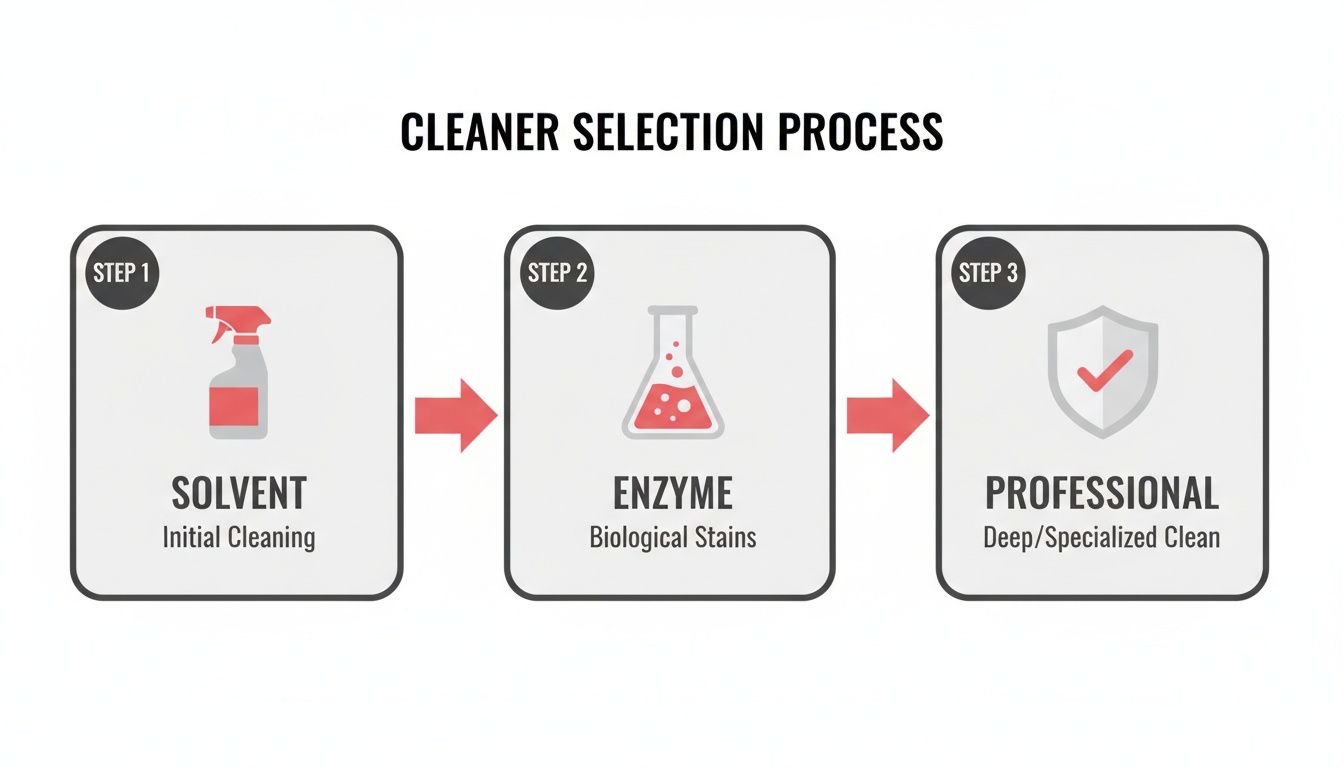
You can see how a detailer adapts their tools based on the stain's specific chemistry, moving from solvents to enzymes to more powerful professional-grade solutions as needed.
The Gentle Touch Required for Leather Seats
Everything changes when you’re working with leather. It isn't porous like cloth, but it has a delicate protective finish on the surface. Using aggressive, high-alkaline cleaners or scrubbing too hard will strip that finish right off, leading to dryness, cracking, and permanent discoloration. It happens faster than you think.
For leather, we only use pH-neutral cleaners. These specialized formulas are designed to gently lift oil from the surface without damaging the leather's natural moisture barrier. We always apply the cleaner to a soft microfiber towel or a gentle horsehair brush—never directly onto the seat itself—to maintain total control over the amount of product used.
After cleaning leather, there's one step that absolutely cannot be skipped: conditioning. A high-quality leather conditioner is crucial for replenishing the essential oils that get stripped away during cleaning. This leaves the surface supple, protected, and with that original rich sheen.
For a deeper look into general upkeep, you might find our guide on how to clean car seats at home helpful for more routine care tips.
The Method for Tough Vinyl Surfaces
Vinyl is probably the most durable material you'll find in a car's interior, but it's not invincible. Its biggest weakness is scratching. If you use an abrasive cleaner or a brush with stiff, aggressive bristles, you can easily create fine scratches on the surface, which permanently dulls the finish.
Our method for vinyl involves a strong, professional-grade degreaser that is specifically formulated to be non-abrasive. We apply it and then use a soft-bristled detailing brush to gently agitate the area, letting the chemical do all the heavy lifting. The key here is patience—letting the product dissolve the oil so it can be wiped away cleanly without any harsh scrubbing.
This kind of material-specific expertise is exactly why hiring a professional is often the safest and most effective way to go. We don't just have the right products; we have the hands-on experience to apply the correct technique for your vehicle's specific needs, ensuring a perfect result every single time.
Your Top Oil Stain Questions, Answered
Let's be real. When you see a fresh oil stain blooming on your car seat, your mind probably starts racing with questions. As professional detailers, we’ve heard just about every one of them. We're here to cut through the noise and give you some straight-up advice, drawing from our experience right here in Central Pennsylvania.
Think of this as a chat with a pro. We want you to understand what really works and what can make things worse, so you can make the right call for your car.
Can I Just Use Something From My Kitchen, Like Baking Soda or Vinegar?
This is easily the most common question we get, and we totally get the temptation. A quick internet search brings up dozens of "DIY" solutions using household items. But from our professional experience, we strongly advise against it. These home remedies are one of the top causes of permanent damage we see in the field.
Vinegar, for instance, is an acid. That acidity can eat away at the color in your cloth seats or destroy the protective coating on your leather, leaving it faded and brittle. Baking soda is abrasive, meaning it can create micro-scratches on leather and vinyl. On cloth, it often just pushes the oil deeper while leaving a gritty residue that’s nearly impossible to fully remove.
The bottom line is that professional, pH-balanced cleaners are engineered for one job: to be tough on stains without harming your car's interior. It’s all about using the right tool—and the right chemistry—for the job.
Seriously, How Fast Do I Need to Act Before It’s Too Late?
When it comes to oil stains, time is not on your side. The longer that oil has to seep into the fibers of your upholstery, the tougher it bonds, making it exponentially harder to remove.
For cloth seats, the window is frustratingly small. A fresh oil stain can set in and become nearly permanent in just a couple of days, especially if your car sits in the sun, which basically bakes the oil right into the fabric. You get a little more breathing room with leather and vinyl, but the oil will still eventually seep in and cause a deep discoloration that surface cleaning just won't touch. Your best shot at a complete removal is to have the stain professionally treated within the first 24 to 48 hours.
Will Professional Cleaning Get Rid of That Gross Oily Smell, Too?
You bet it does. In fact, that's one of the biggest differences between a spot-clean and a true professional detailing service. That lingering greasy smell, whether it’s from french fries or engine grease, is caused by oil particles that have soaked deep into the seat's foam padding.
Spraying an air freshener is just a temporary fix; it's like putting a band-aid on the problem without treating the wound. Our hot water extraction method, on the other hand, attacks the source. It doesn't just lift the stain you can see; it powerfully flushes out the oil particles trapped deep inside the seat. For those especially stubborn smells, we have specific treatments that neutralize the odor molecules for good, leaving your car smelling genuinely fresh, not just perfumed.
Wrestling with a tough stain can be a real headache. If you're around Harrisburg or Mechanicsburg and would rather just have it done right, let us take care of it. You can see our results and what your neighbors think by checking out our Google Business Profile. We'll bring the right tools and expertise straight to your door.
When to Call a Professional for a Flawless Finish
Sometimes, an oil stain just refuses to budge. We get it. Knowing when to call in an expert isn't about admitting defeat; it’s about making a smart call to protect your car's interior and its value. Pushing forward on your own can often turn a small problem into a permanent one.
So, how do you know when you’ve hit that wall? There are a few clear signs that professional help is your best bet.
The Tell-Tale Signs It's Time for a Pro
If you find yourself in one of these situations, it's a good idea to put down the spray bottle and pick up the phone.
The Stain is Old or Set-In: An oil stain that's had days, weeks, or even months to become one with the fabric is a whole different ballgame. If the sun has baked it in, simple surface cleaning just won't cut it.
You're Dealing with a Massive Spill: A small drip is one thing. A large spill that has soaked a big part of the seat is another beast entirely. This kind of job needs heavy-duty extraction equipment to pull all that oil out from the deep foam padding.
Your Seats are Made of Delicate Material: Are your seats Alcantara, suede, or perforated leather? These high-end materials are notoriously fussy. The wrong product or technique can cause irreversible damage like discoloration, matting, or making the material stiff and brittle.
Previous DIY Attempts Have Failed (or Made it Worse): If you've already tried a few methods and the stain is still staring back at you—or you've now got a lovely water ring to go with it—it’s time to stop. More attempts can just push the stain deeper and make a professional's job even tougher.
The Professional-Grade Difference
When you hire a service like ours, you’re getting more than just stronger chemicals. You’re getting access to equipment that home machines simply can't compete with. We use commercial-grade heated extractors and powerful steam cleaners that work at much higher temperatures and pressures. This lets us safely break down and flush out the most stubborn, embedded oil without oversaturating your seats.
This isn't just about cleaning; it's a full restoration. We're removing the stain from its source, killing any lingering odors, and making sure the surrounding fabric is perfectly blended and residue-free.
For a closer look at our advanced techniques, check out our guide on professional stain removal services. It breaks down exactly how we tackle the messes that others can't. For drivers in the Harrisburg, Mechanicsburg, and Carlisle areas, seeing is believing. We invite you to see what a difference our professional touch can make. Check out our work and read reviews from your neighbors on our Google Business Profile. Let us handle the tough stuff so you can get back to enjoying a spotless car.
Don't let a stubborn oil stain ruin your car's interior. The Mobile Buff brings professional-grade tools and expertise right to your driveway. Book your mobile detailing appointment today at https://themobilebuff.com and let us restore your car seats to their flawless, pre-stain glory.

