


Monday morning, the car smells like your dog has been riding in it for a week, even though you already tried the quick wipe-down and the air freshener. The seat still looks faintly stained, the carpet feels damp in one corner, and the odor comes back every time the cabin warms up. That's the moment many owners realize this isn't a normal tidy-up, it's a professional pet stain removal problem.
In vehicles, pet messes behave differently than they do on a living room carpet. Upholstery seams, floor mats, seat foam, headliners, and the padding underneath all hold onto contamination in ways a surface cleaner can't reach. For Central Pennsylvania drivers, that's why a mobile detailer with the right chemistry and extraction equipment can make the difference between covering the smell and clearing it out. If you're already comparing options, The Mobile Buff's guide on removing pet smell is a useful place to start.
The Morning You Catch the Smell
You know the routine. You toss a coffee into the cupholder, buckle in, and before the day even starts you catch that sour, stale pet odor that wasn't there yesterday, or at least didn't seem that strong. In a commuter car, that smell is more than annoying, because it lingers in the seats and vents long after you've “cleaned” the visible spot.
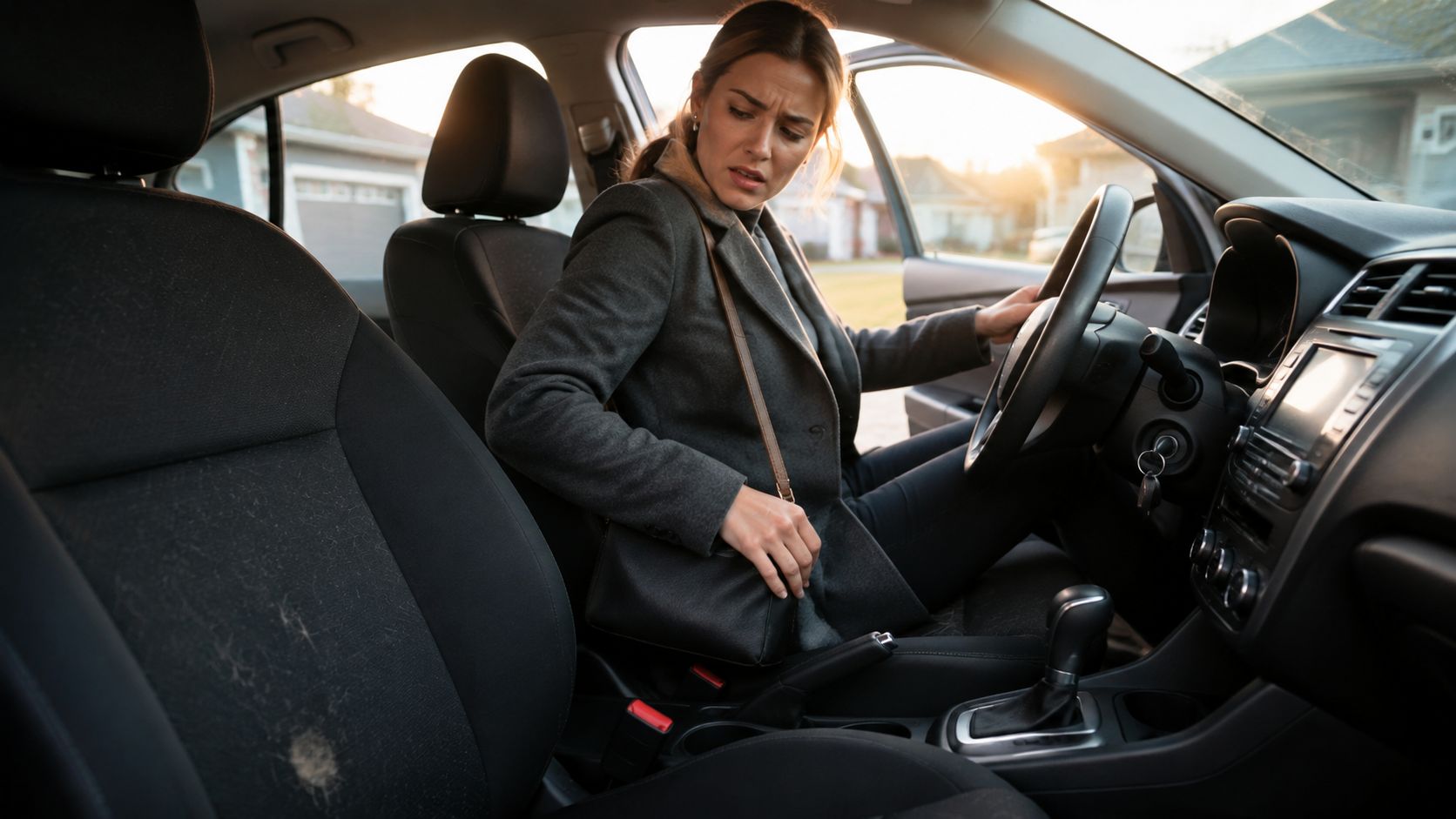
A lot of drivers try the fast fix first. They blot what they can, spray a cleaner, crack the windows, and hope the weekend handles the rest. Sometimes that works for a fresh surface accident, but the smell that returns on Monday usually means the contamination got past the top fibers and into the materials below.
Why vehicle interiors hold onto pet odor
Carpet in a home is one thing. A car seat is another. Foam cushions, carpet backing, seat tracks, and even the headliner can trap organic residue, which is why an odor can feel “gone” for a day and then come back when humidity or heat rises.
If the smell comes back after the car warms up, the source is still in the vehicle somewhere.
That's why this topic matters for drivers, not just homeowners. A vehicle can look clean and still carry a pet accident in the foam, the carpet pad, or the ventilation path. Once that happens, the problem stops being a wipe-down job and becomes a detailing job that needs the right process.
What Professional Pet Stain Removal Is
A pet accident in a vehicle rarely stays on the surface. By the time a driver notices the smell, urine or other organic residue has often worked into the seat foam, carpet backing, seams, or cargo-area padding. Professional pet stain removal addresses that buildup with a process, not a quick spray and wipe.
The work starts with enzyme treatment to break down the residue the pet left behind. That matters because dried contamination binds to fabric and padding, and surface cleaner alone only reaches the top layer. From there, hot-water extraction removes the loosened material from the textile instead of pushing it deeper into the cabin.
The chemistry comes first
Enzyme cleaners are useful because they target the organic material in the accident itself. Industry guidance points to enzymes such as protease, lipase, amylase, and uricase as the chemistry that helps break down uric acid crystals and other organic residue before extraction removes the loosened soil load from the fabric and padding carpetcleaningauthority.com. In the field, that means dwell time matters. If the product is pulled out too quickly, it does less than the label promises.
The next step is hot water extraction, which flushes the loosened contamination out of carpet or upholstery. Cleaning references describe truck-mounted systems operating at 150°F to 230°F with vacuum performance around 200 to 300 CFM as a standard for pulling dissolved soil from carpet and padding carpetcleaningauthority.com. That kind of pull is what separates a surface refresh from real removal.
Where odor treatment fits
Some interiors need more than extraction. Once odor has moved into vents, backing, or padding, detailers rely on targeted odor treatment to reach the source instead of covering the smell in the cabin air. Mobile pros often pair extraction with treatments such as Bio Bomb because spot cleaning alone rarely reaches those hidden areas.
The order matters here. Cleaning has to happen first, then odor treatment can be applied where lingering contamination remains in the vehicle. If the cabin still smells after the visible stain is gone, the source is usually still trapped somewhere under the fabric or in another hidden surface. For a closer look at that stage of the process, see odor removal in car detailing.
Air treatment can help with what is floating around the cabin. If you are also dealing with allergens, the best air purifier for pet dander may help reduce airborne particles, but it does not replace extraction or odor neutralization inside the seat foam. The stain still has to be removed from the vehicle first.
For a local example, The Mobile Buff handles this kind of interior work on-site, which avoids the drop-off and pickup headache that comes with a shop visit. Their broader interior service process is outlined in their full detail breakdown, and it follows the same basics detailers rely on in the field, chemistry, heat, agitation, and controlled extraction.
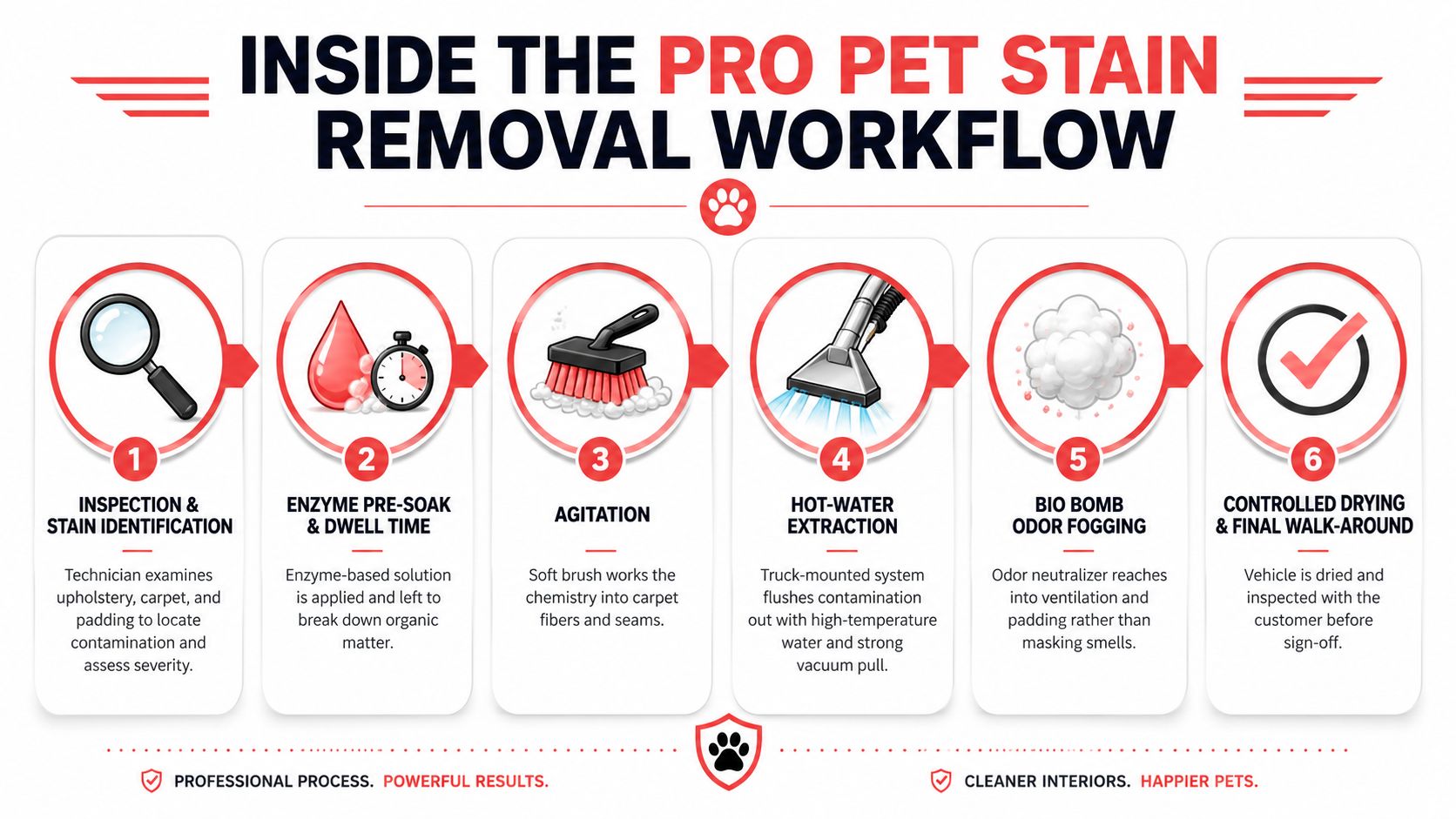
Inside the Pro Workflow From Inspection to Final Walk-Around
A real pet-stain appointment starts with a close inspection, not with a spray bottle. The technician checks the seat face, seams, carpet edges, cargo areas, and any padding that feels damp or smells stronger than the rest of the cabin. That first look tells the detailer where the contamination sits and whether the work stays at the surface or moves deeper.
The order matters
The process usually runs in a sequence that protects the fabric and keeps the contamination moving out, not further in. The stain gets pre-treated with an enzyme solution, then agitated lightly so the chemistry reaches the fibers and seams. After the dwell time, hot-water extraction flushes the loosened material out of the textile and backing.
Pre-treat before extracting, and extract before any odor fogging. Skipping that order leaves residue behind.
After the extraction pass, an odor treatment can be used to deal with the source that's still in the cabin air, the vents, or the deeper materials. Controlled drying comes next, because a damp interior can hold odor and slow the final result. A proper walk-around at the end matters just as much as the first inspection, because it confirms whether the stain, the smell, or both need another pass.
A mobile setup makes this process easier for busy owners because the work travels to the driveway. That means no waiting room, no pickup logistics, and no reason to drive a pet-smelling vehicle across the county before it's cleaned. A two-to-three-hour appointment is common for a decent interior job with stain and odor work, though the exact time depends on how deep the contamination goes and how long the cleaner has to dwell.
What gets checked before sign-off
- Seat foam: Technicians smell and press the cushion to see whether odor is still trapped below the fabric.
- Carpet backing: The surface may look fine while the pad underneath still carries residue.
- Headliner and vents: If odor is airborne in the cabin, these areas get checked too.
- Dryness: A vehicle shouldn't be handed back with lingering damp spots that re-activate the smell.
The final handoff is simple. If the smell is gone and the textile looks restored, the job is done. If not, the technician knows whether another pass is justified or whether the contamination has gone beyond a normal interior cleanup.
Common Stain Types and How Pros Treat Each One
A dog that tracked in mud, a cat accident on the back seat, and a vomit spot in the cargo area all call for different treatment. In vehicle interiors, the surface only tells part of the story. A detailer checks the fabric, the foam underneath, the seam lines, and the nearby plastic before choosing a method, because a stain that looks minor on the seat face can still be sitting in the padding or along the edge of a buckle.
Fresh urine usually gives the cleanest result. If it is still recent, I start with an enzyme pre-treatment, give it time to work, agitate lightly, then extract before it settles deeper into the carpet or seat foam. Once it dries, the job changes. Old urine often needs repeat treatment and stronger sub-surface extraction, because the odor can sit below the visible spot and come back after the car warms up.
Vomit is a different kind of problem. It leaves organic residue that can hang in seams, around stitching, and under trim if it is only wiped off the top. Mud is often less about odor and more about grit, so I dry-remove what I can first, then rinse and extract so the soil does not get pushed farther into the fibers. Blood needs a careful touch. Heat can set it faster than people expect, so controlled spot treatment matters more than speed.
Pet hair is its own task. It does not dissolve, and a standard vacuum rarely pulls all of it out of seat fabric or carpet texture on the first pass. Rubber brushes, grooming tools, and repeated agitation loosen the hair so the vacuum can grab it. That is the same reason a cleaning artificial turf guide can feel familiar to anyone who has dealt with embedded fibers. The debris sits in the structure, not just on top.
A good job usually follows the stain, not a fixed script.
- Fresh urine: Enzyme pre-treatment, short dwell time, extraction.
- Dried urine: Longer dwell time, repeat treatment, deeper extraction.
- Vomit: Organic residue removal, seam attention, full rinse and extraction.
- Mud: Dry removal first, then shampoo extraction.
- Blood: Cautious spot treatment and controlled extraction.
- Pet hair: Specialized release tools, then vacuuming and final grooming.
The tool changes with the mess, and so does the time on the job. One vehicle clears quickly because the contamination stayed near the surface. Another keeps fighting back because the residue moved into the backing, the foam, or the hidden edges of the interior where spot cleaning never really reaches.
DIY Spot Cleaning vs Calling a Professional
A fresh pet accident in a vehicle is manageable if you move fast. Blot the area, apply the right enzyme cleaner, and dry it before the spill has time to sink deeper into the seat foam or carpet pad. Once the stain has already traveled into the backing, or the odor comes back after the first wipe-down, DIY work starts to hit its limit.
At home, the tools are usually basic. A spray bottle, a towel, maybe a consumer carpet machine. That setup can lift surface soil, but it does not give you the heat, vacuum pull, or dwell time control that a pro uses to reach deeper contamination. In car interiors, that difference matters because urine, vomit, and spilled pet messes do not stay neatly on top of the fabric.
A professional service costs more than a store-bought cleaner, but the price reflects deeper work, not just more labor. Broader pet odor removal pricing often lands in the range reported by worldmetrics.org, and severe contamination can climb much higher. In a vehicle, the value is usually simpler. You avoid scrubbing the same spot repeatedly and still finding a urine smell every time the cabin warms up.
DIY works for a fresh surface accident. If the odor returns, the cleaner never reached the source.
The choice usually becomes obvious once you look at the mess itself.
- The stain is set: Old urine and repeated accidents often need extraction that goes beyond a spot cleaner.
- The smell keeps coming back: That usually means the contamination is below the visible fiber.
- The interior is large or complex: Seat foam, cargo areas, and headliners take real time to treat correctly.
- You want one finished result: A professional brings agitation, heat, odor treatment, and drying into one workflow.
For readers who also maintain outdoor surfaces, a cleaning artificial turf guide shows the same basic limit from another angle. Surface cleaning only goes so far once contamination gets below the top layer. In a vehicle, that is why mobile pros like The Mobile Buff use odor treatments such as Bio Bomb alongside hot-water extraction. The spot cleaner may make the stain look better, but the deeper treatment is what helps neutralize what the surface wipe leaves behind.
What It Costs and How Long It Takes
The price question usually comes right after the smell hits you. In vehicle interiors, the answer depends on how far the contamination has spread into the seat foam, carpet backing, or headliner, and how much extraction time the job needs. A fresh spot on the surface is one kind of job. Repeated accidents that have soaked deeper into the padding are another.
A mobile detailer is usually pricing the work by scope, not by a single flat promise. A light seat or carpet treatment may only need pre-treatment, agitation, and extraction. A heavier job can add odor treatment, longer dwell time, repeated passes with hot-water extraction, and slower drying so the cabin is ready to use without bringing the smell back when the interior warms up.
What changes the quote
Old urine, soaked foam, and pet hair packed into seams take more labor than a recent spill. If the stain is still active, the technician has to inspect the area first, choose the right chemistry, and work in the right order so the odor source is not just masked. That is why a simple cleanup and a full odor recovery job do not cost the same.
The timing works the same way. A small stain on a seat bolsters can be handled quickly. A cargo area, floor carpet, or roof liner with deeper contamination takes longer because the material needs careful treatment, controlled extraction, and drying time between passes. The result is less about a rushed visit and more about whether the interior is finished when the technician leaves.
For Central PA drivers comparing real-world service pricing, the Atticus Cleaning Services carpet care costs page is a useful reference for how professional cleaning is commonly priced by scope. The same logic applies inside a vehicle, more contamination means more labor, more chemistry, and more attention to drying.
What the appointment usually looks like
The technician shows up with the extractor, pre-spray, odor treatment, brushes, and drying gear. You do not need to pull a machine out of your garage or guess at the right cleaner for upholstery, carpet, or plastic trim.
First comes inspection. Then the detailer treats the stain, works it with the right tool, extracts the residue, and checks whether the odor still lingers in the foam or backing. If it does, a second round of treatment may be needed before the cabin is closed up.
That is the honest budget picture. You are paying for labor, chemistry, heat, and drying control, not just a quick wipe and a scented cabin.
When a Stain Cannot Be Fully Reversed
Some stains cannot be fully erased, and pretending otherwise only burns time and money. If urine has permanently changed the color of the fabric, if the fibers have been damaged, or if the contamination has soaked into the padding and subfloor, a cleaner can still improve the interior without making it perfect. In vehicle work, that usually shows up on seats, floor carpets, or a headliner where the spill traveled farther than the surface stain suggests. Once the backing is involved, the job shifts from stain removal to damage control.
Older stains are harder because the residue has had time to bond with the material. Heavy scrubbing can make the problem worse by roughing up fibers, spreading the contamination, or pushing liquid deeper into the foam. Once the surface has been altered, the best result may be partial restoration rather than a flawless finish.
The same limit shows up with heat, harsh spotters, and repeated over-wetting. If a driver has already attacked the area with strong chemicals or a stiff brush, the fabric may be faded, matted, or physically worn in a way cleaning cannot reverse. A proper detailer will still inspect the spot, test the material, and decide whether extraction, odor treatment, or a more limited clean is the right call.
The earlier you call, the more likely the stain is recoverable.
A professional inspection keeps you from chasing a problem that has already crossed the line. If the stain is still treatable, a detailer can usually make a visible difference with the right pre-spray, agitation, and hot-water extraction. If the material has already been permanently altered, a straight answer is better than paying for another round of cleaning that cannot bring the fabric back.
SafeClean notes that pet stains may not be fully removable when the carpet has permanently changed color, the urine has damaged the fibers, the stain is very old, or aggressive chemicals and scrubbing have already harmed the material SafeClean. In a vehicle, that is often the point where you stop chasing a perfect match and decide whether cleaning, odor treatment, or replacement is the practical fix.
Book a Mobile Pet Stain Detail in Central PA
If your car smells like pets every time you start it, the fix is probably more than a quick wipe and a spray. A proper interior detail removes the source, treats the odor, and gives you a cabin that feels normal again. For busy drivers in Harrisburg, Mechanicsburg, Carlisle, Newport, and surrounding Dauphin and Perry counties, that kind of service fits better on your driveway.
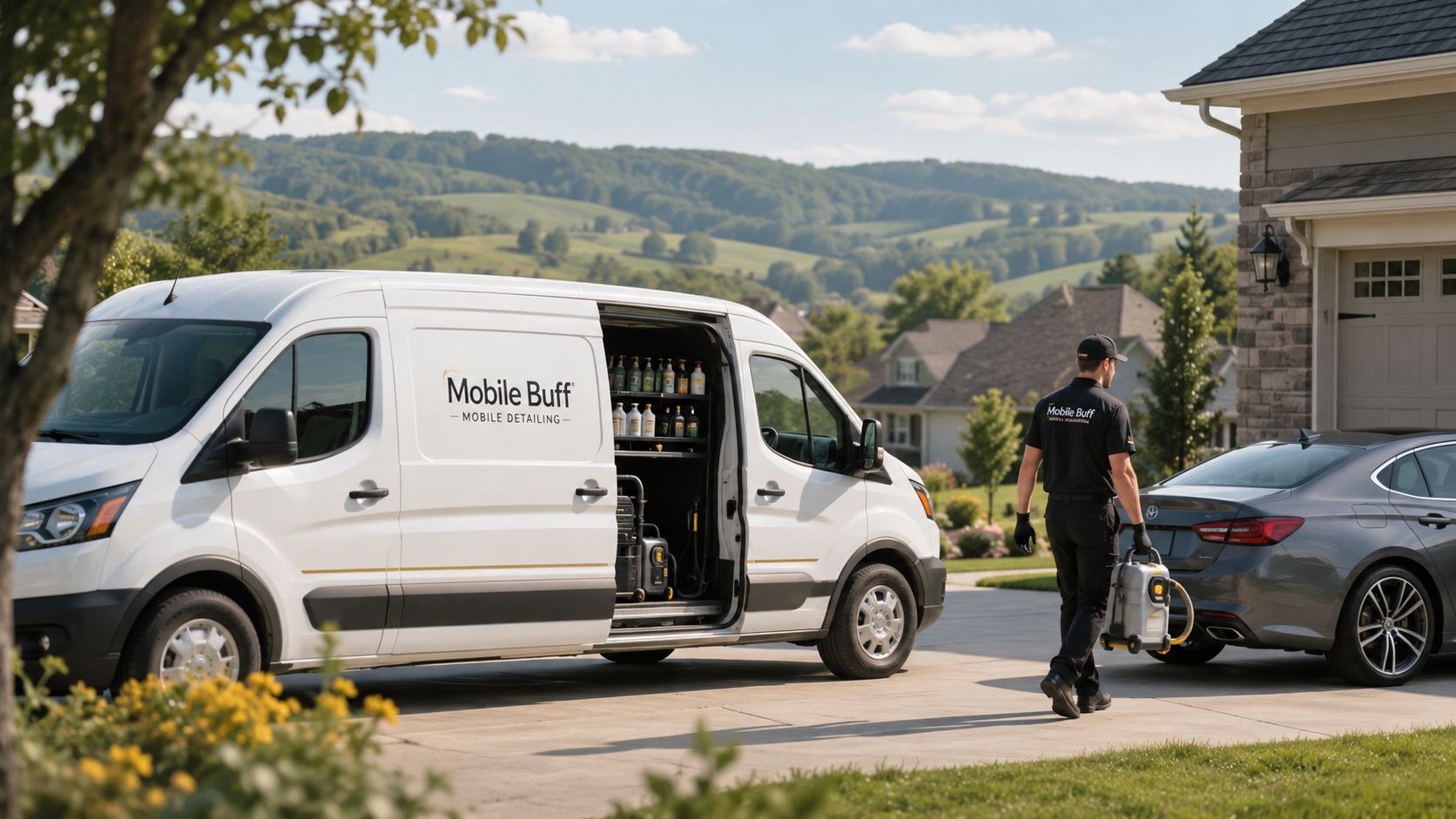
The Mobile Buff offers flexible options like Interior & Exterior, Exterior & Headlight, Interior & Headlight, and Full Service & Headlight, with appointments available seven days a week from 7am to 3pm and electronic billing on completion. If the stain is in the seats, the carpet, or the cargo area, this is the kind of mobile setup that keeps the work simple for you.
If your vehicle still carries pet odor after spot cleaning, book a mobile interior detail with The Mobile Buff. You can check availability, review the service options, and schedule a visit that brings professional pet stain removal right to your driveway.

