


You know the feeling. The car looks decent on Saturday morning, then by Tuesday the front bumper is wearing bug guts, the lower doors have road film, and the hood picks up another chip from the commute home. In Central Pennsylvania, that turns into a real decision fast, because the car isn't sitting in a showroom, it's living in a driveway, under trees, in a school pickup lane, or on the kind of roads that keep gravel moving.
That's where paint protection coating stops being marketing fluff and starts being a practical choice. For one household, it's about keeping a new SUV looking clean through winter salt and grocery runs. For another, it's about protecting a weekend car before the Carlisle season. The right answer depends on how you drive, where you park, and how long you plan to keep the vehicle. If you want a local example of how driveway access changes the whole ownership equation, the setup is very similar to what homeowners think about when planning an Atlanta Concrete Solutions driveway, since the surface a vehicle lives on changes how often it gets washed and how much grime it picks up.
For owners who prefer service at home, a mobile approach can make the process easier without changing the standard of prep, and this auto detailing home service guide shows why driveway-based care has become so practical.
Why Your Driveway Deserves a Better Answer
A lot of people hear paint protection coating at a car wash and assume it is just another add-on with a glossy brochure. It is more practical than that. A busy parent in Harrisburg who is juggling child seats, a dog, and a packed schedule needs a different answer than the enthusiast in Carlisle who wants to keep a clean hood ready for show season.
The question is use, not hype
If the vehicle lives outside, sees salt, and collects miles, the protection has to hold up to more than a nice look after the first wash. If it is garage-kept and washed with care, the goal shifts toward preserving gloss and cutting down on maintenance time. That is why the category keeps growing, with analysts estimating the global market at USD 524.5 million in 2022 and projecting it to reach USD 907.8 million by 2033 or USD 1.1 billion by 2035, depending on the forecast horizon, while the U.S. market was estimated at USD 105.04 million in 2023 and projected to reach USD 158.21 million by 2030 at a 6.2% CAGR (market data).
That kind of growth fits what people are buying. One analysis reported automotive demand at 67.85%, another at 77.8%, and TPU at 72.15% to 75.1% of material share, which points to a market that is still centered on automotive use, still practical, and still built around a durable protective layer.
Practical rule: if the vehicle sees daily road debris, judge protection by what happens on the front end, not by how it looks in the first week.
The stakes are straightforward. Protection can cut down on wash time, reduce the chance that a chip turns into a rust spot, and help preserve resale value when the car changes hands. The people who benefit most usually are not chasing perfection, they are trying to avoid damage that was easy to prevent.
A driveway matters here too. The surface a car lives on affects how often it picks up grime, how quickly winter mess builds up, and how much extra washing the owner ends up doing, which is why the same thinking shows up in projects like an Atlanta Concrete Solutions driveway. For owners who want the work handled at home, a mobile setup can make the process easier without changing the quality of prep, and this auto detailing home service guide explains why driveway-based care has become so practical.
What a Paint Protection Coating Actually Does
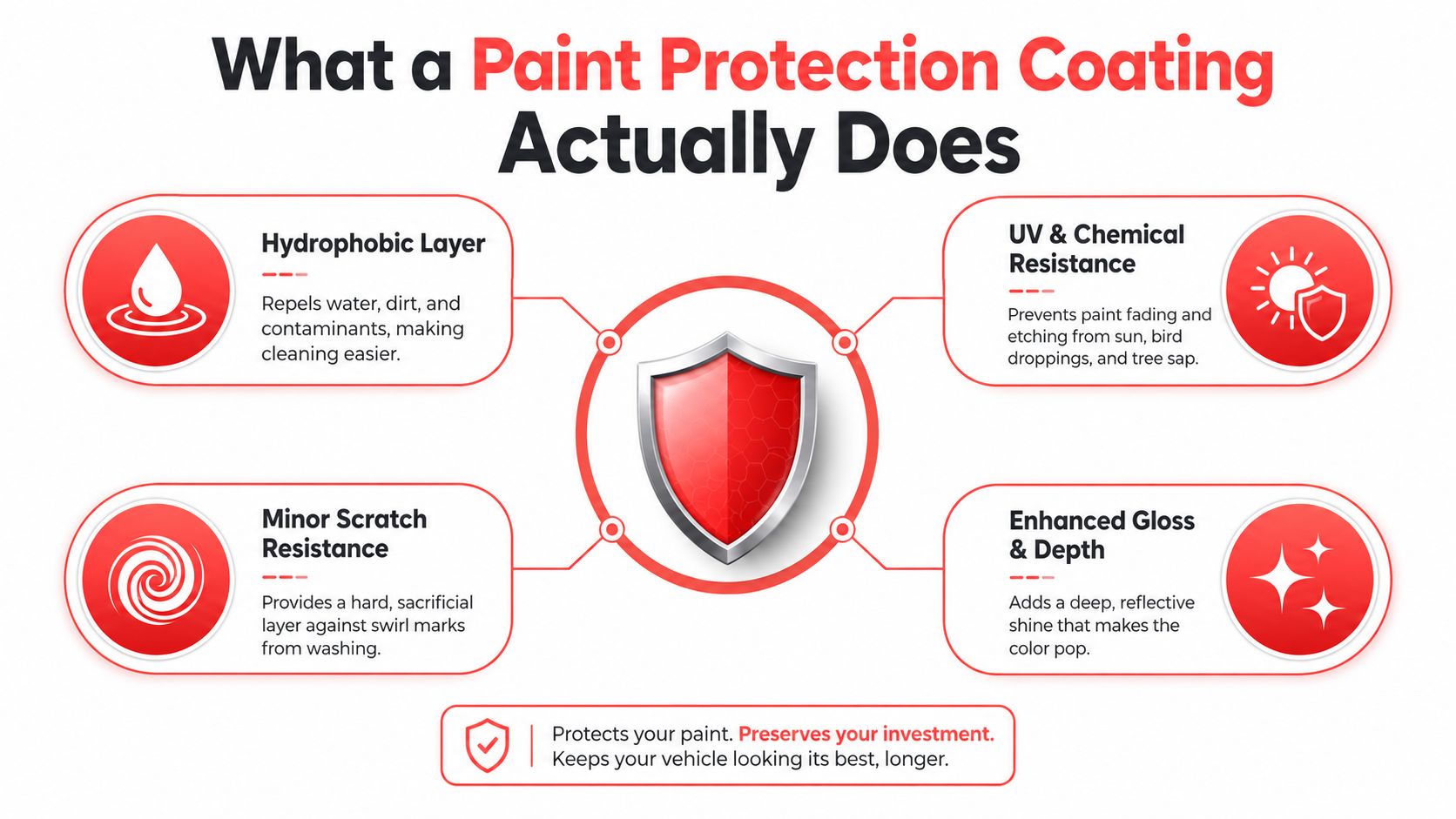
At the simplest level, paint protection coating is a clear sacrificial layer that takes abuse before the factory paint does. It acts as sunscreen for the finish when UV exposure is the problem, and as a phone screen protector when the worry is everyday contact and minor impact. It's not there to replace paint, it's there to absorb the wear that would otherwise hit the clear coat.
Two mechanisms, one umbrella term
Ceramic coatings work by chemically bonding to the paint surface and changing how it behaves. They're valued for slickness, water behavior, and resistance to environmental contamination. Paint protection film, by contrast, is a physical urethane layer, and the material itself is described as a thermoplastic urethane film used to guard against stone chips, bug splatter, and minor abrasions (PPF overview).
That's why both products sit under the same umbrella. They both protect paint, but they do it in different ways. Ceramic is about the surface reaction. PPF is about the barrier itself.
Practical rule: if a product can't absorb impact, it's not a substitute for a film layer on chip-prone panels.
The payoff usually lands in three places. First, the finish keeps more of its original look. Second, washing gets easier because contaminants don't cling as aggressively. Third, the paint has a better chance of staying healthy for years instead of weeks. Patent literature even ties high-quality clarity to low haze, with preferred haze values below 6%, and sometimes below 5%, 4%, 3.5%, or 3%, which matters because you want protection without dulling the color (patent reference).
A useful mental model is this. PPF is armor for the worst-hit areas. Ceramic is a maintenance layer for the rest of the vehicle. When people understand that, the confusion usually clears up quickly.
The Main Types of Paint Protection Coating
The industry uses the same phrase for a few different products, so it helps to separate them by what they're made to do. A quick comparison makes the trade-offs easier to see.
| Coating Type | Material | Typical Thickness | Best At |
|---|---|---|---|
| Spray-on ceramic | Liquid polymer or SiO2-based coating | Very thin | Gloss, water behavior, easier washing |
| Professional ceramic coating | Crosslinking protective coating | Very thin | Stronger chemical resistance and longer-lasting surface behavior |
| Paint protection film | Thermoplastic urethane film | Much thicker than liquid coatings | Stone chip defense and physical abrasion resistance |
| Hybrid package | Film plus ceramic | Layered system | Impact protection where it matters, easier maintenance everywhere else |
Why the products exist
Spray-on ceramic coatings appeal to owners who want easier maintenance and a cleaner finish without a heavy install. Professional coatings push farther on preparation and bonding, so they're usually the better choice when the owner wants durability and consistent behavior from the surface. If you want a deeper primer on that side of the category, the ceramic coating guide is the right place to start.
PPF exists for a different reason. It's there because some damage is physical, not chemical. A front bumper, hood, mirror cap, or rocker panel takes the first hit from road debris, and a film layer is built to take that punishment first.
Hybrid packages make sense when the vehicle has mixed needs. A commuter that sees highway miles can benefit from film on the front end and ceramic everywhere else. A garage-kept sports coupe may not need full-body film, but it can still benefit from ceramic on the rest of the paint and on trim.
Practical rule: don't pick the product first, pick the damage you're trying to prevent.
Owners also care about feel. Ceramic leaves the paint feeling slick and easy to rinse. PPF feels more substantial, because it is. That thickness is the point, and it's why the categories aren't interchangeable.
Paint Protection Film vs Ceramic Coating
The easiest way to sort this out is to treat PPF and ceramic coating as different answers to different problems. PPF is the answer when you're worried about impact, especially on front-facing panels. Ceramic coating is the answer when you want better surface behavior, improved gloss, and more resistance to environmental contamination.
What each one actually protects against
PPF is a physical barrier. That means it helps with stone chips, light scuffs, and road debris that would otherwise strike the paint directly. It's also described as self-healing under heat for light marks, which is why it's so common on high-wear zones.
Ceramic coating bonds to the clear coat and changes how the surface reacts to water, dirt, and chemicals. It does not turn the vehicle into a force field. It won't stop a rock from chipping paint on the interstate, and it shouldn't be sold that way. For a detailed look at installation realities, the PPF installation guide explains why prep and edge handling matter so much.
The practical split is easy to remember:
- Highway commuter: prioritize PPF on the front end.
- Garage-kept weekend car: ceramic may be enough on most panels.
- Mixed use vehicle: use both, because they solve different problems.
- Lease or short-term ownership: choose the option that matches how much you'll recoup in convenience and appearance.
The trade-off is cost versus risk. A gravel-heavy commute makes impact protection more valuable. A lightly used car with careful washing habits may get more day-to-day benefit from ceramic. There isn't a universal winner, because the winner depends on where the car lives and how it's driven.
Ceramic protects the finish from the environment. PPF protects the paint from the road.
That's the line most spouses remember, and it's accurate enough to make a real buying decision from.
How a Professional Application Actually Works
A proper coating job starts long before the product touches the paint. First comes a hand wash, then chemical decontamination, then clay, and then machine polishing if the paint needs correction. That sequence matters because a coating seals in what's underneath it, and bad prep gives you a sealed-in problem.
The prep stage is the job
A clean panel isn't enough. Old wax, bonded contamination, and fine wash marks all affect how well a coating bonds and how good the finish looks afterward. A reputable installer also wipes the surface down to remove polishing oils before application, because coating chemistry needs bare, prepared paint to perform the way it should.
That's where temperature and environment come in. 3M lists an application window of 60°F to 85°F (16°C to 30°C) for its Scotchgard™ PPF Pro Series 200 Gloss, along with film-with-adhesive thickness of 7.8 mil, initial adhesion of 3.8 lbs/in. at 20 minutes and 4.5 lbs/in. after 24 hours, plus 380% elongation at break and 1,900 PSI tensile strength (3M technical data). Those numbers matter because application quality isn't just about skill, it's about the material behaving correctly while it's being laid down.
If you've ever wondered why a rushed install looks fine on day one but starts showing issues later, edge handling is often the reason. Sharp corners and tight recesses are where film is hardest to seat cleanly, and that's why seasoned installers spend so much time on those areas. If you want to compare how one shop approaches the practical side of body work, you can browse T1A Auto's body repair tips and see how much attention proper panel condition demands before any protective layer goes on.
Cure time and owner habits
Once the coating is applied, the vehicle doesn't go back to normal immediately. Owners should expect a cure window and avoid water exposure right away. That's also the point where bad habits cost the most, because cheap installations often skip proper prep, work in poor conditions, or rush the cure.
Practical rule: if the installer can't explain prep, panel wipe, and cure behavior in plain language, keep shopping.
The difference between a decent product and a lasting result usually comes down to process. Professional-grade protection is less about the label and more about the person doing the work.
Real-World Longevity, Maintenance, and Cost Expectations
The lifespan question is where a lot of owners get honest about their budget. Professionally applied PPF is commonly treated as a 5 to 10 year solution, while ceramic coatings are generally discussed as multi-year protection when properly installed and maintained, which is why both are sold as long-term services rather than quick cosmetic fixes (PPF lifespan data).
Think in cost per year, not sticker shock
A front-end film package that lasts years can make sense on a car that sees constant highway travel. A ceramic package can be smarter on a vehicle that's washed regularly, parked sensibly, and not constantly absorbing road debris. The right question isn't, “What's cheapest today?” It's, “What keeps this car looking right for the way I drive it?”
Maintenance also changes the math. Gentle wash habits matter more than almost anything else after installation. That means pH-neutral soap, microfiber drying, and no aggressive brush wash machines if you want to protect the finish. Coated surfaces still need regular care, they just need less of it.
The wrong habits shorten life fast. Parking under sap-heavy trees, hitting coated panels with harsh degreasers, or letting contamination sit too long all make the job harder. For cold-weather owners, a vehicle winter preparation guide is a good reminder that salt and road film are not seasonal nuisances, they're finish killers if you let them pile up.
What the material tells you
Premium film isn't just thicker, it's engineered for clarity and durability. One ProMedia PPF data sheet lists 167 μm total thickness, 94.2 gloss at 60°, 0.42 haze, 91.0% visible transmittance, 97.6% UV rejection, and QUV aging performance of ΔE*ab < 2 after 1000 hours with measured results of 0.17 (ProMedia data). It also reports 1584 gf/inch peel force at 20 minutes and 1838 gf/inch after 24 hours, plus 291.5% elongation at break, which explains why good film can stay clear and hold onto edges after proper cure.
The takeaway is practical. If you want the least upkeep, ceramic plus smart washing is often enough. If you want the most physical defense, PPF pays for itself where damage is most likely.
Which Coating Fits Your Life in Central Pennsylvania
A commuter on I-81 has a different problem than a weekend driver heading to shows. The commuter needs the nose of the car protected from road debris and the finish easy to clean after long, dirty drives. That usually points toward film on the high-impact areas, with ceramic as a helpful layer elsewhere.
Four owner profiles, four sensible choices
The busy parent usually wants a vehicle that cleans up fast after snack crumbs, dog hair, and weather abuse. Ceramic helps with maintenance, and PPF on the front panels makes sense if the family car spends time on fast roads or near construction.
The small-business owner with a few vans or service vehicles often cares about consistent appearance and manageable upkeep. A practical package can be a mix of ceramic and partial film, especially when the fleet is parked outside and needs to look presentable without constant correction.
The enthusiast preparing for a show or resale usually gets the most value from combining prep, paint correction, and selective film. That preserves the panels people notice first, while ceramic keeps the rest of the vehicle easier to maintain between events.
The driver who hates washing probably wants the surface behavior more than anything else. That's where ceramic feels like a daily quality-of-life upgrade, even if it isn't the answer for impact damage.
The right coating follows the driver, not the brochure.
For local owners who want driveway-based service, The Mobile Buff offers paint protection as part of its monthly service, along with exterior hand washing, full interior work, shampoo extraction, stain treatment, pet hair removal, and paint correction as an add-on when surface prep is needed. That kind of setup matters because the car never has to leave home, which is a real advantage for busy households and fleets.
If you split the decision by use case, the answer gets clearer. Highway miles favor film. Easy maintenance favors ceramic. Mixed use usually favors both.
Your Decision Checklist, FAQs, and Next Step
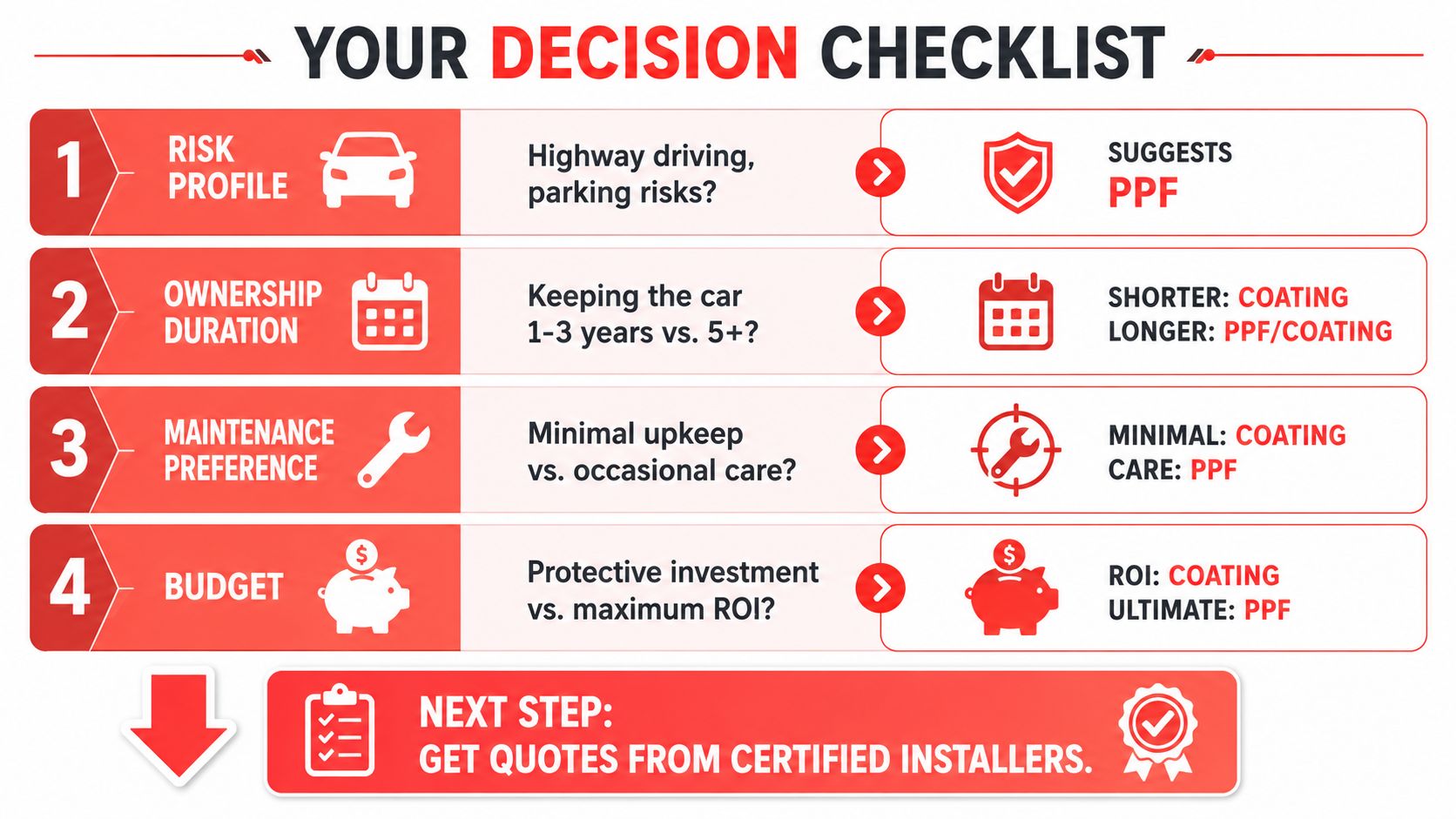
Use this quick filter before you book anything:
- Risk profile: if the car sees highway driving, tight parking, or debris, lean toward PPF.
- Ownership length: if you're keeping it longer, protective layers matter more and the stronger barrier becomes easier to justify.
- Maintenance tolerance: if you want minimal upkeep, ceramic is the easier daily fit.
- Budget goal: if you want the highest physical defense, PPF is the stronger investment.
Common questions buyers ask
Does ceramic coating prevent all scratches? No. It helps with surface behavior and light wash marks, but it doesn't stop rock chips.
Does a new car need protection right away? Usually, yes, if you want to preserve the paint before damage starts. Fresh paint is the easiest paint to protect.
Is it worth it on a lease? Sometimes. If you care about appearance during the lease term and want fewer visible wear marks, it can still make sense.
How long does a mobile appointment take? It depends on the scope, prep, and whether correction is involved, so the right answer comes from a walk-around, not a guess.
If you're ready to compare options on your actual vehicle, book a walk-around consultation with The Mobile Buff and talk through what makes sense for your commute, parking, and ownership plans. You can also check the Google Business Profile to see service areas and recent reviews before you decide.
The Mobile Buff brings professional detailing, surface prep, and paint protection straight to your driveway in Central Pennsylvania, so you don't have to lose a day at a shop to get the car protected right. If you want help choosing between film, ceramic, or a hybrid package, visit The Mobile Buff and set up a consultation for your vehicle.

