


You get in the car for a normal drive, then notice everything at once. Dust across the dash. Crumbs tucked along the seat rails. A coffee mark in the cupholder. Maybe the windows have that smeared look that only shows up in morning sun.
That's usually when a car interior cleaning kit starts to sound like a smart fix. One box, a few bottles, some towels, maybe a brush or two, and your weekend problem feels manageable. For light upkeep, that can be true.
But a kit only works well when the products match the surfaces, the tools match the dirt, and the person using them knows what to leave alone. That matters more now than it used to. Interiors have become more delicate, more varied, and much easier to mark up with the wrong towel, cleaner, or brush.
Why That Messy Car Interior Is Stressing You Out
A dirty cabin wears on people faster than they expect. It's not just about looks. You sit in that space every day, touch the same controls, set your coffee down in the same sticky console, and keep telling yourself you'll deal with it later. Then later becomes a month.
For a lot of drivers, the mess builds in layers. Parents get crushed crackers and mystery spots on the back seat. Pet owners get hair woven into carpet and fabric seams. Commuters get dust on the dash, oils on the steering wheel, and fingerprints on every screen and glossy trim piece. None of that feels dramatic on its own, but together it makes the whole car feel neglected.
That's why bundled kits sell so well. They promise a clean reset without needing to sort through separate products and tools. It also helps that auto detailing is a large category, not a niche hobby. The U.S. car wash and auto detailing industry was estimated at $18.7 billion in 2026, with 1.5% CAGR between 2021 and 2026, according to IBISWorld's car wash and auto detailing industry report. That says a lot about how much drivers value appearance, upkeep, and resale condition.
Why a kit feels like the easy answer
A kit gives you a sense of control. You can pull it out on Saturday morning, vacuum the seats, wipe the dash, clean the glass, and feel like you've handled it yourself.
That's useful. It's also where a lot of people hit the wall.
A maintenance clean is not the same thing as a correction clean.
If the issue is light dust, small spills, and routine grime, a decent kit can help. If the issue is embedded stains, pet hair, smoke, food residue in seams, or odor trapped in fabric and vents, a kit usually reaches its limit quickly. If smell is part of the problem, this deep cleaning car odors guide is a solid companion read because odor work is a different job from surface wiping.
What matters more than the box
More bottles aren't the answer; better judgment about surfaces and methods is.
This is how professionals view car interior cleaning kits. Some are perfectly fine for maintenance. Some are overpriced bundles with filler products. Some are risky because they encourage one cleaner and one towel for everything. The difference shows up in the result, and sometimes in the damage left behind.
Unpacking a Car Interior Cleaning Kit
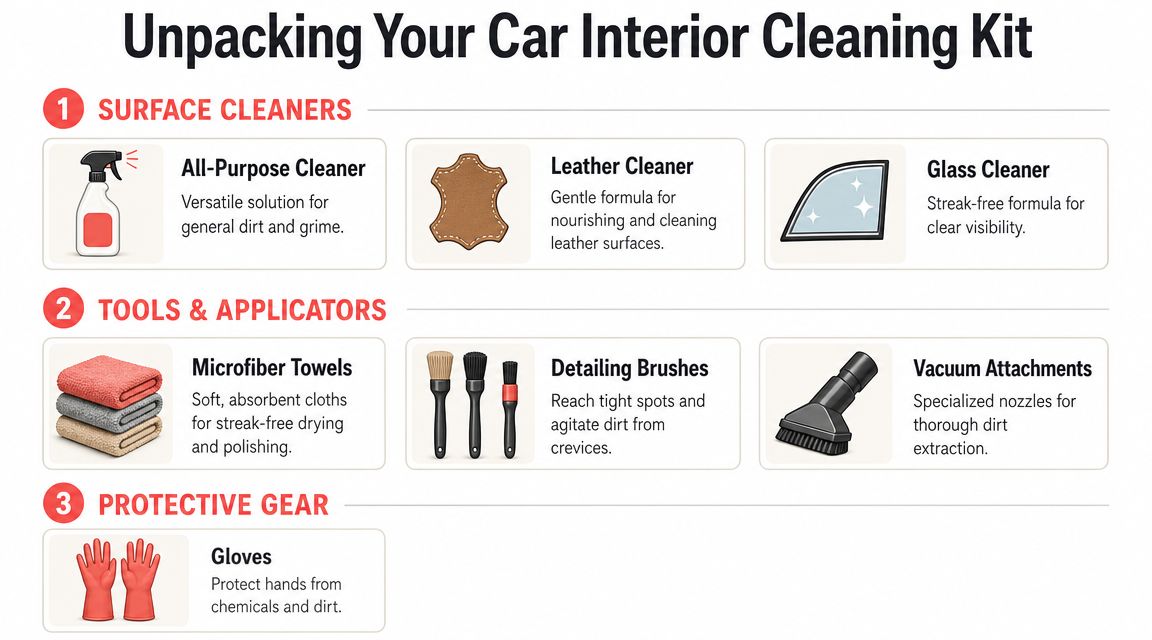
A good kit isn't a random pile of supplies. It's a system. The chemicals should match the surfaces, and the tools should remove soil without grinding it deeper or scratching the finish.
The chemical side
Professional detailing guidance puts a lot of emphasis on lighter cleaner dilutions for maintenance and stronger mixes only when contamination warrants it. It also stresses that a proper setup should include a mild interior cleaner for dashboards and leather, plus dedicated glass and fabric tools, because strong cleaners can dull or damage finishes, as shown in this professional interior detailing guidance.
That's why the chemistry in a useful kit usually breaks down like this:
- Mild interior cleaner for plastics, vinyl, sealed trim, touchpoints, and general wipe-downs.
- Dedicated glass cleaner for windows and mirrors, where streak control matters more than raw cleaning strength.
- Fabric or upholstery product for cloth seats, carpet, and spots that need lift instead of just surface wiping.
A single all-purpose spray can be convenient, but it's usually a compromise. It may be acceptable on some plastics and still wrong for screens, glass, or delicate trim.
The tool side
Tools matter just as much as chemicals. A weak towel can smear. A stiff brush can mar soft trim. The wrong brush can force debris deeper into fabric instead of lifting it out.
Here's the difference at a glance:
| Component | Typical DIY Kit | The Mobile Buff Professional Setup |
|---|---|---|
| Interior cleaner | One general spray | Surface-appropriate cleaner selected by material and soil level |
| Glass care | One towel for everything | Dedicated glass towel and separate glass-safe cleaner |
| Fabric cleaning | Spot spray only | Fabric-safe cleaner, agitation tools, and extraction-oriented workflow when needed |
| Brushes | One or two generic brushes | Multiple brush types, including softer options for delicate surfaces |
| Towels | Basic microfiber assortment | Separate towels by task to avoid cross-contamination |
| Vacuum support | Standard household vacuum use | Attachments chosen for seams, vents, carpets, and tight interior gaps |
Practical rule: If a kit doesn't separate glass, interior surfaces, and fabric work, it's built for convenience first and finish quality second.
A car interior cleaning kit works best when every item has a job. If the box gives you five products that all claim to do the same thing, that's not depth. That's clutter.
Choosing the Right Kit for Your Vehicle
Choosing a kit starts with your interior, not the packaging. Cloth seats, coated leather, piano-black trim, rubber mats, soft-touch dash panels, and large screens don't all tolerate the same product or towel.
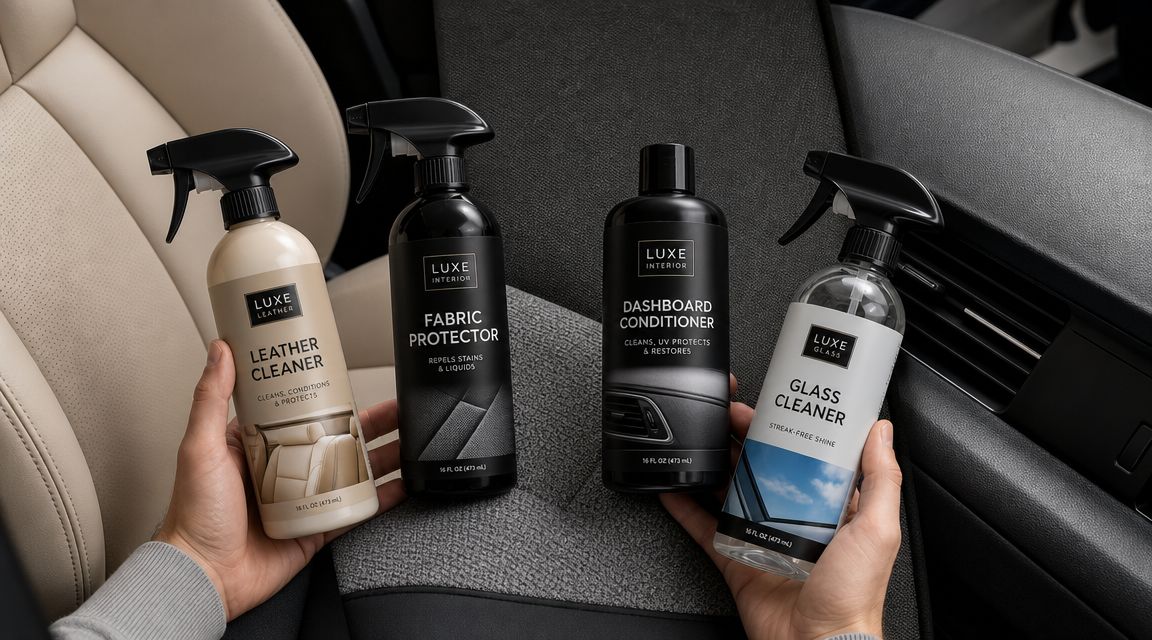
A lot of drivers buy the kit with the most items and assume more pieces means more capability. That's not how it plays out in real use. Some kits pack in extras that look good on a shelf but don't improve the result. Others save money by giving you one mediocre towel, one generic brush, and a cleaner that's merely passable on everything.
Match the kit to the job
A maintenance car doesn't need the same setup as a family hauler or a pet car.
- For light upkeep: Look for a mild interior cleaner, quality microfiber towels, a glass-specific product, and a soft brush for vents and seams.
- For cloth seats and carpets: Prioritize fabric-safe cleaning tools and vacuum compatibility. If you're comparing suction options, this guide on the best vacuum for car detailing helps sort out what makes interior work easier.
- For leather or delicate trim: Avoid “one spray for everything” claims. You want gentler chemistry and better towels, not more aggressiveness.
- For pet hair, sticky spills, or heavy buildup: A kit may help you improve the appearance, but it often won't fully remove what's embedded.
Don't judge by price per ounce alone
One real-world comparison made that point clearly. A 20-ounce Chemical Guys interior cleaner was listed at about $11.97, which made it one of the cheaper per-ounce options in that test, but it still underperformed because the nozzle wouldn't spray properly and it left streaks, as shown in this interior cleaner comparison video. Value isn't just bottle size. It's usability and finish.
That's also why I tell people to be careful with “miracle” cleaners. If a label says it cleans leather, cloth, plastic, gloss trim, screens, and glass equally well, I'd treat that as a warning sign.
Budget kits can still make sense
Not every vehicle needs a premium setup. If you're mostly doing wipe-down maintenance, a simpler kit can be fine. For people trying to choose an all-purpose product more thoughtfully, Fillaree's all-purpose cleaner recommendations are worth reviewing as a general reference point for evaluating cleaner choices.
What matters is being honest about the result you want. If your goal is “clean enough for Monday,” buy for maintenance. If your goal is stain removal, odor elimination, or prep for sale, don't expect a shelf kit to do a shop-level job.
Using Your Kit Safely A Pro's Approach
The safest way to use a car interior cleaning kit is to think like a detailer, not like a shopper. The bottle matters. The method matters more.
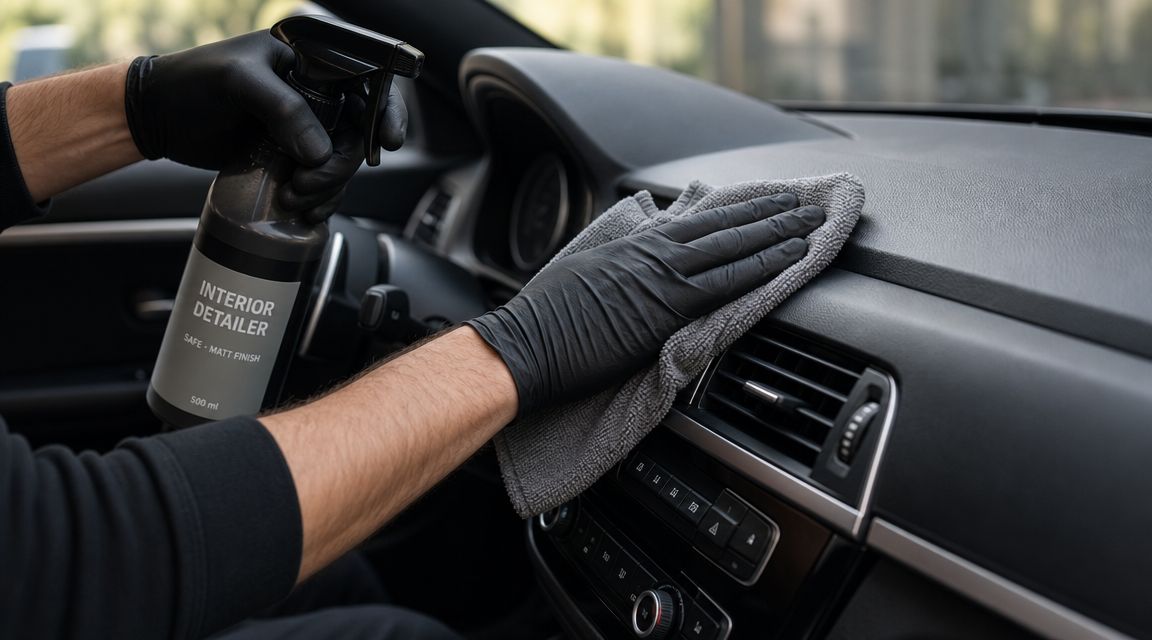
Industry guidance consistently includes microfiber cloths, upholstery shampoo, and dedicated brushes for different surfaces because this isn't just about convenience. It's about controlling abrasion and avoiding situations where a medium-stiff brush used for general interior work gets dragged across Alcantara or soft leather-grain trim, as explained in this AutoZone detailing kit guide.
The habits that prevent damage
A few habits separate a safe clean from a costly mistake:
- Test first: Always try a product in a low-visibility area before using it across a dash, seat, or console.
- Work top down: Dust and loosened debris fall. If you start with carpets and end with vents, you'll redo work.
- Use separate towels: Glass, plastics, leather, and dirtier lower panels shouldn't share the same towel.
- Spray into the towel when appropriate: That gives you better control on sensitive trim and reduces overspray on buttons, seams, and screens.
- Ventilate the cabin: Airflow matters when you're using interior chemicals in a small enclosed space.
The cross-contamination problem
A lot of DIY results go wrong because the tools aren't managed well. One brush gets used on dusty vents, grimy cupholders, rubber mats, and then seat bolsters. One towel wipes the gauge cluster after cleaning a dirty door jamb panel. That's how fine scratches and haze happen.
For more everyday maintenance guidance, these car interior cleaning tips are a useful reference.
Soft materials don't forgive rough technique. They show it later, usually in sunlight.
There's also a difference between wiping and lifting. A microfiber towel should collect loosened soil into the fibers. If the towel is overloaded, dirty, or too flat for the task, you're just moving grime around.
A quick visual helps if you want to see safe interior wipe-down technique in action:
Know when to stop
If a stain needs repeated heavy passes, or a surface starts looking shiny in the wrong way, stop. More pressure and more product usually don't fix that. They just increase the odds of damage. That's the point where a professional service becomes the safer move.
What DIY Kits Can't Do The Professional Difference
A car interior cleaning kit can absolutely help with upkeep. It can remove dust, clean touchpoints, improve glass, and freshen up a vehicle that isn't too far gone. What it can't do is replace equipment, experience, and material-specific judgment when the interior is heavily soiled or sensitive.
Deep cleaning is not the same as surface cleaning
The first limitation is depth. A kit can wipe, agitate, and improve. It usually can't fully extract contamination that has settled into fabric, padding, carpet backing, or tight interior seams. That's why some stains look lighter after DIY cleaning but reappear once the material dries. The surface got attention. The deeper contamination stayed put.
Odors work the same way. Fragrance products can change what you smell for a while, but that isn't the same as removing the source. If the smell is coming from spills, pet accidents, smoke residue, or bacteria in soft materials, masking won't solve it.
Modern interiors are easier to damage
The second limitation is risk. Modern vehicles, especially EVs and luxury models, use large touchscreens, soft-touch polymers, piano-black trim, and coated leather. Generic kit advice often pushes all-purpose cleaners that can scratch screens, haze glossy trim, or strip coatings from sensitive surfaces, as noted in this guide on budget vs premium interior kits.
That's where I see the biggest gap between DIY expectations and real-world results. A person buys a kit thinking they're being careful because they avoided harsh chemicals. Then they use the wrong towel on a gauge screen, the wrong brush on a suede-like insert, or too much product on a glossy console and end up creating a different problem.
Where professional work changes the result
Professionals don't just bring stronger products. They bring separation of tasks, better tool control, and a process built around the actual materials in the car.
The hardest interiors aren't the dirtiest ones. They're the ones that are dirty and delicate at the same time.
That matters on sale prep, on family vehicles with layered messes, and on newer cabins where every black trim piece seems ready to show a mark. A DIY kit is a maintenance tool. It is not a substitute for corrective interior work.
Is It Time to Call a Mobile Detailing Pro?
If the interior just needs a tidy-up, a decent kit can do the job. If you're dealing with stains that keep coming back, hair that won't release, odors that live in the cabin, or delicate materials you don't want to gamble on, it's time to hand it off.
A mobile detailer makes even more sense when time is the primary concern. Many don't mind wiping a dash. What they don't want is losing half a Saturday vacuuming seams, cleaning glass twice, chasing streaks, and still feeling like the car isn't thoroughly clean.
When professional service is the smarter call
- Stain removal and pet hair: These jobs usually need more than a kit includes.
- Persistent odors: Surface sprays won't handle firmly embedded odor sources.
- Pre-sale cleanup: Presentation matters, and missed details cost you.
- Sensitive interiors: Screens, glossy trim, and coated materials need a safer approach.
- Convenience: Mobile service means the work gets done at your home or office.
For drivers in Central Pennsylvania, professional interior work is often the easier answer when the goal is a true reset instead of a quick improvement. One practical option is professional car interior cleaning, especially if you want a better sense of what deeper interior service involves.
Here's the direct local service reference:
| Service | Link |
|---|---|
| Google Business Profile | View The Mobile Buff on Google |
If you're in or around Harrisburg, Mechanicsburg, Carlisle, Newport, and nearby areas, mobile detailing is often the safest path for interiors that need more than shelf products can deliver.
If your car's interior needs more than a quick wipe-down, book with The Mobile Buff. We handle deep interior cleaning, stain and pet hair removal, and odor treatment at your home or office so you don't have to guess which kit, towel, or cleaner is safe for your vehicle.

