


Fleet detailing prices typically range from $60 to $80 per vehicle for recurring maintenance service, but they can climb to $150 to $400+ for deeper cleanups, especially when vehicle size, condition, and add-ons change the scope. If you're pricing an initial reset for a mixed fleet, expect a very different quote than you would for scheduled upkeep on already-maintained units.
That pricing gap is where most fleet managers get stuck. One quote sounds cheap, another sounds high, and neither tells you enough about what you are buying. A van used by a sales rep and a van used on a jobsite might wear the same company logo, but they do not require the same labor.
A clean fleet isn't just about appearance, either. Your vehicles show up at customer homes, offices, loading docks, and job sites. People notice faded trim, dirty door jambs, stained seats, and cloudy headlights. They also notice when your vehicles look cared for.
The practical question isn't just, "What are fleet detailing prices?" It's, "What service level makes financial sense for my operation?" That's where a lot of public pricing guides fall short.
Why Predictable Fleet Detailing Prices Matter
If you manage several vehicles, you already know the primary headache isn't one dirty truck. It's inconsistent condition across the whole fleet. A few units look presentable, a few are overdue, and one or two need serious recovery work before anyone should park them in front of a customer.
That inconsistency makes budgeting hard. It also makes vendor comparison harder, because one detailer may quote a maintenance-level service while another is pricing a near-restoration. Without a clear scope, two quotes can look close on paper and be completely different in labor, time, and result.
Budgeting gets easier when the scope is stable
Predictable fleet detailing prices matter because they help you plan operations instead of reacting to complaints. When you know what "maintenance clean," "interior reset," or "full detail" includes, you can build those costs into routine fleet care the same way you handle inspections and mechanical service.
A good pricing conversation should answer questions like these:
- What counts as standard soil versus heavy contamination?
- Which vehicles are being priced together and which are exceptions?
- How often are services scheduled, and does frequency change the labor needed?
- Which add-ons are separate, such as odor removal or headlight restoration?
If you already track inspections and service intervals, it helps to treat cleanliness the same way. A simple fleet maintenance checklist can make detailing needs more consistent before you even ask for a quote.
Practical rule: The most useful quote isn't the lowest one. It's the one that clearly defines what your fleet will look like after service and what conditions trigger extra charges.
Appearance affects more than appearance
Fleet managers usually feel pressure from two sides at once. Accounting wants cost control. Operations wants vehicles available. Sales and customer-facing teams want clean units that reflect well on the business.
Those priorities can all work together when pricing is predictable. Scheduled detailing reduces guesswork, lowers the chance that badly neglected vehicles need major corrective work, and helps keep brand presentation consistent. That's why understanding pricing structure matters more than chasing the cheapest line item.
The Three Main Fleet Detailing Pricing Models
Most fleet detailing prices fall into one of three models. The model itself doesn't tell you whether a quote is good or bad, but it does tell you how risk is being shared between the fleet and the detailer.
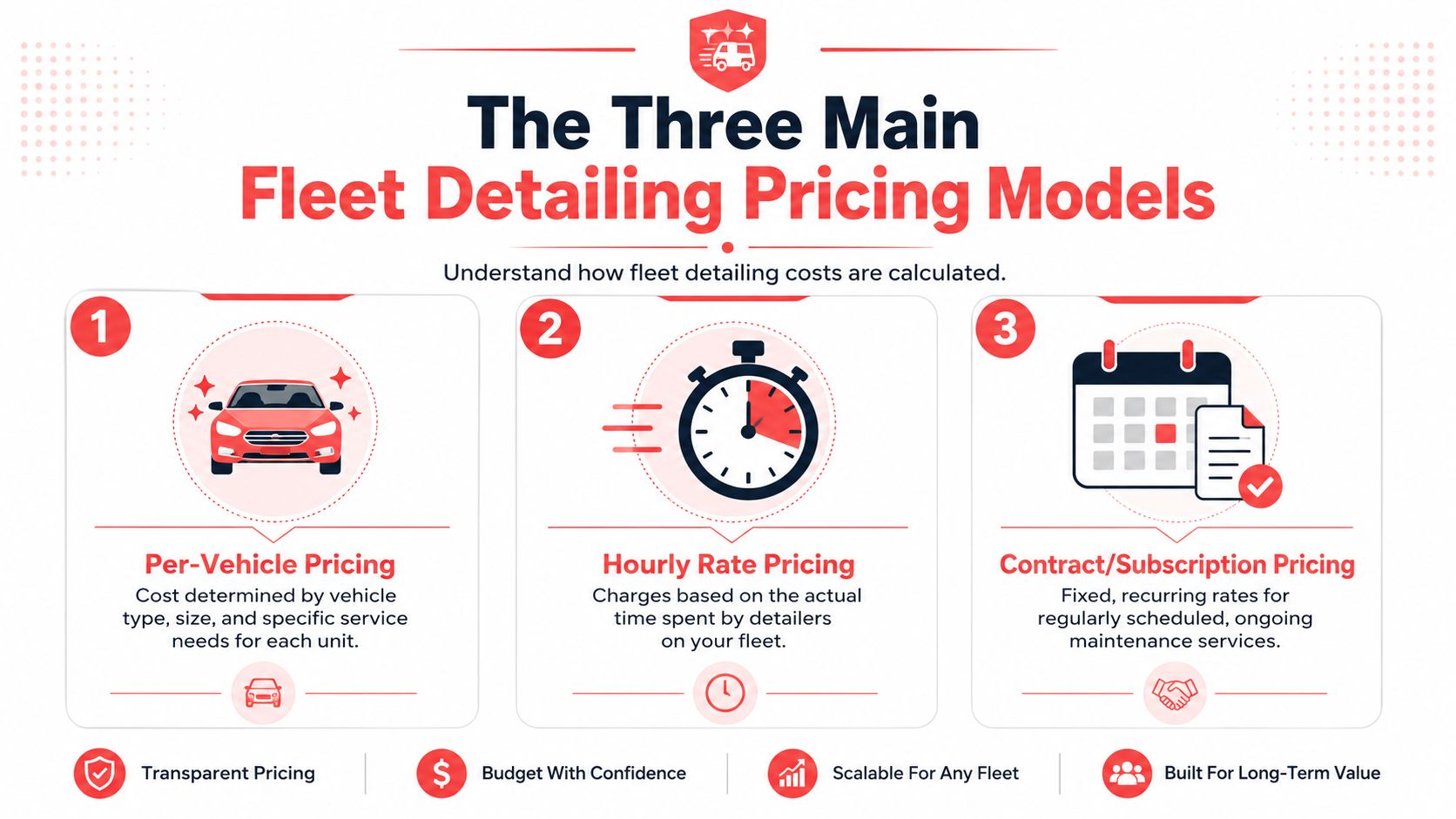
Per vehicle pricing
This is the easiest model to understand. Each vehicle gets a set rate based on type, size, and agreed service level.
For a fleet manager, the benefit is clarity. You can forecast spend quickly if most of your vehicles are similar and stay in similar condition. This works especially well for sales sedans, light-use SUVs, and regularly maintained branded units.
The downside is that per-vehicle pricing only stays clean when the service scope stays clean. If some units arrive with packed pet hair, spilled coffee, heavy mud, or strong odors, the flat price can stop making sense fast.
Best fit: uniform fleets with consistent upkeep.
Hourly pricing
Hourly pricing is common when the condition varies a lot or when the work is less predictable. Think turnover vehicles, field units, or trucks that come back from rough environments with caked-on grime and interiors that need careful recovery.
From the detailer's side, hourly pricing protects labor on jobs where no one can responsibly promise a flat result without seeing the vehicle first. From the fleet side, it can feel less predictable unless the provider documents limits, priorities, and approval steps.
A smart use of hourly pricing is for exception work only. Keep routine units on a predictable maintenance plan, and reserve time-based pricing for outliers.
If a vendor won't separate routine maintenance from exception handling, the quote often becomes harder to manage than the cleaning itself.
Contract or subscription pricing
This is usually the most operationally efficient option for fleets that want consistency. A contract or subscription model sets recurring service intervals and fixed expectations for what happens at each visit.
This model often works best because it reduces swings in condition. Vehicles don't have time to get as far gone, so the labor stays closer to plan. It also helps managers line up cleaning with dispatch and downtime windows. If you're also trying to understand mobile fleet repair costs, the same principle applies. Predictable field service is easier to budget when scheduling is built around recurring needs instead of emergencies.
Here's the trade-off in plain terms:
| Pricing Model | What You Gain | What You Need to Watch |
|---|---|---|
| Per vehicle | Simple budgeting | Scope creep on dirty units |
| Hourly | Fair billing for tough jobs | Less certainty before work starts |
| Contract or subscription | Stable appearance and scheduling | Requires a clear service agreement |
The best model depends on whether your fleet is mostly standardized, mostly unpredictable, or somewhere in between.
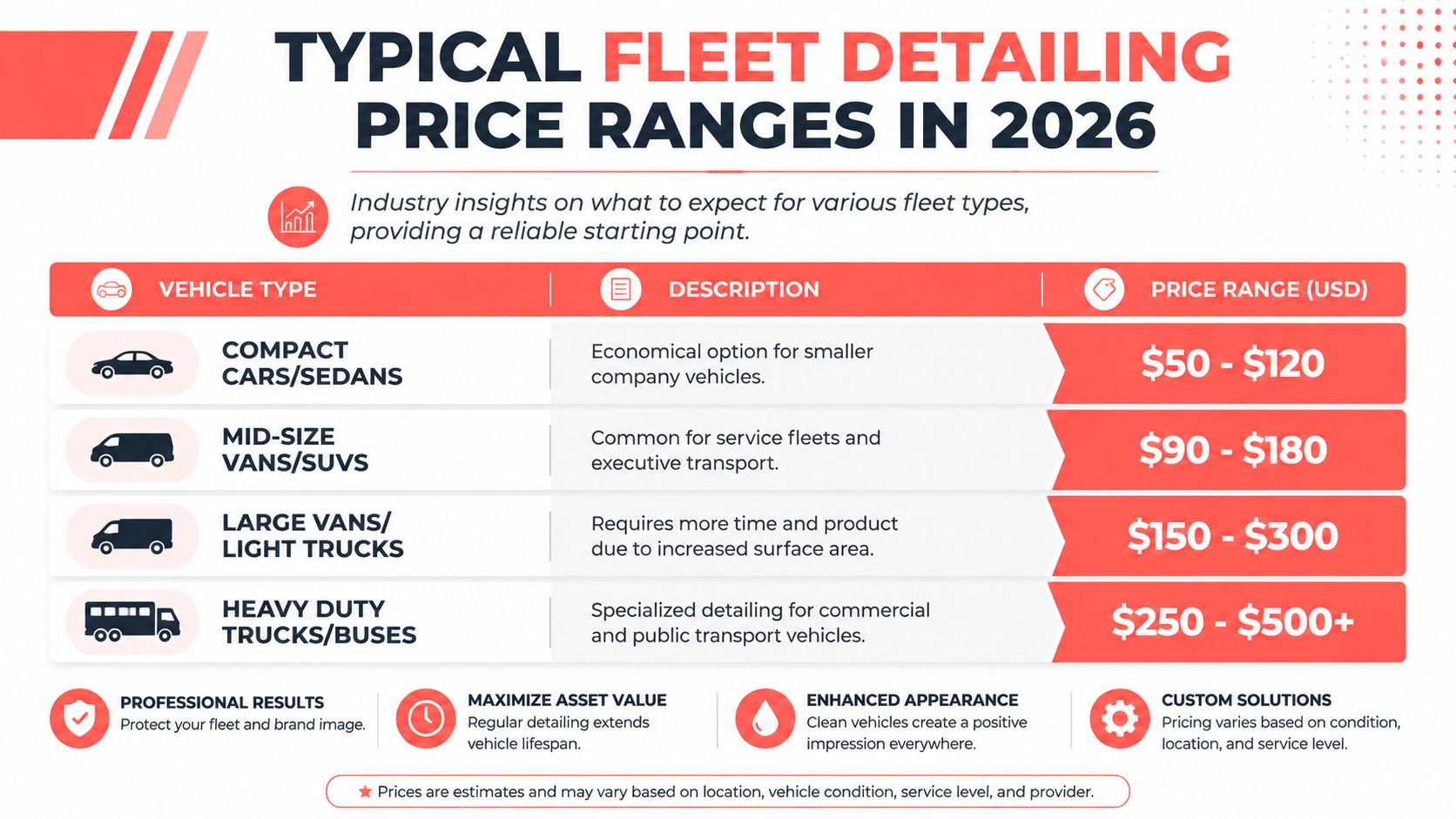
Typical Fleet Detailing Price Ranges in 2026
Here are the price anchors that matter most when you're evaluating fleet detailing prices.
According to a 2026 car detailing pricing guide, full-service fleet detailing is typically sold as a bundled, high-ticket service rather than a simple wash. That guide lists a full detail for a sedan or coupe at $175 to $275, SUVs and crossovers at $225 to $350, and trucks or vans at $250 to $400. With engine-bay cleaning added, those packages move to roughly $225 to $325 for sedans, $275 to $400 for SUVs and crossovers, and $300 to $450 for trucks and vans. The same source notes that fleet accounts such as rental or corporate vehicle pools often pay about $60 to $80 per vehicle for recurring service.
That range tells you something important. Recurring fleet service and full-service detailing are not the same product. One is maintenance. The other is corrective, labor-heavy work.
A visual price snapshot helps:
What the recurring range usually means
When you see $60 to $80 per vehicle for recurring service, think of it as a maintenance relationship. The vehicles are usually being serviced on a repeat schedule, and the condition is expected to stay within normal limits.
That kind of pricing usually makes the most sense when:
- Vehicles are serviced regularly instead of only when they become embarrassing
- The fleet has uniform use patterns and similar buildup
- You want predictable visual standards across multiple units
It does not automatically mean every possible issue is included.
What the full detail range really reflects
The higher bundled detail ranges exist because the labor changes fast when you're dealing with interiors, edges, buildup, contamination, and larger body sizes. A work van doesn't just have more paint. It has more glass, more trim, more vertical surface area, and usually more interior abuse.
This is also why the jump from sedan to SUV to truck or van is real. More vehicle means more time, more chemicals, more towel turnover, more vacuuming, and more finish work.
Later in the buying process, it's helpful to compare visual expectations with actual process. This walkthrough gives a useful sense of what a professional service visit can involve:
A simple way to think about the ranges
Use these ranges as planning anchors, not promises:
| Service Situation | Practical Budget Starting Point |
|---|---|
| Recurring maintenance on managed fleet vehicles | $60 to $80 per vehicle |
| Initial full detail for sedans | $175 to $275 |
| Initial full detail for SUVs or crossovers | $225 to $350 |
| Initial full detail for trucks or vans | $250 to $400 |
| Full detail with engine-bay cleaning on larger units | Up to $450 depending on vehicle type |
If you're pricing an initial reset, budget differently than you would for ongoing maintenance. That's the biggest mistake I see managers make.
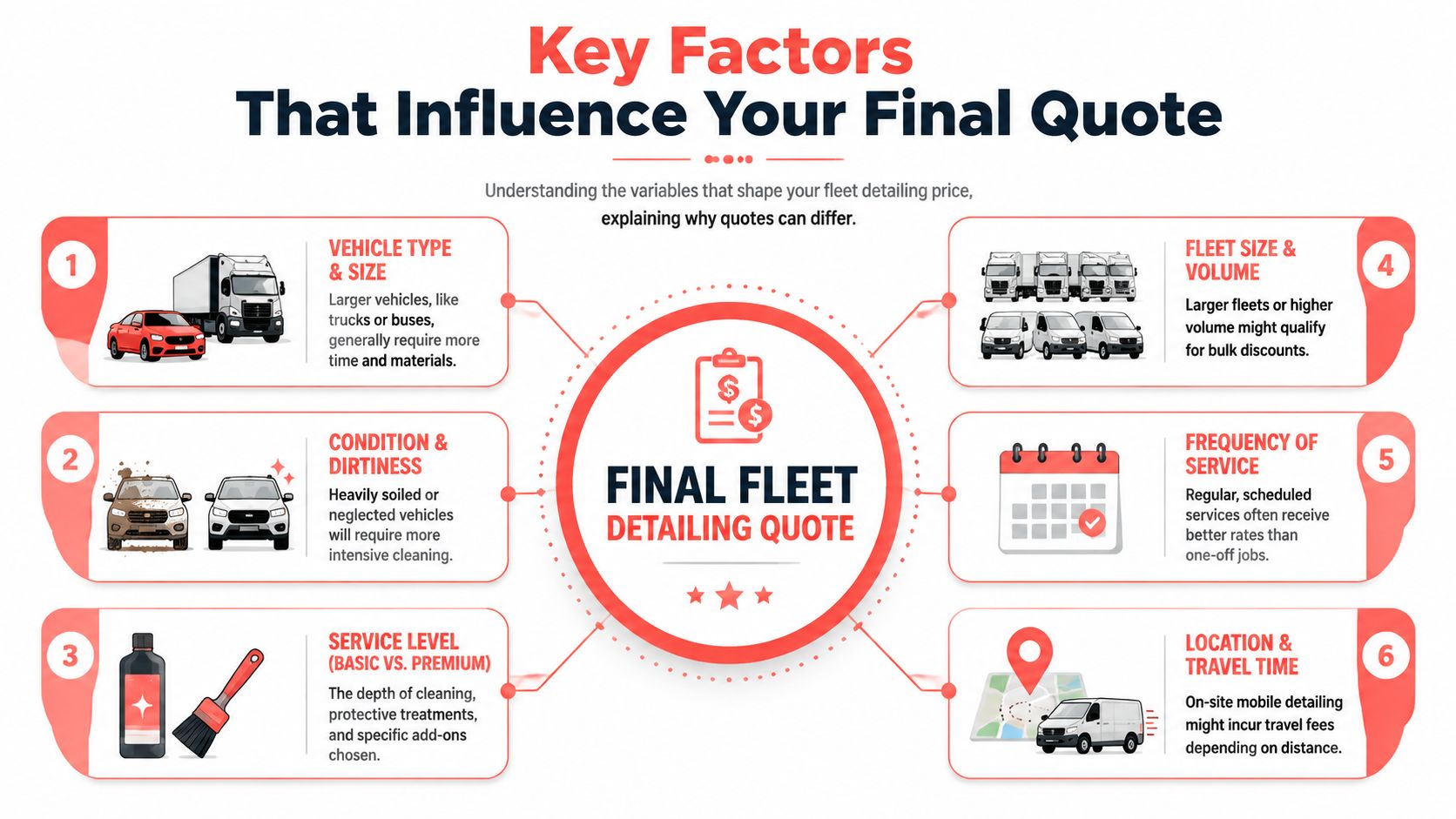
Key Factors That Influence Your Final Quote
Two fleets can have the same vehicle count and still receive very different quotes. The difference usually isn't the number of vehicles. It's the condition, service level, and operational friction around those vehicles.
A widely cited pricing guide on car detailing charges and recurring fleet service notes that corporate fleet accounts often pay about $60 to $80 per vehicle for recurring service, but those public ranges don't always spell out what's included. The same guide also notes that add-ons and heavy soil remediation can push a detail from $150 to $500+ depending on condition. That gap is exactly why final quotes vary.
Vehicle type and working conditions
A compact sedan used for client visits is one thing. A van used by a plumbing, electrical, or construction team is another. Work vehicles collect different contaminants, and some of them are much slower to remove than light road film or office dust.
A quote usually rises when vehicles have:
- Large cabins or cargo areas that need more vacuuming and wipe-down time
- Textured plastics and utility flooring that hold grime
- Crews eating, storing tools, or tracking in debris every day
- Exterior buildup from job sites, road salt, or industrial fallout
Scope is the real cost driver
The biggest pricing mistake is assuming "detail" means the same thing from one provider to the next. It doesn't. Some quotes cover a maintenance clean. Others include deeper interior work, stain treatment, jamb cleaning, trim dressing, or specialty correction.
Ask these scope questions before approving a quote:
- What's included in the base service? Exterior wash, vacuum, wipe-down, glass, door jambs, tires?
- What counts as extra? Pet hair, odor removal, biohazard-style contamination, engine bay, headlight restoration?
- What condition triggers a surcharge? Sand, caked mud, excessive staining, sticky residue, embedded debris?
- How is rework handled? If a vehicle needs more than the scheduled maintenance level, what happens next?
Field advice: A low recurring rate can still be expensive if half your fleet keeps getting moved into exception pricing.
Scheduling and location matter too
Mobile service is convenient, but route efficiency still affects labor planning. If vehicles are spread across multiple yards, dispatched unpredictably, or unavailable when the crew arrives, the job becomes harder to deliver efficiently. That's one reason fleet managers also benefit from stronger logistics planning. If your team is refining stop sequencing and technician movement, OnRoute's guide to dispatching is worth a look.
When scheduling is tight and vehicles are grouped by service need, detailers can work faster and quotes tend to reflect that efficiency more accurately.
How to Calculate Your Fleet Detailing Costs
The easiest way to budget fleet detailing prices is to separate your estimate into two buckets. First, your initial cleanup cost. Second, your recurring maintenance cost. Mixing those together usually creates bad forecasts.
Start with a simple inventory
List your vehicles by type, then note anything that makes them exceptions. You don't need a complicated spreadsheet at first. You need a usable planning draft.
Use a working table like this:
Sample Fleet Detailing Cost Calculator
| Vehicle Type | Quantity | Est. Price Per Vehicle | Subtotal | Notes (e.g., Add-ons) |
|---|---|---|---|---|
| Sedan or coupe | ||||
| SUV or crossover | ||||
| Truck or van | ||||
| Exception vehicles | ||||
| Recurring maintenance units |
Build the estimate in layers
Start with your base category. If the vehicle needs an initial full detail, use the relevant full-detail range discussed earlier. If it's staying on a maintenance schedule, use the recurring-service range discussed earlier. Then add notes for anything that may require separate approval.
A practical workflow looks like this:
- Group similar units together. Don't average sedans and cargo vans into one number.
- Flag problem vehicles early. One heavily soiled van can distort your expectations for the whole fleet.
- Separate add-ons from baseline service. Engine bay cleaning, odor work, and headlight restoration should be visible in the budget.
- Choose a service interval. Monthly, biweekly, or another cadence should reflect how the vehicles are used.
If you'd rather skip manual estimating, a mobile detailing pricing calculator can help you organize a starting point before requesting a formal quote.
Clean budgeting starts with honest condition notes. If your estimate assumes maintenance-level vehicles but the fleet actually needs recovery work, the quote won't be the problem. The assumptions will be.
What this template helps you avoid
This calculator won't replace a professional inspection, but it does stop the most common budgeting mistake. That mistake is asking for one number to cover vehicles with different sizes, different abuse levels, and different service goals.
A fleet quote gets much more accurate when you can say, "These six vehicles need recurring upkeep, these three need interior reset work, and this one needs extra attention." That gives the detailer something concrete to price, and it gives you a budget you can defend.
Is Professional Fleet Detailing a Good Investment
Yes, when it's matched to the right service level and schedule. The mistake is treating professional detailing as cosmetic spending with no operational value. For most fleets, that's too narrow.
The broader market supports that view. The global auto detailing services market was valued at $27.4 billion in 2025 and is projected to reach $48.6 billion by 2034, representing a 7.2% CAGR, according to DataIntelo's auto detailing services market report. That doesn't tell you what your exact return will be, but it does show that professional vehicle care is an established and growing service category, not a fringe add-on.
Where the return actually shows up
A clean fleet protects value in plain, practical ways. Dirt, salt, residue, and neglected interiors don't help a vehicle age well. Regular professional cleaning supports paint condition, interior usability, and overall presentation over time.
The return also shows up in how your company is perceived. A branded vehicle is mobile advertising whether you intended it to be or not. Customers don't separate vehicle condition from company standards. They assume one reflects the other.
For many businesses, the value shows up in three places:
- Asset care: Routine cleaning helps preserve surfaces and keeps small issues visible.
- Brand image: Clean vehicles reinforce professionalism at every stop.
- Driver experience: Employees generally take better care of vehicles that already look maintained.
Put detailing in the same category as other operating costs
If you already review fuel, repair, and admin spend, it helps to view vehicle appearance as part of operational discipline instead of as a vanity purchase. For a broader budgeting mindset, this breakdown of 2026 trucking business expenses is a useful reminder that fleets run on many small recurring decisions, not just large repair events.
Professional detailing also works better when it's aligned with your overall field service strategy. If you're comparing wash-only options with broader upkeep planning, these mobile fleet washing services show how recurring cleaning can fit into a fleet program without turning every visit into a full detail.
Clean vehicles don't eliminate operating costs. They help prevent avoidable neglect, support brand standards, and reduce the chances that minor appearance issues become major reset jobs later.
Get a Custom Fleet Detailing Quote in Central PA
If your fleet operates in Central Pennsylvania, generic online averages will only get you so far. A useful quote needs your actual vehicle mix, your service frequency, and an honest look at condition. A small sales fleet and a rotating group of service vans won't be priced the same, and they shouldn't be.
For businesses in Harrisburg, Mechanicsburg, Carlisle, Newport, and nearby areas, on-site service usually makes the most sense because it cuts down on transport hassle and keeps vehicles closer to their normal route flow. That's especially helpful when you need several units handled without sending drivers across town to a shop.
What to have ready before you ask for a quote
The faster way to get accurate fleet detailing prices is to send useful information up front. That usually includes:
- Vehicle list: sedan, SUV, truck, cargo van, or mixed fleet
- Current condition: maintained, moderately dirty, or needs initial reset
- Service goal: recurring upkeep, one-time deep clean, or selective add-ons
- Scheduling needs: where the vehicles are parked and when they're available
One local option is The Mobile Buff, which provides mobile detailing services in Central PA, including interior and exterior detailing, engine bay cleaning, odor elimination, stain and pet hair removal, and headlight restoration.
Use reviews to judge transparency
Before you hire any fleet detailer, check whether their public reviews talk about reliability, communication, and consistency. Those are the traits that matter in a fleet relationship. A flashy before-and-after photo is nice, but dependable scheduling and clear scope matter more once multiple vehicles are involved.
You can review local feedback and photos on The Mobile Buff's Google Business Profile. That gives you a better sense of how the service presents itself before you request pricing.
The right next step isn't hunting for the cheapest guess. It's getting a quote built around your real fleet, your standards, and your usage pattern.
If you want clear, no-pressure fleet detailing prices for your vehicles in Central PA, contact The Mobile Buff for a custom quote. Share your vehicle types, current condition, and service frequency, and you'll get a practical estimate built around what your fleet needs.

