


You wash the car, step back, and the paint still looks speckled. The glass has those pale rings. The chrome trim looks dusty even though you just cleaned it. That's usually not leftover soap. It's mineral residue.
Hard water stain removal gets frustrating because the spots don't behave like normal grime. A routine wash can remove dust, road film, and pollen, but it won't reliably dissolve mineral deposits that have dried onto the surface. On cars, that difference matters. The wrong approach can turn a small cleanup job into scratched glass, marred trim, or clear coat damage.
A lot of owners also run into a second problem. Some “water spots” aren't really removable stains anymore. They've crossed into etching, where the surface itself has been damaged. That's the line most DIY advice skips, and it's the line that determines whether a cleaner will work or whether the vehicle needs polishing and correction.
Why Those Spots Wont Just Wash Away
If the spots came back right after a wash or after sprinkler exposure, there's a reason. Hard water is defined by its concentration of dissolved calcium and magnesium. The U.S. Geological Survey classifies water with 121–180 mg/L of calcium carbonate as hard, and anything above 180 mg/L as very hard according to the U.S. Geological Survey's water hardness guide. When that water evaporates, those minerals stay behind on the vehicle.

That's why basic soap often disappoints. Car shampoo is made to lift contamination and lubricate the wash process. Mineral scale is different. It bonds to the surface and usually needs a product and method built to break that bond down safely.
Why regular washing misses the problem
A normal wash usually fails for three simple reasons:
- The stain isn't oily dirt: It's mineral residue left behind after water dries.
- The bond is chemical: The deposit often needs an acidic or purpose-made descaling cleaner, not stronger scrubbing.
- Time matters: If you rush the process, the product doesn't get enough contact time to soften the buildup.
Practical rule: If the spot looks chalky, crusty, or cloudy after a proper wash, stop treating it like ordinary dirt.
If you want a deeper background on where spotting starts, this breakdown of what causes water spots on cars is useful. The same basic chemistry also shows up on home glass, so readers dealing with both house and vehicle spotting may also find these proven methods for window water spot removal helpful for understanding how mineral deposits behave on glass.
Assessing the Damage on Your Vehicle
Before you reach for any remover, figure out whether the spot is sitting on the surface or whether it has already damaged the surface. That distinction saves a lot of people from wasting time, and it prevents the common mistake of scrubbing harder when the cleaner isn't the issue.
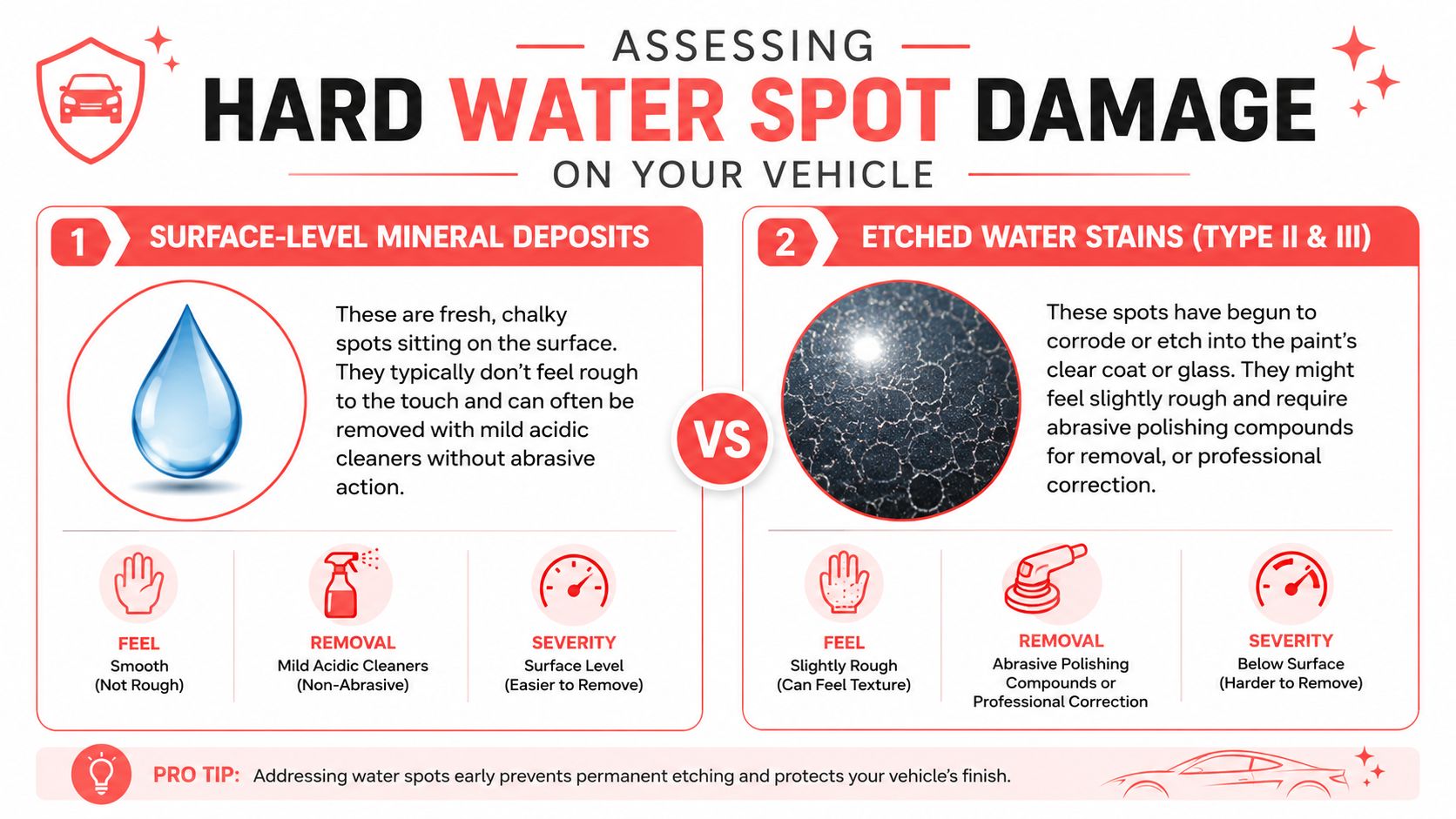
Surface deposits and etched spots are not the same thing
Professional detailers and glass care specialists separate surface scale from irreversible etching. As noted by Window Cleaner's guidance on hard water stains from glass, etched glass or paint can keep a hazy or cloudy look even after cleaning because the material itself has been damaged. At that point, cleaning alone won't fix it.
That same logic applies to vehicles. If a spot disappears after proper chemical treatment, it was likely surface mineral buildup. If the outline remains, especially as a dull ring or cloudy patch, you may be looking at etching.
A simple hands-on check
One practical way to judge the spot is the baggy test. Put a thin plastic sandwich bag over your fingertips and gently glide across the clean, dry panel or glass.
Here's what you're feeling for:
- Raised or crusty texture: Often points to mineral deposit still sitting on top.
- Smooth but visibly cloudy area: Often points to etching or damage below the surface.
- Mixed result: Very common. The top layer may be removable, but the stain may also have already marked the clear coat or glass underneath.
The bag amplifies texture better than bare skin. It won't diagnose every case perfectly, but it's a useful reality check before you start chasing spots with more pressure.
If the spot looks lighter after cleaning but never fully clears, that's usually a sign the deposit was only part of the problem.
Quick decision guide
| What you see | What it usually means | What to do next |
|---|---|---|
| Chalky rings that feel slightly raised | Surface mineral residue | Try a safe professional remover with proper dwell time |
| Cloudy patch that stays after cleaning | Likely etching | Stop escalating chemicals and consider polishing |
| Spot on glass with a stubborn haze | Could be etched glass | Test gently, then move to professional correction if needed |
A lot of owners get stuck because they assume every water spot is removable. It isn't. If the spot has already etched into paint or glass, stronger DIY methods usually don't solve it. They just add risk.
Professional Removal Techniques for Car Surfaces
When hard water stain removal is done correctly, the process is controlled and patient. The goal is to dissolve or loosen the mineral deposit with as little abrasion as possible. Scrubbing harder is usually what creates the next problem.

Dwell time matters more than force
A key principle in stain removal is dwell time. For many mineral deposits, allowing a specialized remover to sit for 5 to 10 minutes gives the chemistry time to break down the bond so the residue can be removed with minimal abrasion, as described in Aquasana's hard water stain removal guidance. That matters on vehicles because minimizing abrasion helps reduce the chance of scratching.
People often get impatient. They spray, wipe immediately, see little change, and then start scrubbing. Usually the better move is to let the product work, then reassess.
How the approach changes by surface
Glass
Automotive glass can handle dedicated water spot removers better than delicate painted panels, but it still rewards restraint.
A safe professional workflow usually looks like this:
- Start with a clean surface: Remove loose dirt first so you're not grinding debris into the glass.
- Apply a dedicated mineral remover: Use a foam or microfiber applicator, not a harsh pad.
- Allow contact time: Follow the product instructions and don't rush the wipe-off.
- Repeat if needed: Multiple mild cycles are safer than one aggressive pass.
If the glass still looks cloudy after proper chemical treatment, the issue may be beyond surface scale.
Paint and clear coat
Paint is where DIY advice gets risky fast. Modern clear coat doesn't like aggressive rubbing with random household products, and what works on a shower door does not automatically belong on a hood or roof.
For paint, professionals usually rely on:
- Dedicated automotive water spot removers
- Soft microfiber towels or foam applicators
- Follow-up decontamination if needed, including services like clay bar treatment for cars when bonded contamination is part of the issue
One product used in professional service work is The Mobile Buff's dedicated water spot remover, which is formulated to dissolve calcium and magnesium residue from paint. That kind of product makes more sense than improvising with random household chemicals on clear coat.
What works: Chemical breakdown, light agitation, repeat passes if necessary.
What fails: Heavy hand pressure, abrasive pads, and guessing.
A clay bar can help in some cases, but it isn't a cure for etched spotting. If the damage is below the surface, clay won't level it.
A quick visual demo helps make the process easier to understand:
Chrome and trim
Chrome can usually be cleaned with the same mindset as glass. The deposit needs to soften before you wipe or agitate. Trim is less forgiving. Some finishes stain, haze, or discolor if the wrong cleaner sits too long.
That's why pros patch test first, work small areas, and remove residue completely. On mixed-material exterior parts, technique matters as much as chemistry.
Tackling Hard Water Stains Around the Home
The same mineral issue that spots your vehicle also shows up on shower glass, faucets, and sink fixtures. The principle stays the same. Dissolve the deposit first, then wipe or lightly agitate.
For home fixtures, a commonly recommended workflow is a 1:1 distilled white vinegar-to-water solution with a dwell time of at least 15 minutes, followed by wiping with a non-scratch pad, as outlined in Good Housekeeping's hard water stain cleaning guide. That sustained contact is what helps break down calcium carbonate scale.
Where this method makes sense
- Shower doors: Spray the solution evenly, let it sit, then wipe with microfiber or a non-scratch pad.
- Faucets and showerheads: If the fixture allows it, soak or bag the affected end so the mineral-crusted area stays fully in contact with the solution.
- Sinks and similar surfaces: Use the same slow approach instead of aggressive scouring.
A useful local resource for homeowners dealing with bathroom and window buildup is this Phoenix homeowner's guide to glass stains, which gives good context for how mineral spotting behaves on household glass.
Patch test first. Household fixtures vary more than people think, especially with plated finishes, coatings, and decorative hardware.
The main caution from an automotive perspective is simple. Home methods belong on home materials. They don't automatically translate to paint-safe car care.
How to Prevent Hard Water Stains from Returning
The cheapest hard water stain removal job is the one you never need. Prevention beats correction because once spotting bakes onto a surface, every cleanup becomes slower and riskier.
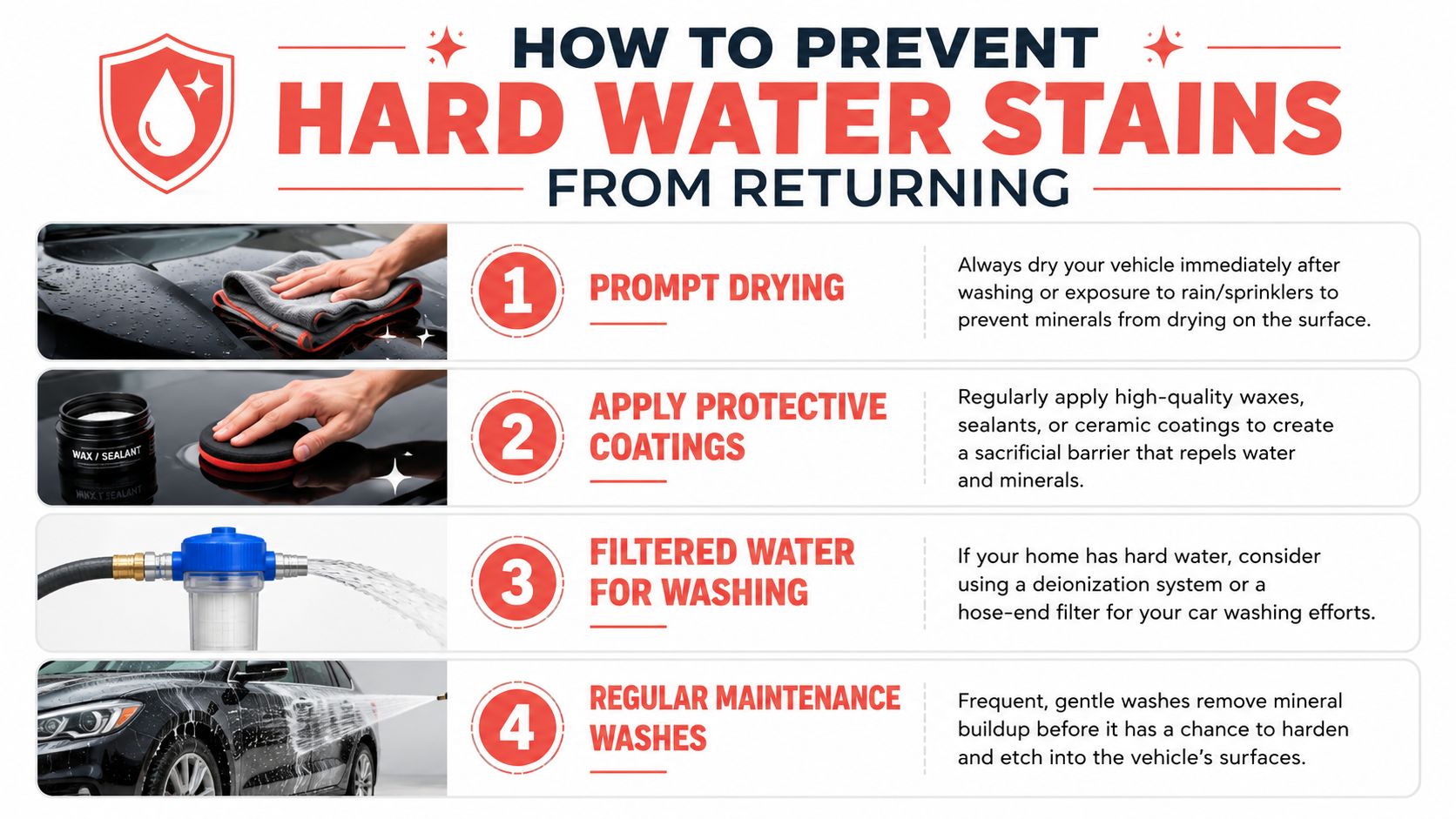
Habits that reduce spotting
- Dry the vehicle promptly: Don't let wash water or sprinkler water sit and evaporate on paint or glass.
- Wash before buildup hardens: Regular maintenance helps remove fresh residue before it turns stubborn.
- Watch where you park: Sprinklers, hard well water, and repeated sun-baked drips create the worst repeat offenders.
Protection changes the game
Protection doesn't make minerals disappear, but it gives them less opportunity to bond directly to the surface. Waxes, sealants, and coatings act as sacrificial layers, which makes maintenance easier and cleanup safer.
If you're weighing longer-term protection, this overview of what ceramic coating is is a good starting point. A properly protected vehicle is still vulnerable to neglect, but spotting is usually less stubborn and less likely to turn into a correction job.
Bottom line: Dry faster, protect the surface, and don't leave mineral-rich water to bake in the sun.
When DIY Is Not Enough Call The Mobile Buff
If you've used safe methods and the spots still show up as a haze, shadow, or dull ring, you're probably not dealing with simple residue anymore. You're dealing with damage that cleaning won't reverse.
One reason DIY advice falls short is that some stain-removal methods work on removable fixtures because the part can be soaked directly. As noted in Leaf Home's discussion of hard water stains, that kind of immersion approach may work for faucets, but it isn't practical for a car's body panels. Vehicle paint and glass need controlled correction, not improvised workarounds.
That's where professional judgment matters most. A detailer has to decide whether the problem needs chemical removal, decontamination, machine polishing, or a combination of those. Go too mild and the defect stays put. Go too aggressive and you risk thinning clear coat or adding avoidable marring.
For another perspective on how persistent mineral spotting can move beyond basic cleaning, Cultivate House Detailing's hard water advice is worth reading.
If you're in Central Pennsylvania and the spots won't clear, check our reviews and recent work on our Google Business Profile. Mobile service means the correction work comes to your driveway, which is a lot easier than experimenting with stronger products and hoping for the right result.
If your paint, glass, or trim still looks spotted after safe cleaning, book a visit with The Mobile Buff. We can assess whether you're dealing with removable mineral buildup or true etching, then recommend the right correction without putting your vehicle at unnecessary risk.

