


You're standing in the driveway with a bucket, a hose, and a car that's picked up a week of pollen, brake dust, and road film. The job feels simple enough. Add soap, scrub, rinse, done. But the part often overlooked is where that dirty water goes after it leaves the paint.
In Central PA, that runoff doesn't just disappear. It moves across pavement, toward storm drains, and eventually toward local waterways, including the Susquehanna River and the smaller creeks that feed it. That's why the product choice matters, but it's also why the washing method matters just as much.
Your Car Wash and Its Environmental Footprint
A driveway wash feels harmless because it's familiar. It's a common childhood experience. Kids help, the radio's on, suds run down the concrete, and the car looks better for a few days.
But that runoff carries more than soap. It can also carry loosened grime, traffic film, traces of oil, old dressings, and whatever came off the wheels and lower panels. When that water heads into a storm drain, it isn't the same as wastewater that goes through a treatment process.

Why more drivers are paying attention
This isn't a fringe concern anymore. The global car care products market reached USD 13.40 billion in 2025 and is projected to grow to USD 13.82 billion by 2026, reflecting stronger demand for environmentally safer options, according to Fortune Business Insights on the car care products market.
That growth tells you something practical. More drivers want products that clean well without adding unnecessary risk to the environment. They also want products that make sense for regular maintenance, not just an occasional feel-good purchase.
If you want a broader look at how professional detailers approach lower-impact washing, this guide on eco-friendly car detailing methods is a useful place to start.
Practical rule: A cleaner wash starts with two questions. What am I putting on the vehicle, and where is it going after I rinse it off?
The local angle matters
In this area, people care about their neighborhoods, their property, and the rivers and streams around them. That makes car washing one of those everyday habits worth rethinking. Not because every driveway wash is reckless, but because small habits repeated over time add up.
A lot of customers start by asking about biodegradable car wash products because they want a safer soap. That's the right instinct. The next step is understanding what “biodegradable” means, because plenty of labels sound green without saying much at all.
What Biodegradable Really Means for Car Care
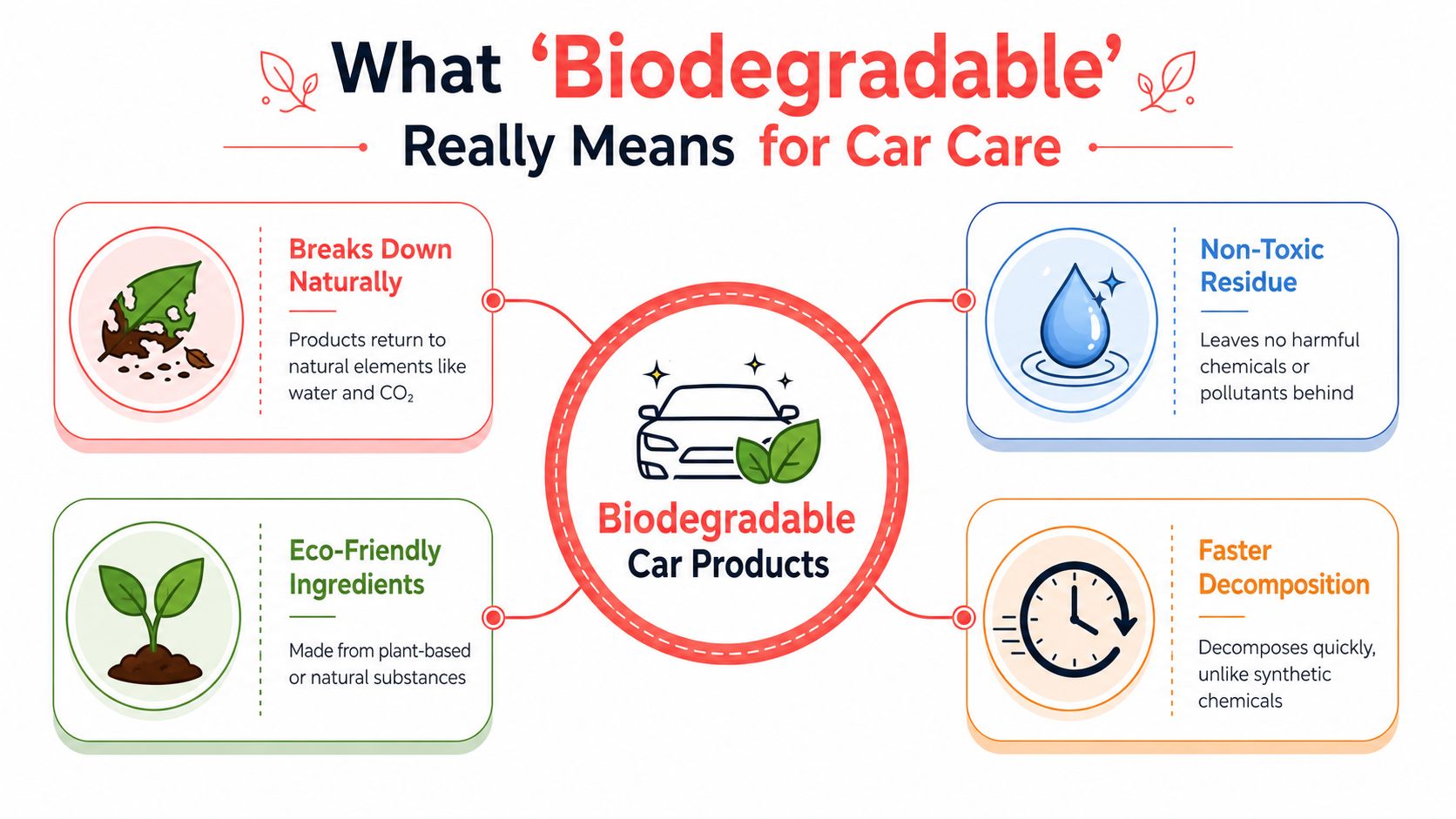
The easiest way to understand biodegradability is to compare a banana peel with a plastic bag. One breaks down naturally with help from microbes and time. The other hangs around much longer. Car care chemistry works the same way.
With biodegradable car wash products, the goal is to use ingredients that nature can break down more quickly and safely after the cleaning job is done. That doesn't mean every product labeled “green” qualifies. It means the formula has to be built for breakdown, not just cleaning power.
What the chemistry looks like in plain English
A verified explanation from Bliss Car Wash's breakdown of biodegradable soap chemistry says biodegradable car wash soaps use simpler ester linkages and shorter carbon chains that microbes can break apart under enzymatic action. In practical terms, that allows them to decay within weeks instead of lingering in soil and waterways for years.
That same source explains why many better formulas lean on plant-based surfactants from renewable materials such as coconut, corn, and sugar. These ingredients are chosen because they can do the cleaning work while also breaking down more cleanly after use.
What good formulas avoid
Professional-grade eco-conscious soaps usually avoid the ingredients detailers don't want running off a property line in the first place.
- Persistent additives: These can stay in the environment longer than they should.
- Heavy metals: Lead, zinc, and copper don't belong in a wash soap.
- Phosphates and synthetic polymers: These raise obvious concerns when runoff reaches soil and water.
- Older chelating choices: Better formulas may use mild co-surfactants like EDDS instead of EDTA.
That pattern shows up in many categories of sustainable biobased cleaning products, not just automotive care. The good ones don't rely on a green label alone. They rely on chemistry designed to work, then disappear more responsibly.
If a soap cleans well but leaves behind ingredients that persist in waterways, it isn't an eco-friendly win. It's just a different bottle.
Why this matters on the paint too
There's a practical upside for the vehicle itself. Formulas built around milder, biodegradable ingredients are often easier on waxes, sealants, and coated surfaces than harsh household cleaners or aggressive degreasers. That doesn't mean every biodegradable soap is premium. It means the best ones are engineered to clean without punishing the finish.
For a closer look at the kinds of materials professionals look for, this article on eco-friendly detailing products helps connect the ingredient side with real detailing use.
Decoding Labels and Spotting Greenwashing
The bottle says “natural.” The label uses leaves, water drops, and a soft green color palette. None of that proves the formula is a good choice.
Greenwashing happens when packaging makes a product sound more environmentally responsible than it really is. In car care, that usually shows up through vague language, incomplete ingredient disclosure, or claims that aren't backed by meaningful testing.
What to look for first
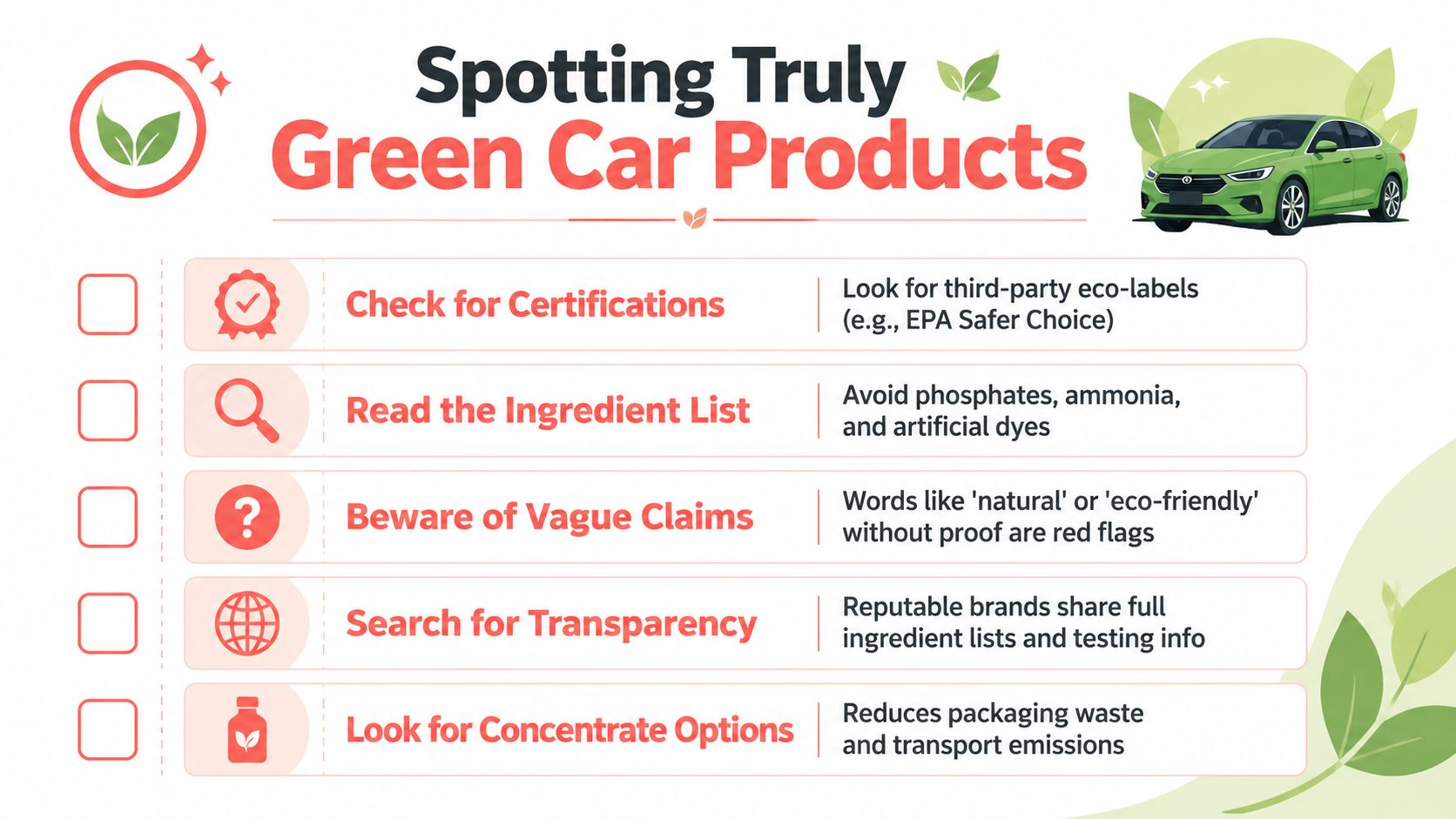
A strong label gives you something specific to verify. The most important marker is whether the product has been tested under ASTM or OECD protocols and identified as readily biodegradable under standard conditions. That's much more meaningful than a vague “eco-safe” badge invented by the brand itself.
Here's the quick screen I'd use before any product goes near paint:
| Check | Why it matters |
|---|---|
| Certification language | Shows the claim is tied to a recognized testing standard |
| Full ingredient transparency | Brands that disclose more usually have less to hide |
| Intended use on automotive paint | Reduces the risk of using the wrong cleaner on clear coat |
| No broad miracle claims | “Cleans everything” usually means compromise somewhere |
Ingredients that should raise a red flag
A verified guideline from UsedCars.com on environmentally friendly car care products states that biodegradable car wash soaps should be formulated without phosphates, chlorine, ammonia, petroleum-based solvents, and synthetic fragrances.
That list is useful because it cuts through the marketing language. If you see those ingredients, the product isn't the kind of biodegradable car wash solution most professionals want in runoff.
A simple label review looks like this:
- Phosphates: Skip them.
- Chlorine: Wrong fit for safe routine car washing.
- Ammonia: Too harsh for many exterior surfaces.
- Petroleum-based solvents: Not what you want in everyday wash runoff.
- Synthetic fragrances: Often unnecessary, sometimes misleading.
Before you buy, it helps to hear another perspective on what misleading marketing can look like in practice.
What greenwashing sounds like
Watch for language like this:
- “Eco-inspired” with no test standard listed
- “Biodegradable ingredients” when the full formula isn't described
- “Safe for the environment” without any detail on what's excluded
- “Professional strength” used as a distraction from poor disclosure
Smart buyer check: If the label gives you mood words but no standards, no exclusions, and no ingredient detail, keep walking.
Do Eco-Friendly Soaps Actually Clean Well
Yes, they can. But the honest answer is more useful than a simple yes.
Some older “green” soaps earned a weak reputation because they didn't cut through bug residue, road film, or oily buildup very well. Modern formulas are much better, especially when they're used the way pros use them. Correct dilution, the right wash media, and a surface-appropriate method make a huge difference.
Where they perform well
On regular maintenance washes, biodegradable car wash products usually handle the job just fine. Dust, pollen, light grime, and day-to-day contamination come off well when the soap has enough lubricity and the wash process is controlled.
They also tend to be a better match for protected vehicles. If a car has wax, sealant, or a ceramic coating, a milder pH-balanced wash soap is usually what you want. Strong household detergents strip protection faster and can leave the finish looking tired.
For anyone still tempted to reach for kitchen soap, this piece on avoiding dish soap in car care explains why detailers steer people away from it.
Where technique matters more than the label
Eco-friendly doesn't mean all-purpose. If a vehicle has baked-on bugs, heavy wheel contamination, greasy jambs, or winter buildup, the soap alone may not do everything. A professional may need separate wheel cleaners, iron removers, or targeted pre-treatment that's selected for the surface and contamination level.
That's where DIY washing usually goes sideways. People use too little product, too much product, the wrong towel, a contaminated sponge, or a cleaner that wasn't designed for automotive finishes at all.
A better rule is this:
- Routine dirt: A biodegradable wash soap is often ideal.
- Heavy contamination: Use professional process, not stronger random chemicals.
- Protected finishes: Mild, paint-safe products are usually the safer bet.
For better maintenance habits between major details, these hand car wash tips from a detailing perspective are worth keeping in mind.
A quality soap helps. The wash method decides whether the finish ends up clean, marred, or only half done.
Why Professional Application Matters Most
The biggest misconception I hear is that washing at home with a biodegradable soap must be the greenest choice. It sounds logical, but the soap is only part of the equation.
Runoff control, water handling, product dilution, and contamination management matter just as much. A safer soap in an uncontrolled driveway wash can still send dirt, traffic film, and other residues into the storm system.
Why the driveway assumption falls apart
A verified point from Turtle Wax Pro's discussion of eco-friendly car wash chemicals highlights that many consumers assume home washing is preferable, but commercial car washes often filter and reuse water multiple times before release. The same source notes that King County guidelines recommend looking for commercial facilities that use eco-friendly products or self-wash facilities where you can bring your own safe products, rather than assuming home washing is the better environmental option.
That's an important trade-off. Biodegradable chemistry is better than harsh household cleaners, but controlled water management can make a professional setting the smarter overall choice.
What pros do differently
Professional results don't come from soap alone. They come from a system.
- Measured dilution: Pros don't guess. They mix products to the concentration that delivers cleaning without waste.
- Targeted tools: Separate mitts, wheel media, drying towels, and sprayers reduce cross-contamination.
- Lower-water methods: Rinseless and waterless approaches can work extremely well for the right vehicle condition.
- Surface judgment: Pros know when a panel needs gentle agitation and when it needs chemical decontamination instead.
That process protects the vehicle and cuts down on unnecessary runoff.
Choosing a safer service locally
If you're comparing options, look for a provider that talks clearly about methods, paint safety, and product choice instead of just promising a fast shine. Reviews can help, and so can a quick look at a business profile such as this Google Business listing for a local detailing service.
The greenest wash isn't the one with the loudest label. It's the one with the safest product, the right method, and the least waste.
Your Eco-Friendly Car Care Solution
Most drivers don't want to become label experts, chemical testers, and wash-process specialists just to keep a vehicle clean. They just want a car that looks good, stays protected, and doesn't create unnecessary environmental mess in the process.
That's where the value of biodegradable car wash products becomes evident. The best ones are built with ingredients that break down more responsibly, avoid harsher problem chemicals, and support better routine maintenance. They're a smart part of modern car care.
The short version that matters
If you're making better choices for your vehicle and your community, keep these points in mind:
- Biodegradable means more than branding: The chemistry has to support natural breakdown.
- Labels need proof: Testing standards and ingredient transparency matter.
- Cleaning power is there: Modern eco-conscious soaps can perform very well in maintenance washing.
- Method decides the outcome: Product choice alone doesn't solve runoff and contamination issues.
That last point is the one many people miss. Even a good soap can be used poorly. Even a well-meaning driveway wash can create avoidable runoff. Professional application removes a lot of that guesswork.
Why convenience matters too
Busy families, commuters, pet owners, and anyone juggling work and home life usually don't need more weekend chores. They need a practical maintenance plan that keeps the car presentable without cutting corners.
That's why professional detailing makes sense for a lot of Central PA drivers. You get paint-safe methods, better product selection, and a cleaner result without experimenting on your own vehicle. You also avoid the common DIY mistakes that lead to water spots, swirl marks, stripped protection, and half-clean wheels.
If your goal is a cleaner car and a smarter wash process, the safest move is simple. Leave the chemistry, technique, and product matching to professionals who do this every day.
If you want a cleaner vehicle without the driveway guesswork, book with The Mobile Buff. We bring professional mobile detailing to Harrisburg, Mechanicsburg, Carlisle, Newport, and nearby Central PA communities, using paint-safe methods and eco-conscious products that make sense for real-world maintenance. Whether you need a hand wash, full interior and exterior detail, pet hair removal, odor treatment, or headlight restoration, we'll come to you and do it right.

