


You wash the car on Saturday, stand back, and finally get that clean, glossy look you wanted. By Sunday afternoon, there's dust on the hood, light spotting on the glass, and the finish already feels like it lost something. That cycle gets old fast.
Most drivers who ask about ceramic coating mobile detailing are trying to solve exactly that problem. They want a vehicle that stays easier to clean, looks sharper between washes, and doesn't require constant upkeep just to look cared for. They also don't want to give up the car for days if that can be avoided.
That's where mobile ceramic coating makes sense, if the job is done the right way. The coating itself matters, but so do the prep work, the environment, and the cure conditions at your home or office. Those are the parts generic articles usually skip, and they're the parts that decide whether the finish looks excellent for the long run or becomes an expensive disappointment.
Tired of a Car That Only Stays Clean for a Day
You wash the car on Saturday morning, pull it into the driveway, and for a few hours it looks right again. By the next day, pollen is back on the horizontal panels, water spots have started to show, and the paint already feels rougher than it did after the wash.
In Central PA, that cycle is common. The mix of road film, tree fallout, pollen, rain, and regular commuting can make a freshly cleaned vehicle look tired fast. Owners usually are not chasing a show-car routine. They want the vehicle to hold its finish longer and take less work between washes.
Ceramic coating can help with that, but the result depends on more than the product in the bottle. The prep has to be right. The paint has to be properly cleaned and corrected. And for a mobile installation, the work area at your home matters more than many people realize. Shade, enough room to move around the vehicle, and protection from wind, sprinklers, and sudden weather all affect the final result and the early cure time.
That last part gets skipped in a lot of generic articles. At home, a high-quality coating job is possible, but it is not ideal in every driveway. If there is no garage or covered space, I would rather say that upfront than apply a coating in conditions that put the finish at risk.
What most people are really asking
When someone reaches out about ceramic coating, the main questions are usually practical:
- Will the car stay easier to clean after rain, dust, and normal driving?
- Will the gloss hold up better than a quick spray wax or wash-applied protectant?
- Can the job be done at home properly with my setup and the weather that day?
- Am I paying for real long-term value or just a nicer-looking detail for a week?
Those are the right questions to ask before booking any coating service.
A good coating job starts before the bottle is opened. If the prep is rushed, the coating locks in haze, missed contamination, and avoidable defects instead of protecting a properly finished surface.
If you want a clearer breakdown of the basics, our guide on what ceramic coating is and how it works covers that foundation. For another outside perspective, Discover SwiftJet's car ceramic guide.
What Ceramic Coating Is and Why It Is Not Magic
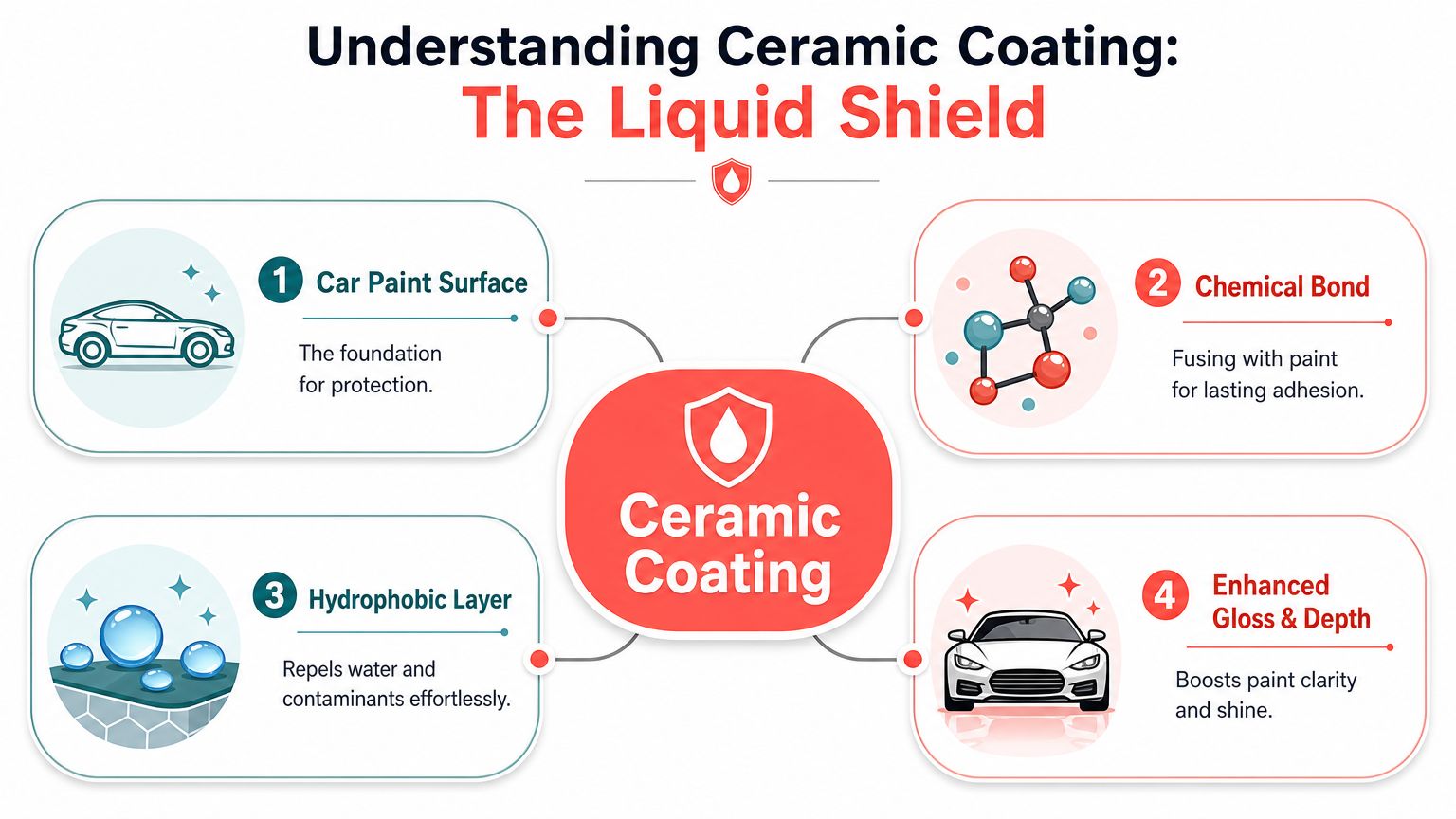
Ceramic coating is best understood as a thin protective layer that chemically bonds to your vehicle's clear coat. It isn't a thick shell and it isn't a plastic wrap. It's more like a liquid-applied glass-like skin that changes how the surface behaves.
Most single-layer coatings are only about 0.5 to 2 microns thick, and their performance comes from the silica-based SiO₂/TiO₂ matrix that creates a glass-like, water-shedding surface, not from thickness alone, as explained in MobiGleam's breakdown of what to look for in ceramic coating.
What it does well
A properly installed coating gives you benefits that are easy to notice in normal ownership:
- Water behavior changes so rain and rinse water bead and release more easily.
- Cleaning gets easier because grime has a harder time sticking to the surface.
- Gloss improves because the paint looks richer and clearer.
- Environmental protection improves against things like UV exposure, chemicals, bird droppings, and similar contaminants, which are described in Treendly's summary of the auto detailing market and ceramic coating behavior.
If you want a broader consumer-friendly primer, Discover SwiftJet's car ceramic guide is a useful companion read. For a more service-focused explanation from our side of the industry, this page on what ceramic coating is helps clarify where it fits in real-world detailing.
What it does not do
At this stage, honest shops separate themselves from hype.
Ceramic coating does not make paint invincible. It does not hide scratches, swirls, oxidation, sanding marks, or etched water spots. It also doesn't turn the car into a maintenance-free object that never needs washing again.
Reality check: A coating improves the surface you already have. It doesn't fix bad paint by itself.
That's why the condition of the vehicle matters so much before installation. If the paint is hazy, scratched, or contaminated, the coating locks that condition in. If the paint is properly corrected first, the coating preserves a much better starting point.
Why the “magic shield” idea causes disappointment
The biggest misunderstanding is thinking ceramic coating replaces all future care. It doesn't. What it does is make future care easier and more effective. For the right owner, that's a huge difference. For the wrong expectation, it becomes frustration.
So the value of ceramic coating mobile detailing isn't fantasy-level protection. It's better gloss, easier washing, improved resistance to common contamination, and a more durable finish than traditional short-term protection. That's strong value. It just isn't magic.
The Mobile Advantage Why Get Coated at Home
Convenience is the first reason many people look into mobile detailing, and it's a good reason. Your vehicle can be serviced where it already lives, whether that's at home or at work, without the usual shop shuffle.
That matters more than people think. Traditional shop scheduling often means dropping the car off, finding a ride, adjusting your day, and waiting for updates. Mobile service cuts out a lot of that friction, especially for families with full calendars or owners who rely on the vehicle daily.
Where mobile service really helps
The biggest win is time.
You can keep working inside. You can stay with your kids. You can handle your day instead of building it around a detailing appointment. When the site is appropriate, ceramic coating mobile detailing gives you professional-level prep and installation without forcing a separate errand.
If you're new to the idea, this overview of what mobile car detailing means gives a good picture of how on-site service works in practice.
The catch most articles ignore
Mobile doesn't mean “anywhere, under any conditions.”
A coating may be applied at your home, but the location still has to support proper work. Good access to water and electricity can help depending on the setup. Shade matters. Wind matters. Dust matters. Most of all, the vehicle needs a protected environment during the curing window.
That's why the right mobile ceramic coating appointment starts with a conversation about your space, not just your car.
- A garage is ideal because it controls contamination and weather better.
- A covered area can work if it stays dry and sheltered.
- An open driveway may or may not work depending on temperature, debris, humidity, and the product being installed.
For local drivers, it also helps to know whether you're in the normal service area and what nearby customers think of the experience. You can check The Mobile Buff's Google Business Profile for service-area details and local reviews.
The Professional Mobile Application Process
A professional coating job has a rhythm to it. Skip one step and the rest of the process loses value.
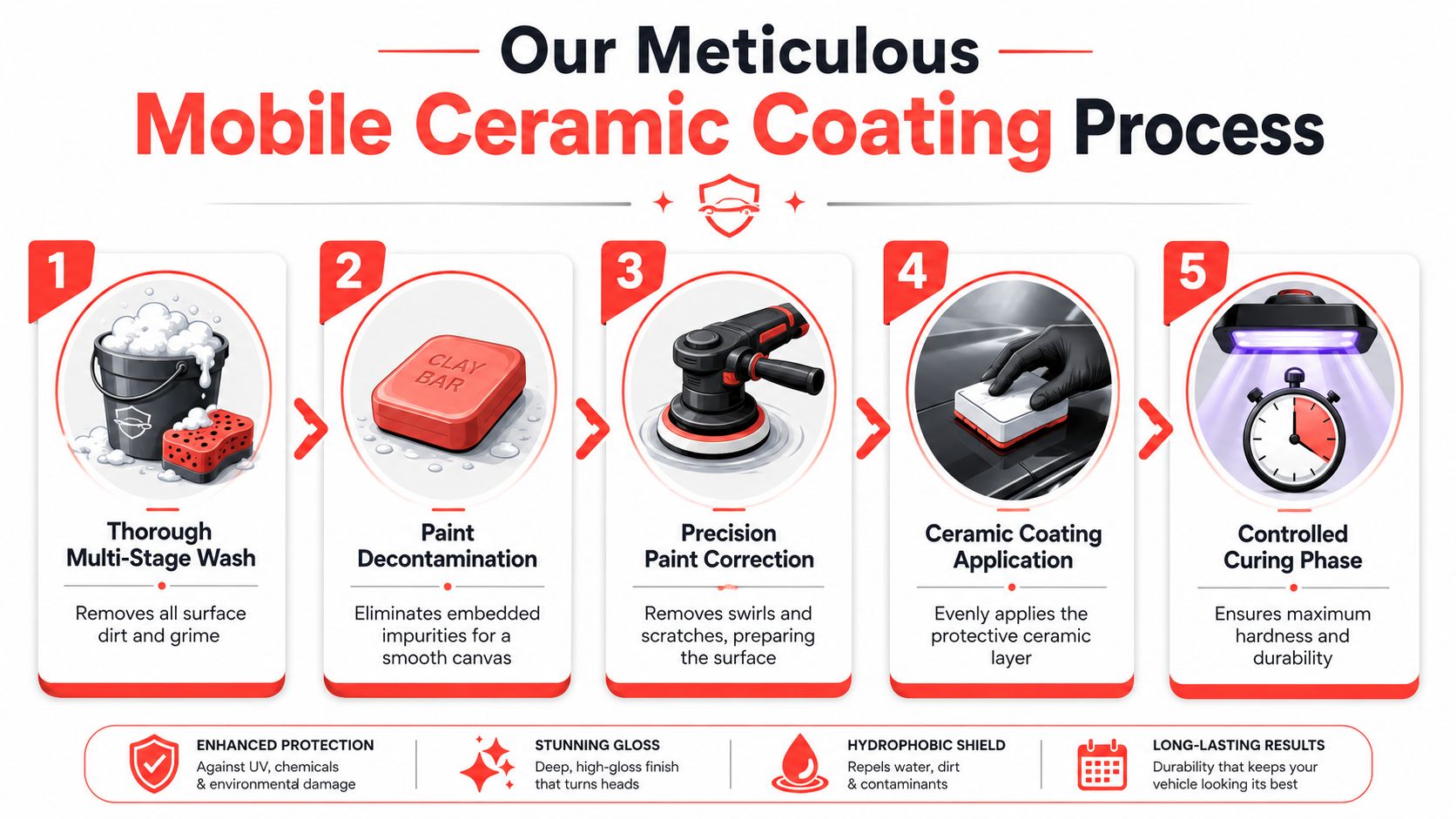
The short version is simple. The paint must be washed thoroughly, decontaminated, corrected if needed, coated carefully in controlled sections, and then allowed to cure under the right conditions. None of that is optional.
Step one starts with a true reset
The vehicle gets a proper hand wash first. Not a quick soap-and-rinse. The goal is to remove loose dirt safely so that later steps don't grind contamination into the paint.
After that comes decontamination. This typically includes chemical removal of bonded contamination and mechanical decontamination with clay when needed. The surface should feel clean and smooth before any polishing even begins.
Paint correction is where the finish is won or lost
This is the part customers often underestimate.
If the paint has swirl marks, wash marring, haze, or light scratches, those defects need to be polished out to the desired level before coating. Applying a coating over flawed paint is like putting a clear screen protector over a dirty phone screen. You don't solve the issue. You preserve it.
A detailed look at ceramic coating application shows why prep quality matters more than product hype.
Most coating failures aren't dramatic. They show up as uneven appearance, trapped defects, high spots, or disappointing durability because the prep and environment were rushed.
For mobile ceramic coating, process control is everything. Coatings bond chemically only after the paint is fully decontaminated and corrected, and the coating can't hide swirls or scratches. It only locks them in. Application also requires a protected, dry environment for about 24 to 72 hours to cure properly, with some mobile workflows specifying a 12-hour dry or garaged period before full hardening, as discussed in this technical video on coating prep and cure control.
A quick visual helps if you want to see coating work in action:
Application is slow on purpose
A coating is usually applied in small sections, then leveled and inspected under proper lighting. That's deliberate. The installer is watching for even coverage, proper flash behavior, and any high spots that need leveling before they harden.
Professional work here depends on:
- Lighting that reveals defects and residue
- Clean applicators and towels
- A consistent panel-by-panel workflow
- Enough patience to inspect every section before moving on
Curing is part of the service
Many customers think the job ends when the last panel is wiped down. It doesn't.
The fresh coating still needs a stable environment. That means avoiding moisture, airborne contamination, and bad weather during the curing period. If the car is left outside too soon, that risk belongs to the result.
That's one reason mobile coating work isn't just “shop work in a van.” It's professional detailing adapted to field conditions, and those field conditions have to cooperate.
Ceramic Coating vs Wax and Sealants
Not every vehicle needs the same protection plan. Some owners want short-term shine at the lowest entry cost. Others want fewer reapplications and easier long-term maintenance. That's where the differences between wax, sealant, and ceramic coating matter.
Traditional wax still has a place. So do synthetic sealants. But they serve a different purpose than ceramic coating.
Three protection options with different jobs
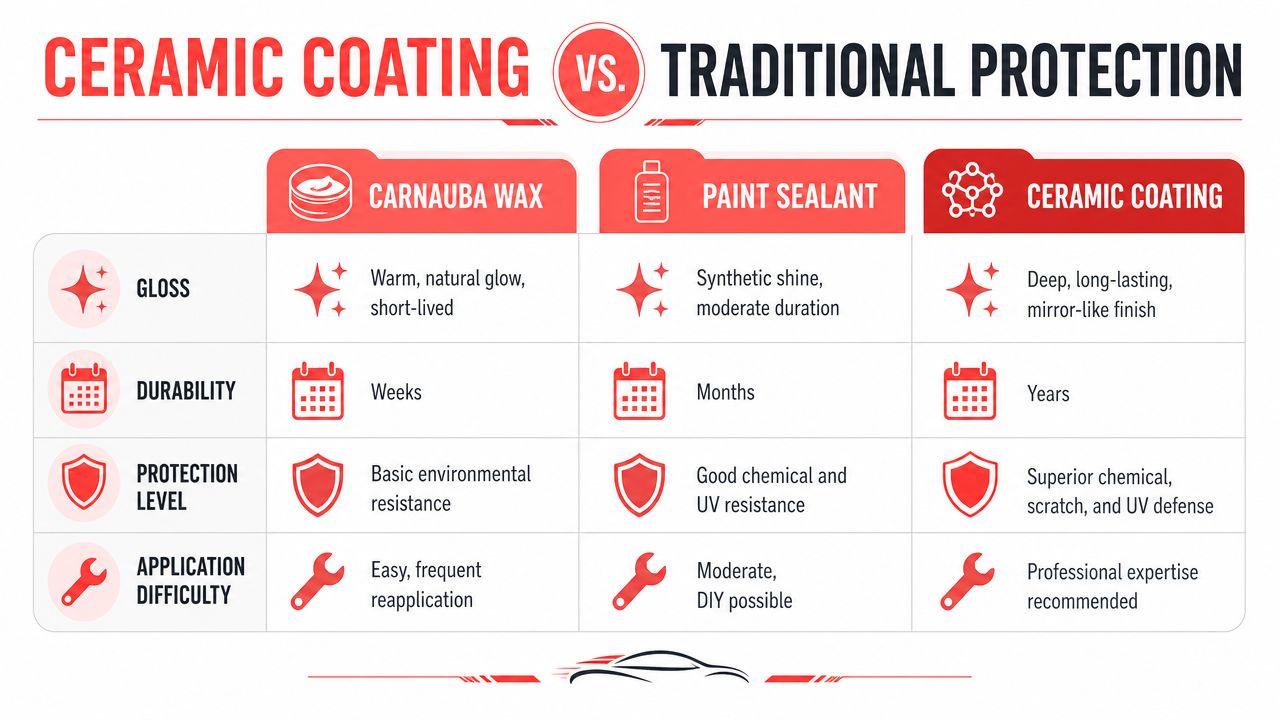
Carnauba wax is the classic gloss product. It can look great, especially right after application, but it's a short-term protection choice and usually makes the most sense for owners who enjoy frequent upkeep.
Paint sealant is the middle ground. It's synthetic, more durable than a basic wax, and often a sensible option for owners who want protection without stepping into a full coating package.
Ceramic coating is the investment option. It demands more prep and more installation discipline, but it gives a more durable, easier-to-maintain surface when the vehicle and owner are a good fit.
Protection showdown
| Attribute | Carnauba Wax | Paint Sealant | Ceramic Coating |
|---|---|---|---|
| Gloss | Warm, natural look | Crisp, synthetic shine | Deep, sharp, glass-like finish |
| Durability | Short-term | Medium-term | Long-term |
| Protection level | Basic surface protection | Stronger chemical and UV resistance | More durable chemical resistance and easier wash maintenance |
| Application | Simple and repeatable | Moderate | Prep-sensitive and best handled professionally |
| Best fit | Hobbyist upkeep | Budget-conscious protection | Owners keeping the vehicle longer or wanting easier maintenance |
The mistake that leads people to overspend
A ceramic coating is not automatically the right answer for every car.
Many consumers interpret “ceramic” as a maintenance-free finish, but that's a myth. Coatings provide strong water-beading and make cleaning easier, yet they do not eliminate the need for regular washing. For some drivers, a simpler protection plan plus regular professional detailing can be the better value, as explained in this article on how ceramic hydrophobics work and what they don't replace.
If the vehicle is lightly used, garaged most of the time, or likely to be sold soon, a simpler protection package can be the smarter purchase.
That doesn't reduce the value of ceramic coating. It just puts it in the right lane. The best choice depends on how the car is used, where it sits, and how long you plan to keep it.
Cost Longevity and Maintenance A Realistic Look
A ceramic coating quote can feel high until you compare it to what is included. Customers are not choosing between one wash package and another. They are paying for decontamination, paint correction if needed, careful panel prep, controlled application, and the time required to give the coating a fair chance to cure properly at home.
That last part gets ignored in a lot of pricing conversations. Mobile coating work can be done at a house, but the job goes much better when there is covered space, stable temperatures, and enough time to keep the vehicle parked and dry after application. If those conditions are missing, the service may need to be rescheduled or adjusted, and that affects value more than any sales pitch does.
What changes the price
The vehicle and the paint decide most of the quote.
- Vehicle size affects labor because larger vehicles have more surface area to wash, clay, polish, wipe down, and coat.
- Paint condition affects labor even more because swirls, oxidation, water spots, and scratches often need correction before a coating goes on.
- Parking and curing conditions matter because a garage or sheltered space usually makes a better coating install possible than an open driveway with sun, wind, or overnight moisture.
- Protection goals matter because a one-step improvement and entry coating package is different from a multi-step correction with a longer-term coating system.
This is why low online price examples can be misleading. Two vehicles of the same model can need very different amounts of prep. One may be ready after a wash, decon, and light polish. The other may need hours of correction before coating even makes sense.
Longevity depends on the install and the owner
Bottle claims are only part of the story.
How long a coating performs depends on prep quality, how cleanly it was applied, whether it had proper curing conditions, and how the vehicle is washed afterward. A well-installed coating on a daily driver that gets safe maintenance washes will usually hold up far better than the same product installed in poor conditions and run through brush washes.
At-home installation adds one more real-world factor. If the car has to sit outside right after service, exposed to rain, pollen, sprinklers, or heavy dew, that can interfere with early curing. That does not mean mobile coating is a bad idea. It means the location has to support the job.
Maintenance is simple, but it still matters
Coated vehicles are easier to wash. They are not self-cleaning.
Good maintenance looks like this:
- Use a pH-neutral car soap
- Wash with clean mitts and drying towels
- Stay out of automatic brush washes
- Remove bird droppings, bug residue, and mineral-heavy water spots quickly
- Book periodic maintenance details if the vehicle lives outside or sees heavy mileage
For many owners, the best value comes from matching the coating to the way the car is used. If the vehicle is parked outside every day and washed carelessly, paying for an expensive coating package may not return what you expect. If you plan to keep the car, can support proper curing, and are willing to maintain it correctly, the coating usually makes ownership easier and keeps the finish looking better longer.
Service quality matters too. Clear communication, honest scheduling, and showing up prepared are part of the job. This piece on avoiding missed calls in auto detailing is written for businesses, but the lesson applies to customers as well. Shops that handle communication well tend to handle the work with the same level of care.
Your Local Ceramic Coating Solution in Central PA
The biggest question with ceramic coating mobile detailing isn't whether a coating can be installed outside a traditional shop. It's whether your location allows the work to be done correctly.
That's the dividing line. A critical question for mobile detailing is whether a coating can cure properly in a driveway. The answer depends on site conditions. Professionals often need a garage or other protected space to manage dust, humidity, and weather so the bond develops the way it should, as discussed in this video on driveway curing conditions and mobile coating limitations.
For Central PA drivers, that means the best approach is usually an honest assessment first. Is the paint a strong candidate for coating? Does the vehicle need correction before protection? Do you have a garage or sheltered setup that supports proper curing? If the answer is yes, mobile service can be a very practical way to get professional results without the usual shop inconvenience.
The Mobile Buff offers ceramic coating as part of its mobile detailing services in the region, with the work centered on proper prep, realistic expectations, and suitable on-site conditions. That's the right order of priorities for coating work.
If you want the deep gloss, easier maintenance, and long-term paint protection that ceramic can offer, the smart next step isn't guessing from a kit label. It's having your vehicle and your parking setup evaluated by a pro who can tell you whether coating makes sense, and how to do it right.
Ready to protect your paint the right way at home? Contact The Mobile Buff for a personalized ceramic coating quote based on your vehicle, paint condition, and setup. If your garage or driveway is a good fit, we'll help you get lasting gloss and easier maintenance without the hassle of a shop visit.

