


Monday morning has a way of exposing weak maintenance systems. A van won't start, another has a warning light the driver noticed too late, and the clean truck you planned to send to a customer is still sitting at the lot with a stale cab odor and road salt packed around the lower panels. For a small contractor or delivery operation, one vehicle down can disrupt the whole day.
Commercial vehicle maintenance works better as a routine than as a series of emergency shop visits. Preventive service, quick inspections, professional cleaning, odor control, and clear records all protect uptime in different ways. The system doesn't need to be complicated, but it does need an owner, a schedule, and a standard that drivers and vendors can follow.
Why a Proactive Program Beats Reactive Repairs Every Time
A reactive fleet usually looks busy, not necessarily productive. Drivers report problems after they become obvious, the shop receives incomplete information, and the owner makes decisions under pressure. A worn tire becomes a roadside failure. A small coolant leak becomes an overheating event. A dirty cab becomes a customer-facing problem when the driver is expected to represent the company professionally.
A proactive program changes the timing of those decisions. The team checks safety-critical components before departure, schedules service around routes, and treats cleaning as part of vehicle preservation rather than an occasional cosmetic extra. That approach matters even more through Central Pennsylvania winters, where road salt, freezing temperatures, potholes, and wet interiors can accelerate wear on both mechanical and finished surfaces.
Practical rule: If a problem can be found while the vehicle is parked, don't wait to discover it on the road.
One van down affects more than the repair order
A breakdown creates several jobs at once. Someone has to arrange a tow or substitute vehicle, reschedule work, contact customers, move tools or materials, and explain why the vehicle wasn't ready. The repair itself may be straightforward, but the surrounding disruption can last much longer.
Preventive maintenance also makes inspection findings more useful. A driver who reports uneven tire wear gives the maintenance team a chance to check alignment, suspension, and tire pressure before the wear spreads. A technician who sees corrosion or contamination during a scheduled inspection can recommend the appropriate repair instead of waiting for a component to fail.
The same logic applies to professional detailing. Salt residue and grime should be removed with approved washing methods, not aggressive household chemicals that can damage trim, clear coat, seals, or interior materials. A clean vehicle is easier to inspect, easier to present to customers, and easier to turn over when it reaches the next driver.

Keep the system small enough to use
A workable program usually has four parts:
- Scheduled service: Base work on manufacturer recommendations, mileage, engine hours, and actual duty cycle.
- Fast inspections: Give drivers a consistent walkaround that catches visible defects without creating paperwork fatigue.
- Professional appearance care: Schedule washing, interior detailing, odor treatment, and headlight work before the vehicle becomes difficult to restore.
- Usable records: Log defects, service, downtime, parts, and resolution time in one place.
The goal isn't to eliminate every repair. That's impossible. The goal is to find problems earlier, make better scheduling decisions, and keep small issues from controlling the workday.
Building Your Preventive Maintenance Schedule That Actually Stays on Track
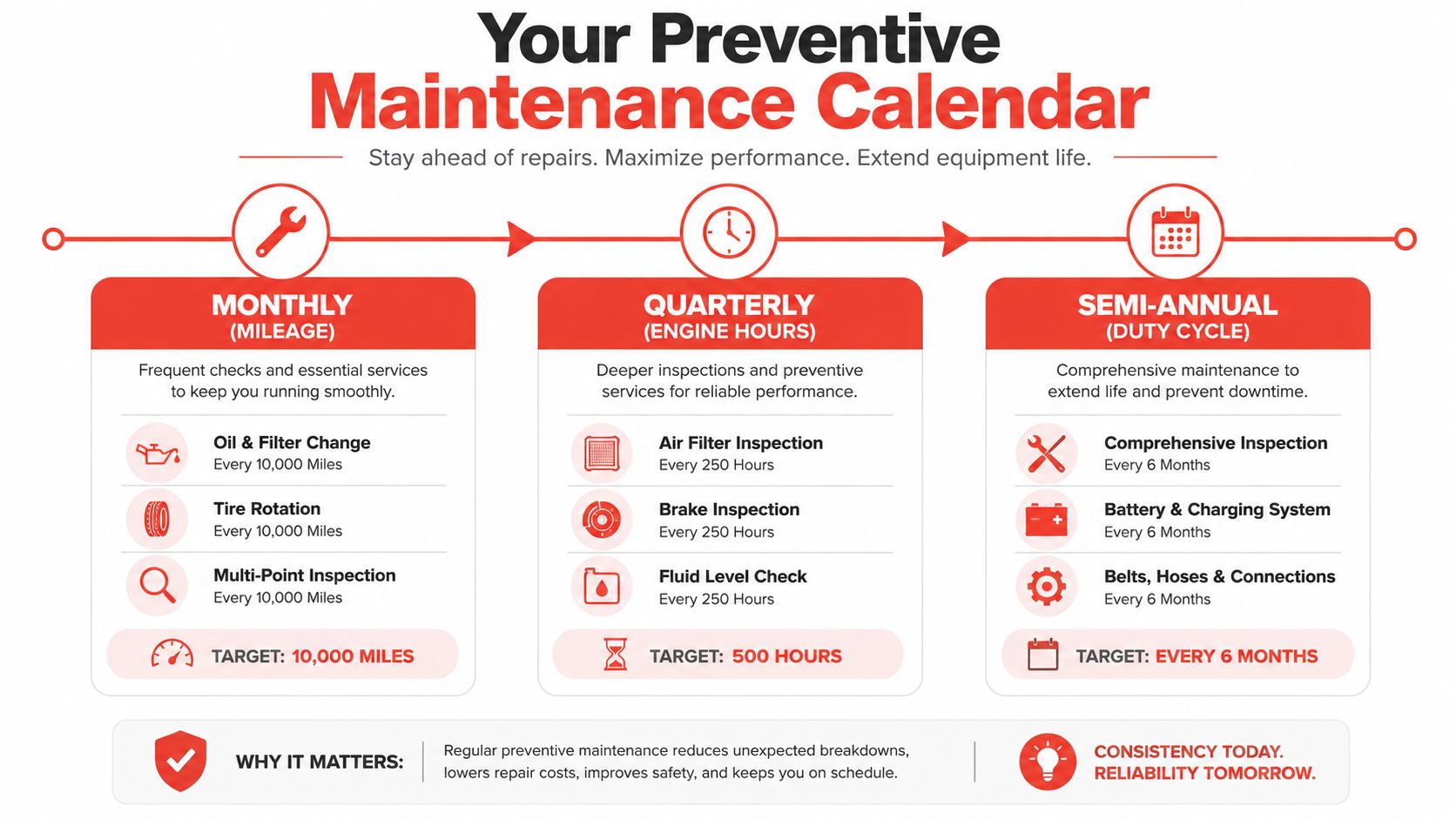
A preventive maintenance calendar should reflect how each vehicle works. Mileage matters for highway units, engine hours matter for vehicles that idle or operate equipment, and duty cycle matters for vans making constant stops, carrying heavy loads, or working on rough routes. Calendar-only scheduling looks tidy, but it can miss the conditions that create wear.
Start with a vehicle register. Record the unit number, make, model, mileage, engine-hour reading when available, assigned route, load pattern, and the person responsible for approving service. Then assign each task to a trigger, such as manufacturer interval, mileage, engine hours, seasonal preparation, inspection finding, or telematics alert.
Separate compliance from operating care
U.S. federal rules require every commercial motor vehicle, including each segment of a combination vehicle, to receive a periodic inspection at least once every 12 months under 49 CFR 396.17. A vehicle that passes an inspection meeting Appendix G standards satisfies that annual requirement for 12 months starting from the last day of the month in which the inspection was performed, as explained in the FMCSA periodic inspection guidance.
That annual inspection is a compliance floor, not a complete maintenance plan. Oil and filter service, brake checks, tire inspections, fluid checks, battery care, suspension review, and seasonal preparation still need their own schedule. For buses, FMCSA guidance adds a shorter component cycle. Pushout windows, emergency doors, and emergency door marking lights must be inspected at least every 90 days, according to the FMCSA bus inspection requirements.
Canadian operators should build schedules around the rules that apply to their jurisdiction and vehicle type. Canadian roadworthiness guidance commonly sets safety inspection frequency between 4 and 13 weeks, depending on operating conditions. It identifies 10 to 13 weeks for lightly loaded vehicles, 6 to 10 weeks for general haulage, and 4 to 6 weeks for arduous heavy-load work. Vehicles and trailers aged 12 years and older have a minimum safety inspection frequency of six weeks, according to the Canadian roadworthiness guide.
Build the calendar around real work
Use a simple ownership model:
- Driver: Completes pre-trip and post-trip checks, reports defects with photos when useful, and removes a vehicle from service when a safety-critical issue requires it.
- Maintenance coordinator: Reviews open defects, groups service by vehicle and route, and confirms parts and vendor availability.
- Technician or approved shop: Performs diagnosis, repair, inspection, and documentation using the correct procedures and parts.
- Owner or manager: Reviews downtime, repeat issues, and replacement decisions.
Schedule routine work during natural gaps. A mobile vendor can handle approved washing, interior detailing, odor elimination, and headlight restoration at the lot while vehicles are already parked. Mechanical repairs, brake work, and safety inspections should stay with qualified technicians and approved facilities.
Use telematics as a prioritization tool, not an automatic order to replace parts. Predictive alerts can identify abnormal temperatures, fault codes, battery concerns, or other changes, but someone still needs to verify the condition and decide whether the repair can wait for planned service. For a clear explanation of the trade-offs, compare predictive and preventive maintenance before building alert rules.
A fleet checklist can help turn this into a repeatable routine. The fleet maintenance checklist is useful as a starting point, but adapt every task to the vehicle manufacturer's requirements, operating conditions, and applicable regulations.
Daily and Weekly Inspection Checklists Drivers Will Use
Drivers don't need a complicated inspection form. They need a sequence they can remember, a clear defect-reporting path, and a manager who acts on what they submit. A short walkaround performed consistently is more valuable than a detailed checklist that gets rushed or skipped.
Start at the same point every time and move in one direction. That prevents the driver from checking the tires twice while forgetting the rear lights or hitch area.
The daily walkaround
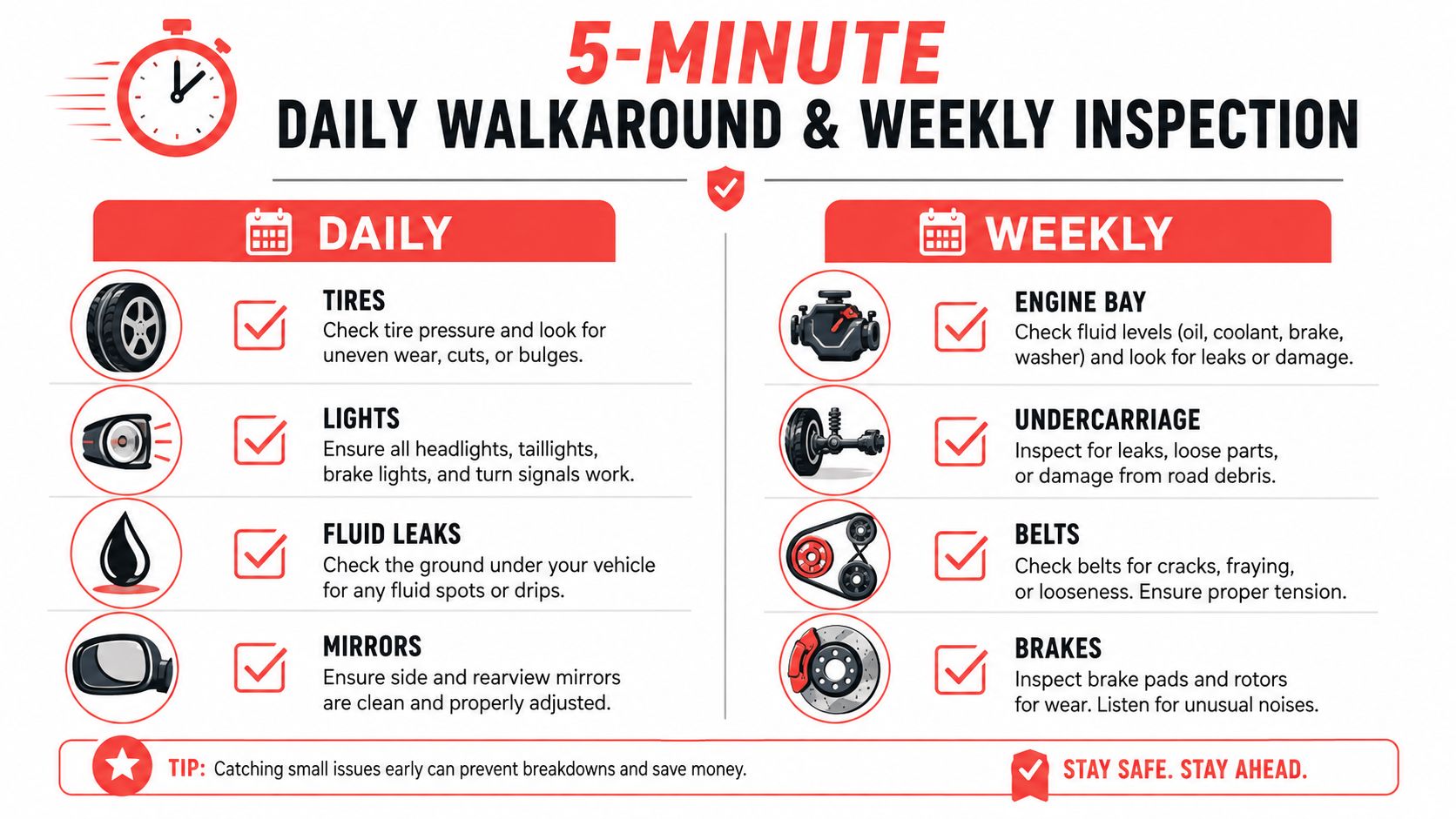
A practical daily routine should include:
- Tires and wheels: Look for visible damage, uneven wear, foreign objects, bulges, and signs of low pressure. Uneven wear deserves a maintenance note because it may point to alignment, suspension, or inflation problems.
- Lights and reflectors: Check headlights, brake lights, turn signals, marker lights, and reflectors. Have another person confirm rear lighting when the vehicle design makes solo checking unreliable.
- Leaks and levels: Look under the vehicle for fresh fluid and inspect accessible oil, coolant, and washer-fluid levels according to the manufacturer's procedure.
- Brakes and air systems: Confirm the service and parking brake operate properly. Drivers of air-brake vehicles should follow the required inspection procedure and report abnormal pressure behavior or leaks.
- Mirrors and glass: Clean mirrors, check for damage, and make sure the windshield and wipers provide clear visibility.
- Emergency equipment: Confirm required warning devices, first-aid supplies where applicable, fire equipment, and other assigned safety gear are present and secured.
- Cab condition: Remove loose objects, note damaged controls, and report odors or contamination that could affect the driver's working environment.
A defect should have a status, not just a comment. Mark it as safe to monitor, schedule for service, or hold out of service pending inspection. Drivers shouldn't make technical judgments beyond their training, but they must report conditions that could compromise safe operation.
Driver standard: If the defect affects steering, braking, visibility, wheel security, or required safety equipment, stop and escalate it before departure.
Canadian operators should pay close attention to trip-inspection rules. A separate Canadian commercial vehicle trip-inspection regulation requires each commercial vehicle to be inspected at least once every 24 hours. A motor coach with air ride suspension, air brakes, and automatic brake adjusters must also be inspected by a licensed technician at least every 30 days or every 12,000 km, whichever comes first, under the Canadian commercial vehicle trip-inspection regulation.
The weekly check catches patterns
The weekly review is where the team looks beyond immediate road readiness. Inspect belts, hoses, battery connections, accessible wiring, fluid condition, underbody areas, brake components, and signs of corrosion. Review the prior week's reports for repeated tire wear, recurring warning lights, hard starts, HVAC complaints, or doors and latches that no longer operate correctly.
Digital forms can make accountability easier when they allow required fields, photos, timestamps, and automatic escalation. A small fleet may use a shared maintenance platform, while a larger operation may integrate inspection records with telematics and work orders. Runera's checklists feature offers one example of how teams can standardize recurring checks without relying on loose paper forms.
Use the same inspection logic for cleanliness. A cab with spilled drinks, embedded mud, pet hair, or persistent odor should be flagged for professional attention, especially if multiple drivers share the vehicle. That keeps appearance issues from becoming customer complaints and gives the detailing vendor enough notice to plan the correct treatment.
Cleaning Detailing and Odor Control as Maintenance Essentials
A commercial vehicle's condition tells you what a basic inspection can't. Dirt can hide leaks, salt can remain trapped around seams and undercarriage areas, and a neglected interior can make drivers less likely to report problems or keep the cab orderly. Professional detailing supports maintenance because it improves visibility, protects surfaces, and makes defects easier to identify.
Exterior washing should remove road film, salt, oils, and job-site grime with commercial-grade products and safe contact methods. A professional detailer will select the process according to the surface, contamination, weather, and finish. Household degreasers, abrasive pads, and improvised mixtures can stain trim, dull paint, damage coatings, or force water into areas that should stay protected.
Use the right workflow for the vehicle
A fleet wash isn't just a quick spray and rinse. The process should include an inspection, appropriate pre-rinse or foam treatment, safe hand contact where needed, wheel and lower-panel attention, thorough drying, and a check for remaining contamination. Interior work should follow the material, not the stain alone. Fabric, vinyl, rubber, plastics, and leather-like surfaces each require suitable products and controlled moisture.
Engine-bay cleaning also needs restraint. Sensitive electrical components, connectors, intake openings, and exposed sensors shouldn't receive uncontrolled water pressure. A professional workflow uses appropriate protection and low-risk methods, followed by drying and inspection.
Headlights deserve maintenance attention because hazing reduces light output and affects the vehicle's professional appearance. Restoration should use an approved process that removes oxidation and applies suitable protection. Replacing or restoring a light based on its condition is a technician's decision, especially when damage exists below the lens surface.
Treat odors instead of covering them
Air fresheners and masking sprays don't solve the source of an odor. Food residue, damp carpet, mildew, smoke, biological contamination, and pet accidents require different cleaning and extraction decisions. Start with source removal, vacuuming, appropriate fabric or hard-surface cleaning, and drying. If the odor remains, a professional-grade treatment such as Bio Bomb can address the cabin more effectively than layering fragrance over contamination.
The service frequency should match the job. Landscaping, construction, food delivery, medical transport, and pet-related work can soil interiors and exteriors in different ways. Winter salt deserves early attention, while spring is a good time to remove accumulated residue and inspect the lower body for corrosion or damage.
Cleanliness is diagnostic: A clean wheel, tire, step, and underbody area makes new leaks, cracks, and abnormal wear easier to spot.
Mobile service is especially useful for small fleets because the vehicle can be cleaned at the facility instead of being driven to a shop and collected later. Coordinate detailing with parked hours, driver changes, fueling, or scheduled inspections. The mobile fleet washing service guide can help owners think through on-site scheduling and service scope.
For Central Pennsylvania businesses, The Mobile Buff provides exterior washes, interior detailing, engine-bay cleaning, stain and pet-hair removal, Bio Bomb odor elimination, and headlight restoration. Fleet managers can also structure recurring care for 3 or more vehicles, allowing appearance work to fit the same planning mindset as mechanical service.
Recordkeeping Cost Tracking and Vendor Coordination Made Simple
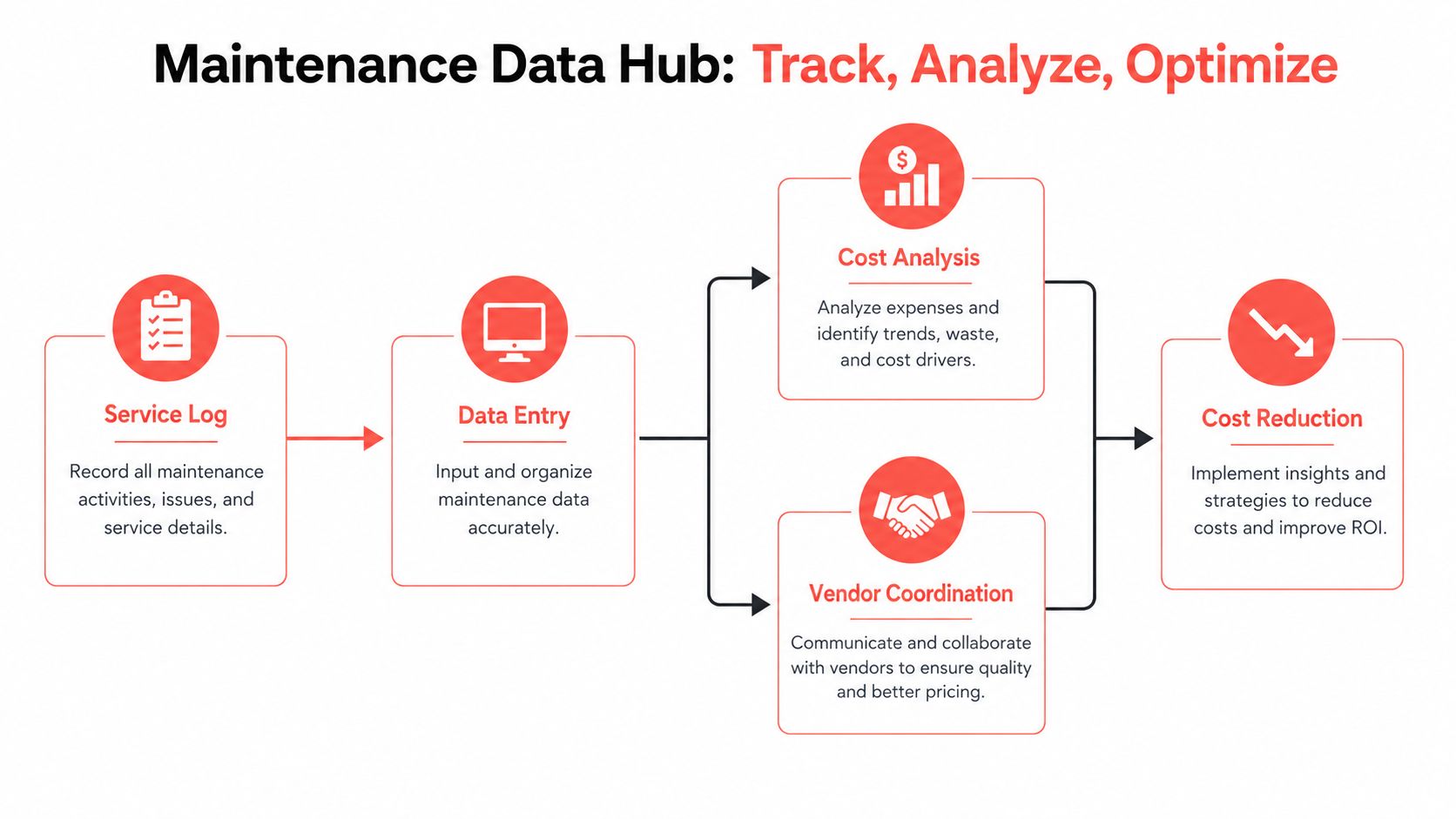
Good records let a fleet manager answer operational questions without searching through scattered invoices. Which vehicle keeps missing service? Which route produces repeated tire or brake complaints? How long does each defect remain open? Is lost operating time caused by repairs, parts delays, diagnosis, approvals, or scheduling?
Create one record for every service event. Include the vehicle identifier, date, mileage or engine hours, reported defect, inspection result, work completed, parts or materials used, vendor, invoice, time out of service, and resolution date. Add route and duty cycle details when they explain different wear patterns between similar vehicles. Use the same vehicle identifiers across inspection forms, fuel records, work orders, and invoices.
Measure downtime against planned use
A useful maintenance measure compares unavailable time with planned operating time, then reviews the result by vehicle class. The U.S. Department of Transportation benchmarking approach defines downtime as hours unavailable because of maintenance or repair. It sets target downtime at 2 to 4% for medium and heavy vehicles and 6 to 8% for specialized vehicles, as described in the fleet maintenance performance benchmark.
Apply the calculation the same way each month:
- Record maintenance events that occur during planned operating time.
- Add the unavailable hours.
- Divide downtime hours by planned operating hours.
- Review the result by vehicle class, route, and duty cycle.
Keep scheduled service inside the planned-availability window. Removing those hours makes the fleet appear more available than it really was. Repair counts also need context. A major failure, a planned inspection, and several quick repairs should not be treated as equal events.
Pair maintenance data with vendor decisions
Track miles between unscheduled events, maintenance-related downtime events, parts turnover, and issue-resolution time. The goal is to identify where a vendor, approval process, parts order, or diagnostic step is holding a vehicle. Review open work orders by age and assign a clear owner for the next action.
Choose vendors according to the work. Mobile detailing can be completed at the lot while a van is parked, reducing unnecessary trips and keeping scheduled cleaning aligned with inspections or driver changes. Mechanical diagnostics, brakes, suspension, and regulated inspections require qualified technicians and approved repair facilities. Require each vendor to return a readable service record, identify deferred work, list parts or materials used, and state what should be checked next.
Fuel records belong in the same operating file. A consistent process to manage vehicle fuel receipts connects fuel spending with the vehicle, driver, route, and maintenance history. Store invoices and work orders electronically, then review unresolved defects on a fixed schedule.
For detailing decisions, compare scope rather than selecting only the lowest quote. The fleet detailing prices guide helps organize discussions around vehicle size, contamination, interior condition, headlight restoration, odor treatment, and recurring service frequency. Clear scope makes vendor invoices easier to compare and helps keep cleaning work from becoming an unplanned source of downtime.
Keep Your Fleet Rolling Longer With Less Downtime
A van that starts each shift clean, inspected, and properly scheduled gives a small fleet more usable working time. The program depends on repeatable actions: drivers check vehicles before use, managers assign defects, technicians follow approved procedures, and vendors complete work while vehicles are already parked.
Fleet benchmarking has associated scheduled preventive maintenance with about 20% fewer maintenance-related downtime days than non-PM operations. The finding supports a practical conclusion: planned service usually costs less disruption than waiting for a failure. Results still vary with vehicle age, workload, weather, and how quickly the team closes reported defects.
Make consistency the advantage
Keep the process manageable:
- Act on small defects: Document the decision for every warning light, soft tire, damp carpet, or unusual odor.
- Schedule by actual use: Combine mileage, engine hours, duty cycle, manufacturer guidance, and inspection findings.
- Protect the vehicle between repairs: Professional washing removes damaging contamination and makes fresh leaks or body damage easier to spot.
- Use alerts carefully: Let telematics prioritize verified conditions, rather than triggering unnecessary parts replacement or shop visits.
- Review the numbers: Track downtime percentage, resolution time, miles between unscheduled events, and repeat defects to identify the next improvement.
Cleanliness supports inspection discipline. Drivers notice leaks, damaged trim, and new smells more readily when the cab is orderly. Managers can schedule interior detailing, odor elimination, exterior washing, and headlight restoration at the facility, avoiding a separate trip for appearance work.
Central Pennsylvania owners and small fleet managers can arrange seven-day mobile service from 7am to 3pm through The Mobile Buff's Google Business Profile. Driveway and lot visits cover washes, interior detailing, odor elimination, and headlight restoration. Electronic billing is completed after service.
If your vans or work trucks need scheduled washing, interior detailing, professional Bio Bomb odor elimination, or headlight restoration at your driveway or lot, visit The Mobile Buff to request service. Put cleaning and appearance work on the same calendar as inspections, then keep the records with the vehicle's maintenance history. That routine helps vehicles stay ready for the next route.

