


The popular advice says a hand car wash is simple to buy: find a busy site, review the revenue, check the equipment, and apply a familiar multiple. That advice misses the part that determines whether you'll own a profitable operation or an exhausting job with expensive overhead. Labor hours per vehicle, realistic throughput, wastewater controls, and service mix matter more than a polished listing or a recently installed pressure washer.
A hand car wash for sale can be a strong acquisition, but only when the numbers reflect how the business runs. The buyer who counts cars, staffed hours, ticket size, and usable capacity will usually outperform the buyer who falls in love with gross sales.
Why Most Hand Car Wash Listings Mislead Buyers
A listing highlights annual revenue, visible equipment, lease terms, and location because those details are easy to sell. They do not answer the question that determines your return: how much cash remains after the labor required to produce every wash? A high sales figure can conceal a low-throughput process, excess staffing, or an owner working unpaid hours.
The industry has established demand. The International Carwash Association has estimated roughly 79,500 car wash locations across North America, more than 2 billion cars washed annually, and about $15 billion in retail sales, in an industry summary published by National Oil & Lube News. The sector grew 47% between 1994 and 2014, and commercial car washing dates back to 1914 in Detroit, Michigan. Those facts support the category. They do not validate the margins, staffing model, or asking price of one hand wash.
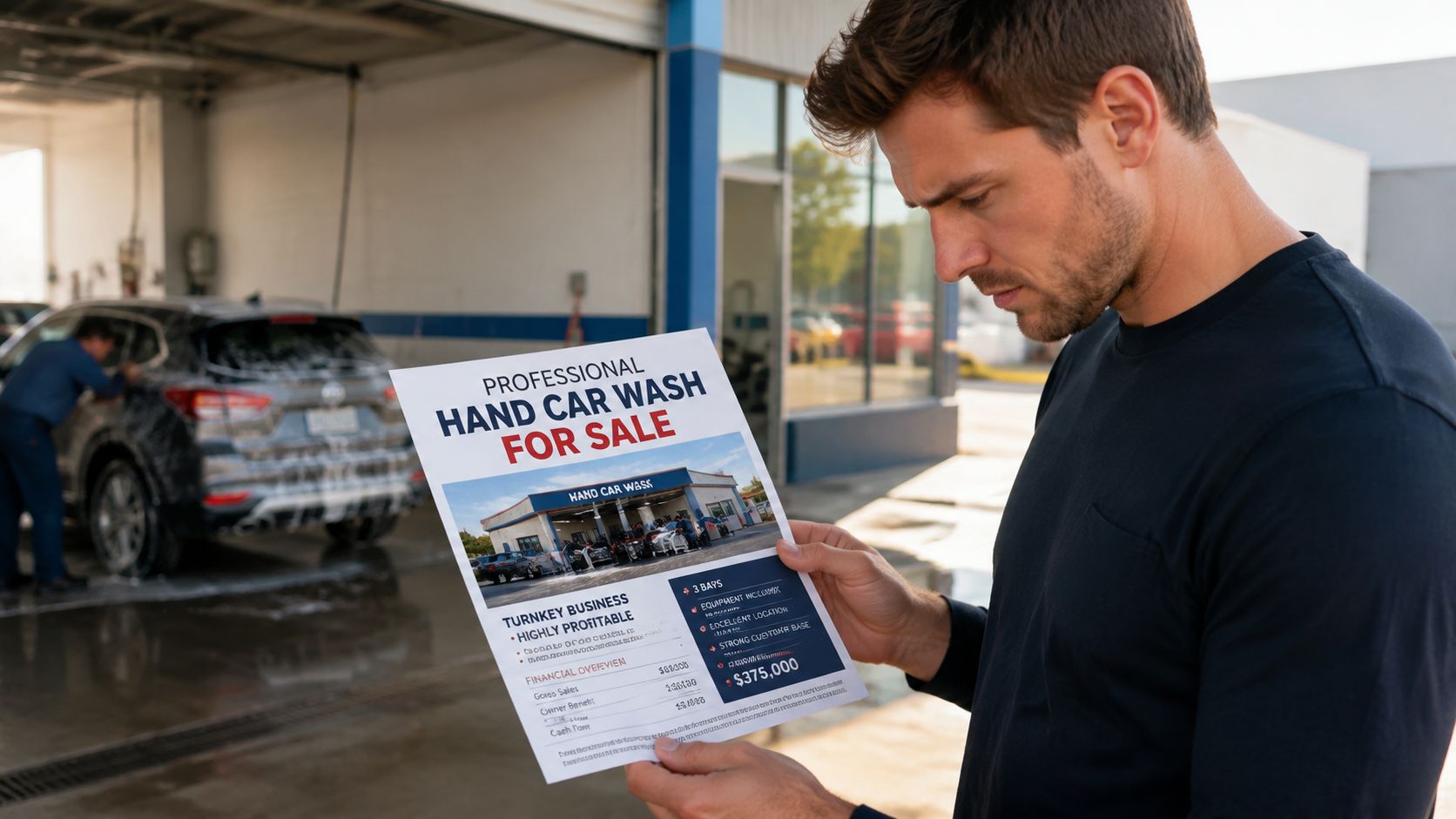
Revenue hides the staffing equation
Hand washing is a labor sequence. Greeting, inspection, pre-rinse, washing, drying, interior work, quality control, and vehicle movement each take time. Count the minutes and staffed positions required for each package. If the seller's revenue depends on employees you cannot recruit or retain, that revenue may vanish after closing.
Full-service sites commonly report net margins of only 10% to 25%, while an attended operation generally needs roughly 35% or more to be considered strong, according to industry margin guidance. Full-service labor can consume about 35% to 50% of operating cost and around 35% to 40% of revenue in mature operations. A buyer who ignores those hours can pay for revenue that does not convert into owner cash flow.
Broker's rule: Never underwrite a hand wash from seller revenue alone. Underwrite the staffed hours needed to produce that revenue.
Location is more than visibility
A roadside site can still underperform if vehicles cannot enter, queue, circulate, or exit without friction. Examine vehicle density, nearby competitors, traffic patterns, weather exposure, parking limits, and the number of cars the site can process during its busiest periods.
Industry guidance identifies 27% of new car wash businesses failing within three years, with 58% of failed operators blaming underestimated capital requirements and 41% citing poor location, as reported in car wash business planning guidance. Treat those figures as a warning to test assumptions, not as proof that any listed business will fail.
Before making an offer, review the guide to the first 90 days as a car wash. Your acquisition plan should account for staffing, customer retention, and uninterrupted operations from the first day.
Building a Realistic Financial Model Before You Make an Offer
Model the operation before you discuss the asking price. Your first worksheet should show cars washed per day, average ticket, service mix, days open, and the staffed hours required for every package.
Use this formula:
Cars per day × average ticket × operating days = wash revenue.
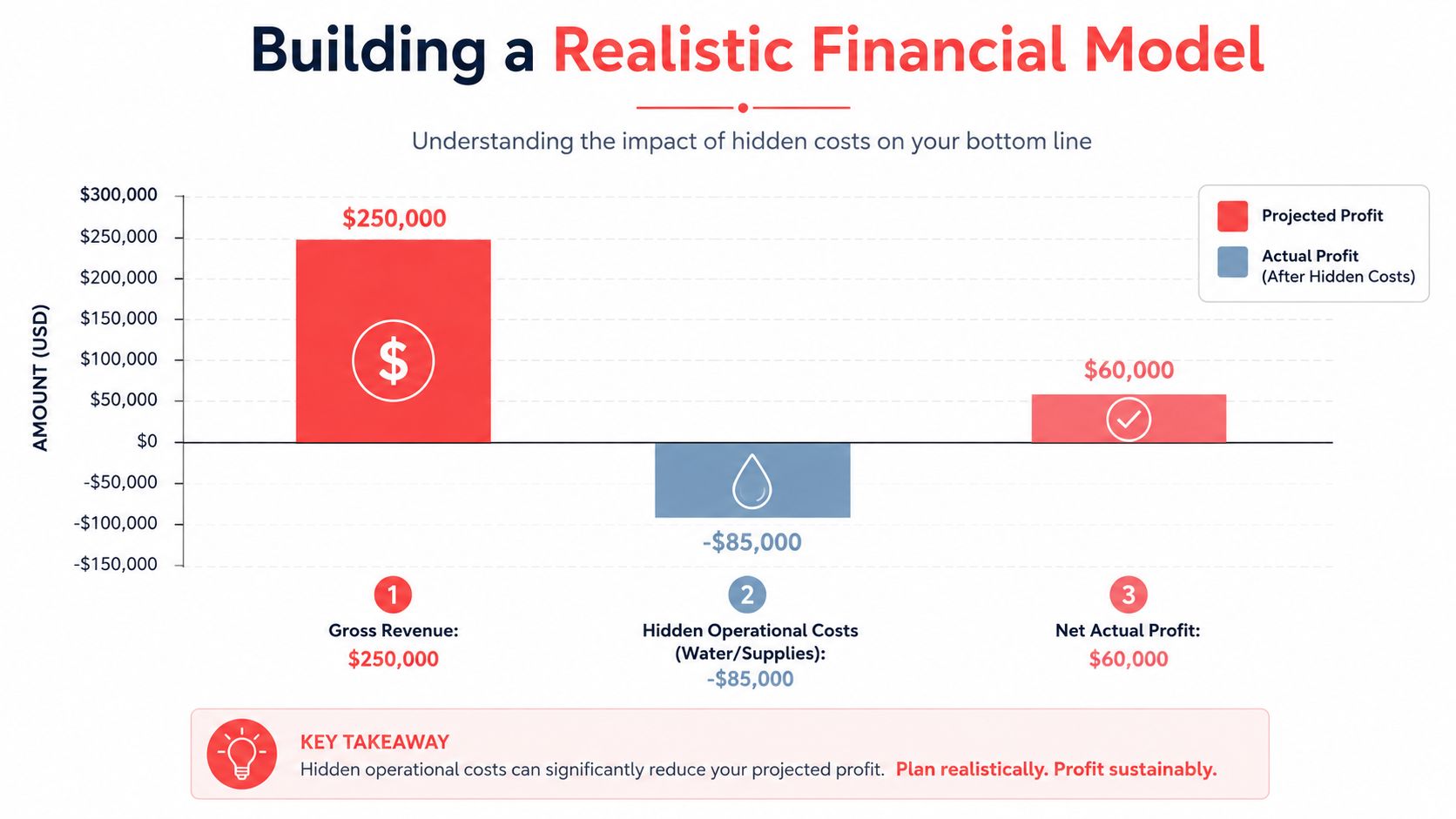
Revenue is only the starting point. Test whether the site can sustain that volume and whether employees can process it without turning sales into payroll. Build conservative, expected, and strong-demand cases. For each case, include labor, supplies, rent, insurance, utilities, merchant fees, repairs, taxes, and owner compensation.
Labor is the variable that deserves the most scrutiny
Labor deserves a separate schedule, not a single expense line. A feasibility review places hand-wash labor roughly between 30% to 40% of revenue, with some practitioner benchmarks near 39%, as discussed in this feasibility comparison.
Request the seller's staffing schedule by day and shift, then reconcile it against payroll records. Calculate staffed hours per car and by service type. That measure exposes weak pricing quickly. A premium package can support more labor, while a low-price wash requires faster cycle times and consistent repetition. If the seller cannot show how hours produce completed cars, the forecast is incomplete.
Review the service menu against actual work time. A package that appears profitable at the ticket level may lose money after interior detailing, stain removal, pet-hair work, or rework is included. Price alone does not reveal contribution margin.
Use benchmarks as a question, not a substitute for records
Industry benchmarks can challenge an aggressive forecast, but they cannot verify it. Ask for bank statements, point-of-sale reports, tax filings, payroll documentation, cancellation records, and daily vehicle counts. Reconcile those records before accepting the seller's revenue figure.
Review average ticket by service rather than relying on a blended average. A business that advertises premium work but mostly sells basic washes carries a different risk profile from one with documented add-ons. Compare the target's menu with local demand and labor time using hand car wash prices.
Build break-even from fixed costs plus variable cost per vehicle. Then compare the required volume with the site's queue length, wash-bay capacity, staffing plan, and busiest operating periods. If the business needs more cars than the property can physically queue or the team can complete, walk away or reprice the deal. An asking-price multiple cannot repair a throughput problem.
Inspecting Equipment and Operations Before Committing
A site visit should feel less like a tour and more like an audit. Run the pressure washers, inspect hoses and reels, test vacuums, examine electrical connections, and ask who maintains each major system. Equipment that works during a ten-minute visit may still fail under a full operating load.
Check the physical systems
Request service records, invoices, manuals, warranties, replacement history, and any equipment leases. Look for cracked hoses, leaking fittings, worn spray guns, damaged flooring, corroded plumbing, poor chemical labeling, and storage areas exposed to weather or vehicle traffic.
The water system deserves special attention. EPA WaterSense guidance reports that self-service vehicle washing averages 15.0 gallons per vehicle, while conveyor washes averaged 30 gallons per vehicle in a 2018 study and 34 gallons in a 2002 study, as documented in EPA vehicle-wash guidance. A hand wash may use a different process, so don't borrow a benchmark blindly. Ask for meter readings, utility bills, reclaim-system maintenance, and evidence that the system performs as represented.
Confirm drainage and wastewater compliance
Wastewater isn't an administrative footnote. UK commercial vehicle-wash guidance recommends directing wastewater from a dedicated, non-permeable area to a foul sewer through an interceptor or silt trap, with drainage plans available. Where a foul-sewer connection isn't possible, the guidance calls for a collection unit and regular emptying by a registered waste collector, as outlined by the UK Parliament environmental audit guidance.
Local requirements vary, so have an environmental professional and the relevant authority review the site before closing. A peer-reviewed study found untreated wastewater discharges into waterways and daily consumption across seven monitored stations ranging from 2,395 liters to 15,480 liters per day, with the broader monitored industry using about 1,000 cubic meters of freshwater daily, according to the published study. Those findings reinforce the need for documented controls, not assumptions.
Use this video walkthrough as a visual prompt during your inspection, then organize financial, legal, operational, and environmental requests with these AmbitionCFO due diligence resources. If the fixed site needs major infrastructure work, compare its economics with a mobile car detailing trailer before committing capital.
Understanding Which Type of Hand Wash You Are Actually Buying
The label “hand car wash” tells you how the work is performed, not what the business sells. Two sites can both wash vehicles by hand while operating with completely different prices, staffing, customer expectations, and break-even points.
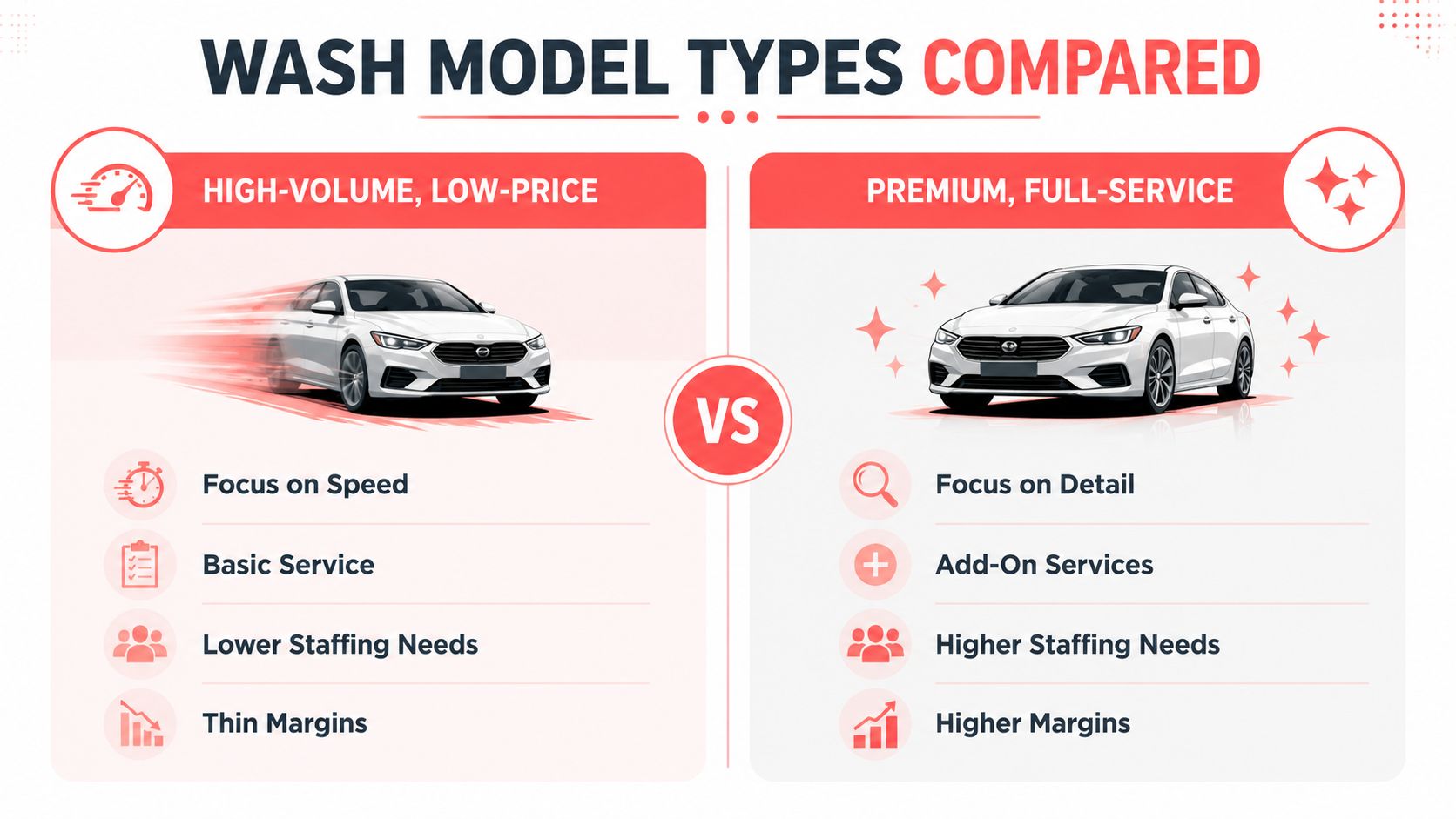
The volume model
A high-volume, low-price operation wins through fast service and repeat demand. Customers expect a consistent exterior clean, quick vehicle movement, visible value, and minimal waiting. The business needs disciplined positioning, short workflows, reliable staffing, and enough queue capacity to avoid turning busy periods into lost sales.
This model can work near dense traffic and price-sensitive customers, but it has limited room for waste. A small increase in staffed hours, rewash frequency, supply usage, or idle time can damage the result because the ticket is designed around speed and affordability.
The premium model
A premium, full-service operation sells attention. Interior cleaning, stain treatment, pet-hair removal, odor control, headlight restoration, paint-care services, and other add-ons can raise the average ticket, but they also increase production time and training demands. The buyer must verify that customers already purchase those services, rather than accepting a projection based on an attractive menu.
Research on hand car washes describes a wide divide between inexpensive exterior cleans and higher-priced full valets. UK evidence cited in worker research on hand car washes includes exterior cleans as low as £5 and full valets around £65. The point isn't to apply UK prices to another market. The point is that service time and price can vary sharply by package, so you must identify the actual operating model before valuing the business.
Fixed site or mobile operation
A fixed site offers roadside presence and a defined workflow. A mobile operation trades some spontaneous traffic for convenience, appointment control, and lower dependence on a single property. Compare the two using labor hours, travel time, equipment capacity, customer acquisition cost, and local demand.
Use a detailed hand wash versus machine wash comparison to clarify where manual service creates value and where mechanization may produce better throughput. Don't buy a premium business if the customer base only wants a cheap exterior wash, and don't force a volume model into a market that values careful, appointment-based detailing.
Negotiating Protections and Closing the Deal Safely
The asking price is only one negotiation term. A weak purchase agreement can turn a seemingly fair price into an expensive transfer of hidden liabilities.
Start by tying the offer to verified performance and physical condition. If pressure washers, reclaim equipment, drainage, vacuums, or electrical systems need replacement, quantify that work and adjust the price or require a seller-funded repair before closing. Don't accept vague promises that equipment is “in good working order.”
Protect the transition
Seller financing can keep the seller economically connected to the accuracy of the financial representations. If the seller refuses reasonable documentation but demands all cash at closing, treat that refusal as a risk signal.
A non-compete should be drafted by counsel for the relevant jurisdiction and should address the business territory and activities that could directly compete. Include transition support, introductions to key vendors, training on point-of-sale systems, and access to operating procedures. The agreement should also state what happens to customer records, phone numbers, digital accounts, signage, domain names, reviews, and service contracts.
Negotiation position: Pay for a transferable operating business, not for the seller's story about what it might become.
Don't let an earn-out replace diligence
An earn-out can align incentives when the seller stays involved, but poorly drafted terms create disputes over pricing, staffing, marketing, and accounting. Define the measurement method, reporting access, decision rights, payment dates, and treatment of refunds or owner expenses. If the seller can't explain the calculation clearly, remove it or have transaction counsel rewrite it.
Before wiring funds, obtain signed purchase documents, lien searches, tax and license confirmations, lease assignments, equipment ownership records, environmental documentation, insurance information, payroll records, and bank-supported revenue evidence. Walk away when the seller blocks ordinary verification, pressures you to skip inspections, or can't reconcile sales records with deposits and tax filings. A deal that collapses during diligence is cheaper than a deal that closes with undisclosed problems.
Your First 90 Days After Taking Ownership
Your first priority isn't a dramatic rebrand. It's operational stability. Keep the customer experience familiar while you learn where time, payroll, supplies, and rework are being consumed.
Days one through thirty
Meet every employee individually and explain what will stay consistent, what will change, and how you'll measure quality. Retain reliable staff where possible, verify work authorization and payroll records with professional guidance, and document the actual workflow from vehicle intake to delivery.
Watch the operation during slow and busy periods. Record where cars wait, where employees walk, which services create bottlenecks, and when quality checks happen. Review daily sales by package, refunds, rewashes, labor hours, supply usage, and customer complaints. Don't change pricing until you understand the current conversion and capacity.
Days thirty-one through sixty
Standardize professional procedures. Use commercial-grade products according to manufacturer instructions, color-coded microfiber systems, labeled dilution bottles, proper chemical storage, and a documented hand-wash process. Avoid home remedies or improvised techniques that can damage paint, trim, glass, or interiors.
Introduce quality checks that supervisors can perform quickly. A clean vehicle delivered late or with missed areas still creates a poor customer experience. Train employees on consistent inspection, safe vehicle movement, interior protection, and clear communication about add-on services.
Days sixty-one through ninety
Test local marketing around the services your operation can deliver profitably. Build accurate Google Business Profile information, request reviews from legitimate customers, improve service descriptions, and create partnerships with nearby offices, apartment communities, dealerships, and fleet operators. Market the actual capacity you have, not the volume you hope to achieve.
Evaluate mobile expansion only after the fixed operation is stable. In Central Pennsylvania, The Mobile Buff serves Harrisburg, Mechanicsburg, Carlisle, Newport, and surrounding areas in Dauphin and Perry counties with mobile exterior washes, interior detailing, engine bay cleaning, stain and pet-hair removal, Bio Bomb odor treatments, and headlight restoration. Its model shows how a professional hand-wash experience can be delivered at a customer's location, but you still need to test travel time, scheduling density, equipment needs, and local demand before adding a mobile unit.
First-quarter objective: Build a repeatable operation that another trained person can run without relying on your constant presence.
The Mobile Buff provides professional mobile hand washes and detailing in Central Pennsylvania, including interior and exterior care, odor treatment, stain and pet-hair removal, and headlight restoration. If you're evaluating a hand car wash for sale or need dependable vehicle care without a shop visit, book through The Mobile Buff and choose the service package that fits your vehicle.

