


You're in a Harrisburg driveway at 7:15 on a damp Saturday, the hose won't quite reach the far side of the SUV, and the homeowner still wants the interior done before lunch. That's the kind of job a mobile car detailing trailer is built for, a self-contained setup that brings the wash bay to the customer instead of asking the customer to come to you. In a growing on-demand market, that model isn't a side hustle curiosity. It's part of a category that Future Market Insights says was worth USD 126.3 billion in 2025 and is projected to reach USD 306.6 billion by 2036 (Future Market Insights).
What a Mobile Car Detailing Trailer Really Is
A Saturday morning in Mechanicsburg usually tells the story faster than any definition. A car sits in the driveway, the owner wants the paint corrected, the kids' crumbs vacuumed out, and the whole thing finished without leaving home. A mobile car detailing trailer is the rig that makes that possible, a towed, self-contained service unit that carries the water, power, air, chemicals, and tools needed to perform professional detailing on-site.
The customer still gets the same core result as a fixed bay, clean paint, cleaned interior, finished trim, and restored presentation, but without drop-off and pickup. That can include exterior wash, interior deep clean, engine bay cleaning, headlight restoration, odor work, and other on-site services that fit the route and the setup. For a practical overview of how mobile detailing is framed as a service, this explanation of mobile car detailing lines up with what operators deliver in the field.
Practical rule: if the trailer can't work without the client's hose or outlet, it's not really mobile. It's just a shop kit on wheels.
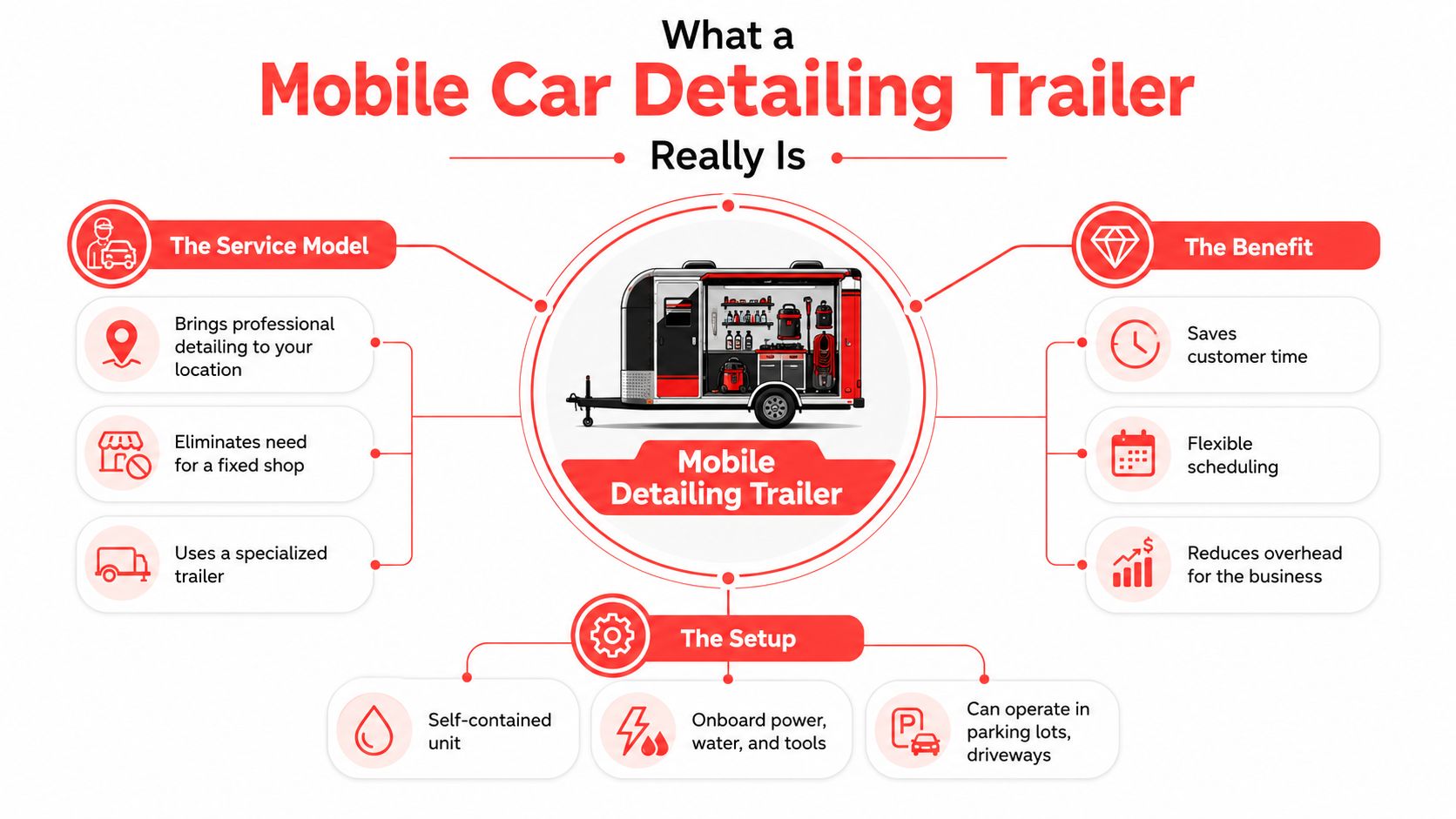
A trailer is a self-contained workflow, not just a box
People shopping for enclosed cargo often start by looking at shell size, then realize the shell is only the beginning. If you want to browse enclosed trailers at Van Dyke, that is a useful place to see the format before you think about water, power, and storage.
The trailer itself is one piece of the business model. The value comes from the way the rig packages the service so one person can pull into a driveway, set up quickly, and complete a professional clean without depending on the homeowner's utilities. That service model is why the setup needs to be planned around the job, not just the trailer shell.
A trailer-based operation usually feels more like a rolling workstation than a vehicle. The best ones are organized around three connected systems, power, water, and workspace. If any one of those is weak, the whole route slows down.
The Power and Water Balance Inside a Trailer
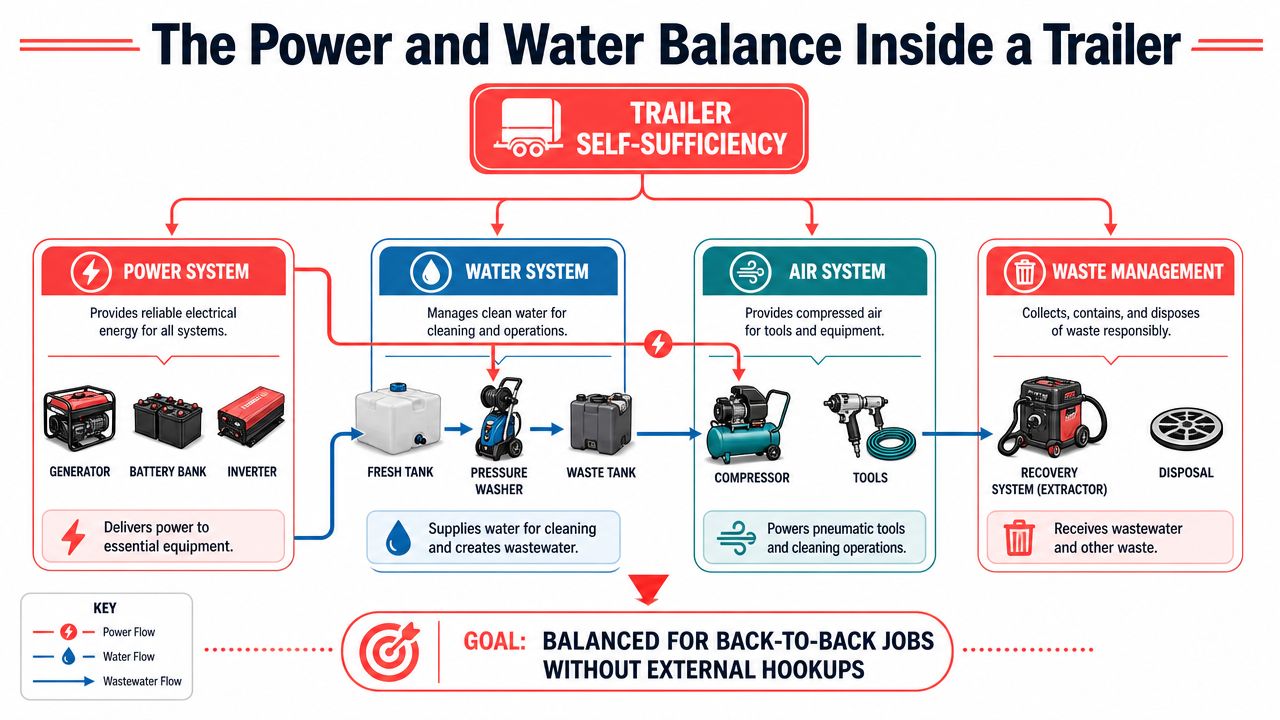
A mobile rig lives or dies by utility balance. A pressure washer only works if the trailer can power it, a water tank only works if the system can move water efficiently, and interior work stays profitable only if extraction, drying, and cleanup do not eat the clock. In one mobile-rig build example, the operator includes both an electric pressure washer and an air compressor as core tools, which is what self-contained work requires (Dream Machine Detailing).
Think in systems, not shopping lists
A trailer works like a small kitchen. The stove, sink, fridge, and storage do not matter separately if the plumbing and wiring cannot support them. In the same way, a professional trailer needs a water system, a power system, an air system, and a plan for waste management so it can handle back-to-back stops.
A practical baseline from detailing equipment guidance is simple. Efficient setups are described as using about 10–15 gallons of water per wash, with a 50–100 gallon tank commonly recommended for solo operators and a 1,500–2,000 PSI electric pressure washer paired with a 12V pump (Detailing Web Studio). That combination shows the economics of the rig before you even pick a trailer shell, because water storage, pump choice, and power supply all determine how many jobs you can run before refilling or reconfiguring.
A trailer that forces constant refills or repeated cable swaps burns time, and time is what eats route profit.
The job sequence has to match the hardware
A trailer is not just for rinsing paint. Mobile detailing usually follows a full on-site cleaning sequence, exterior wash, bug and tar removal, wheel and tire cleaning, safe hand-drying, clay decontamination when needed, then wax or paint sealant for gloss and protection. Interior work can add vacuuming, brushing vents, wiping hard surfaces, sanitizing touchpoints, stain extraction, leather conditioning, odor neutralization, and engine-bay dusting.
That sequence works only if the trailer supports it in order. Water feeds the wash stage, air helps with drying and detail cleanup, and storage keeps chemicals, towels, and tools within reach. If the layout makes the operator walk back and forth across the lot, the trailer looks professional but performs like a bottleneck.
If you want a practical gear reference, a mobile car detailing kit should line up with the same workflow instead of fighting it.
Outfitting Checklist for a Working Trailer
The shell matters, but the workhorse parts inside it matter more. A trailer can look finished on the outside and still waste money if the layout is clumsy, the tools are underpowered, or the storage forces constant repacking at each driveway. That's why commercial detailing trailers are often sold as fully stocked systems, because uptime and payload efficiency matter more than the shell itself (Right Look).
What earns space and what doesn't
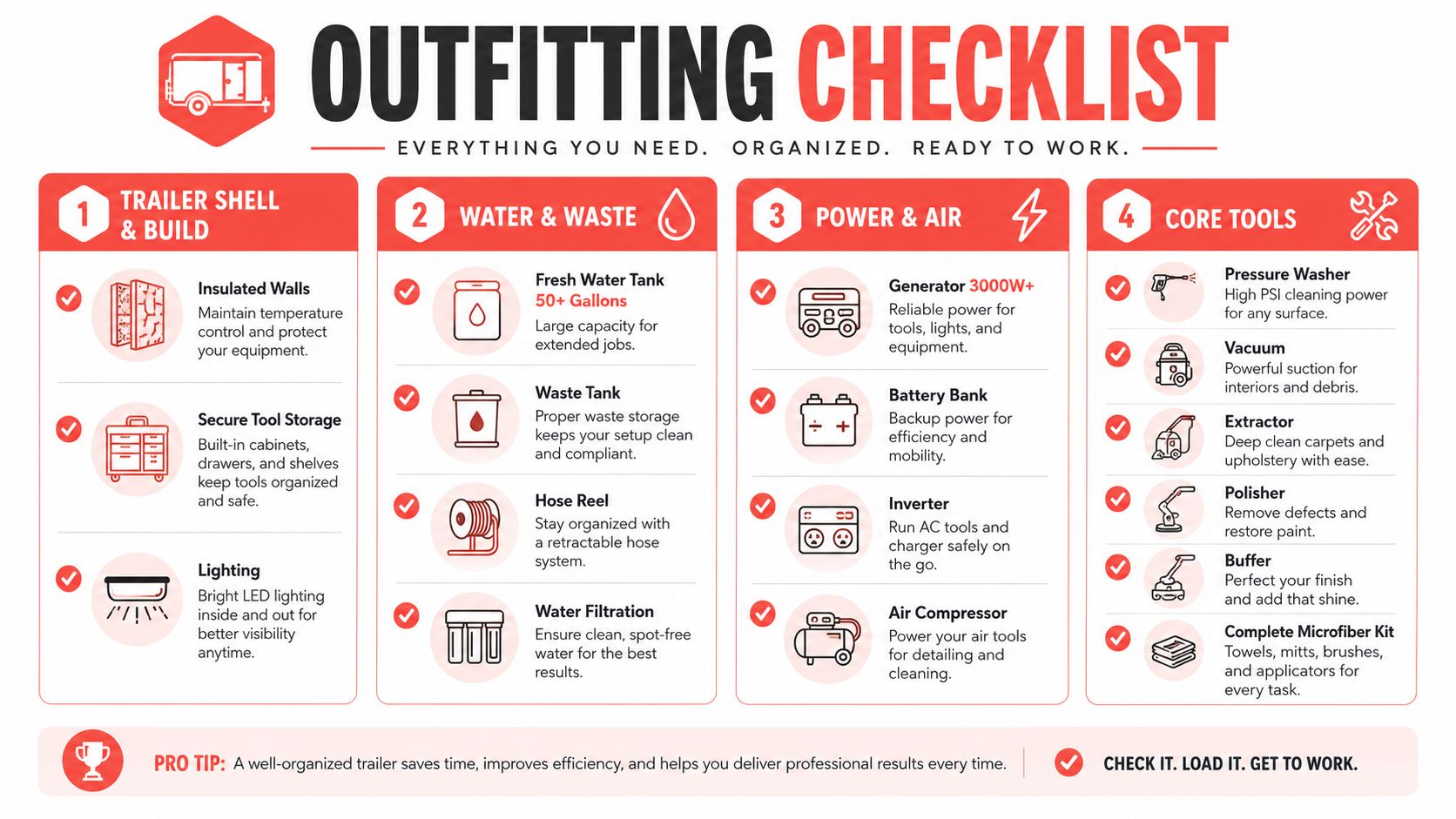
The equipment list should be built around repeatable service, not novelty. A practical build starts with a secure trailer shell, then adds water storage, pressure washing capability, vacuum and extraction, power and air, lighting, hose reels, chemical storage, and safety gear. Each item has a job to do, and if it doesn't speed up setup or improve consistency, it usually doesn't deserve floor space.
- Trailer Shell and Build: Insulated walls, secure tool storage, and interior lighting help protect equipment and keep early-morning setups workable.
- Water and Waste: A fresh-water tank, waste handling plan, hose reel, and filtration keep the rig usable across mixed job sites.
- Power and Air: Generator support, battery storage, inverter capacity, and an air compressor let the trailer run without relying on the customer.
- Core Tools: Pressure washer, vacuum, extractor, polisher, buffer, and microfiber kit cover the actual detailing sequence.
The outside shell should be sturdy enough for daily towing, but the key decision is how quickly the rig can reset for the next stop. That's why a purpose-built trailer often beats a clever home-built layout, especially once the route gets busy.
For a practical view of the gear side, this mobile car detailing kit overview is worth comparing against your own shopping list before you buy duplicate tools you'll never unload.
Turnkey rigs save setup time
A stocked trailer is really a time-management tool. One operator can step into a driveway, open the rear access, and begin service without unloading half the business first. That matters because every extra minute of setup and teardown reduces the number of houses or fleet stops you can cover in a day.
Working rule: buy for repeatability, not for the feeling of having more stuff.
If a component doesn't reduce friction on the route, it becomes dead weight. The best outfitted rigs are organized so the tools used most often are the easiest to reach, and the heaviest items are mounted where they won't shift under towing stress.
Real Costs and ROI Per Job
A trailer build starts paying for itself only when each stop produces enough margin after fuel, water, power, chemicals, labor, and wear on the rig. A trailer that looks organized in the driveway can still bleed profit if it pushes you into the wrong mix of jobs or slows you down between houses.
Use the inputs that actually move profit
A solo operator in a mid-sized Pennsylvania market needs to price each service as a bundle of inputs. Water use is the clearest anchor, and a workable field range is 10–15 gallons per wash, with a 50–100 gallon tank giving enough capacity for mobile solo work. Once the water system is sized correctly, the next cost drivers are machine runtime, tow fuel, chemical use, and the minutes spent on site.
| Service Type | Water Use | Power Use | Typical Charge | Estimated Margin |
|---|---|---|---|---|
| Exterior wash | Low, usually within the lower end of the route range | Light to moderate | $75-$120 | 45%-55% |
| Interior detail | Low water, more labor | Vacuum and extractor load | $150-$250 | 50%-65% |
| Full detail | Route average or above | Highest combined demand | $250-$400+ | 55%-70% |
Those ranges are practical starting points, not a fixed menu. Vehicle condition, package depth, and how much time the stop takes all change the numbers. For a service menu and local framing, mobile car detailing near me prices is a useful comparison point, but the business rule stays the same, full-service work usually gives more room to recover labor and equipment costs than a quick stop.
Bigger isn't automatically better
A larger trailer can carry more water, more tools, and more spares, but that does not guarantee better returns. Bigger rigs can add towing stress, take up more space at the job site, and slow down parking in neighborhoods where driveways, alleys, or curb access are tight.
That matters on route work in Central Pennsylvania. In Harrisburg, a trailer can be awkward in tighter access spots. In Mechanicsburg or Carlisle, the same size trailer may work fine if the driveway and turnaround space cooperate. The profitable choice is the one that keeps setup short and keeps service consistent, not the one that holds the most gear.
Trailer vs Van for Mobile Detailing
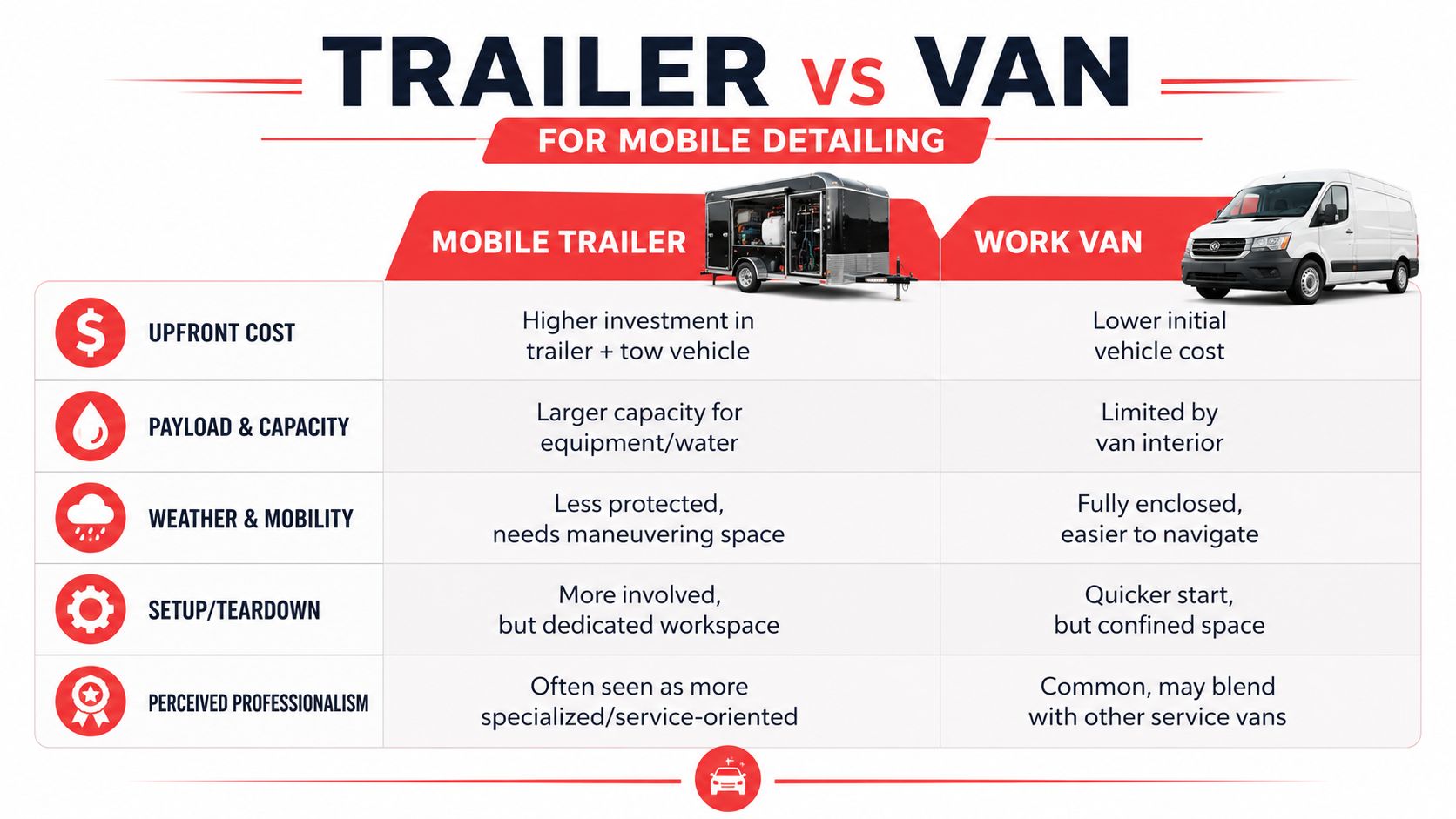
The trailer-versus-van question usually comes up after someone has already priced out a build and realized both options can work. The difference is in how they work day to day. A trailer separates the business from the tow vehicle, while a van integrates everything into one enclosed unit, and that changes how you handle weather, parking, payload, and setup.
What changes in the field
A trailer usually gives you more payload flexibility. That matters if you're carrying water, an extractor, an air compressor, extra chemicals, and a more substantial tool layout. A van is easier to tuck into narrow spaces and can feel simpler in neighborhoods where maneuvering room is limited, but its interior volume is finite and tied to the vehicle body.
Weather and site access are the other big trade-offs. A van keeps everything enclosed, which helps in bad weather and during winter transitions. A trailer is less protected, so the operator has to think harder about where it parks, how it opens, and how much working room is available at each stop.
In a tight Harrisburg row-home alley, the right choice may simply be the one that fits without turning the appointment into a parking problem.
The decision lens that actually helps
For higher-ticket full-detail routes and fleet work, a trailer makes sense because the dedicated workspace can support more gear and a more deliberate process. For quick wash volume in dense neighborhoods, a van often wins on speed and maneuverability. The best format is the one that matches your service mix, not the one that looks more impressive in a lot.
Permits, Wastewater, and Safety Basics
A trailer business still has to act like a real business. That means checking Pennsylvania licensing requirements, local zoning for your home base, insurance coverage, towing rules, and the way you handle wastewater before the first customer ever books. The polished parts of the business get attention, but the compliance side keeps the operation alive.
Keep the paperwork and disposal plan simple
Gray water isn't something to casually dump into a storm drain. Professional operators need a disposal plan, and the right answer usually involves onboard recovery or contained collection and proper off-site disposal, depending on the job and local rules. The point is to avoid treating wastewater like runoff from a backyard rinse.
Commercial auto and general liability coverage belong on the same checklist as the equipment buy. Towing also needs to be safe and legal for the tow vehicle and trailer combo you're planning to run. If the trailer is too heavy, overloaded, or poorly balanced, the business starts with avoidable risk before the first wash bucket is opened.
Safety habits should be built into the rig
A safe rig is easier to run than a chaotic one. Keep chemical storage secured, fasten heavy items so they don't shift, and use lighting that lets you work without guesswork when the day runs long or the driveway is shaded. You also want clear walk paths around the trailer so hoses and cords don't become trip hazards.
- Secure chemicals: Keep product bottles upright and restrained during transport.
- Control electrical load: Don't overload the trailer's power setup.
- Manage slip risk: Wet surfaces need attention, especially on sloped driveways.
- Document disposal: Keep notes on how wastewater is handled by location and service type.
That's the unglamorous part of being professional, but it's what keeps repeat work possible.
Bringing Professional Detailing to Your Driveway in Central PA
In Central Pennsylvania, a solid trailer setup means the detailer arrives with water, power, and the right tools already sorted, so the job starts on time and stays on track. That matters on driveways in Harrisburg, Mechanicsburg, and Carlisle, where one stop may have easy parking and another may leave little room to work around a car, a garage, or a narrow apron. A good rig lets the crew keep pressure consistent, extract properly, and finish the work without leaning on the homeowner for a hose, outlet, or backup plan.
The service menu is usually straightforward when the trailer is set up for real work. Customers tend to ask for exterior wash, full interior detailing, engine bay cleaning, stain and pet hair removal, odor elimination, and headlight restoration. Convenience matters too, especially when appointments are offered from 7am to 3pm, seven days a week, because that fits household routines and fleet timing better than a fixed shop for a lot of local customers.
A provider's driveway routine tells you a lot. Pay attention to how they stage equipment, where they park, how they protect the work area, and whether they handle logistics without turning the visit into a problem for the customer. The gear, routing, and safety habits show up in the final result.
For local booking, check The Mobile Buff's Google Business Profile or their website to schedule a driveway appointment in Harrisburg, Mechanicsburg, Carlisle, Newport, or nearby Central Pennsylvania.
A CTA for The Mobile Buff.

