


If your idea of mobile car detailing supplies is a trunk full of spray bottles, one vacuum, two towels, and a lot of hope, you're not alone. That's how many people start. Then the first real job shows you what's missing. The wheel brush touched the paint bucket. The extension cord won't reach. The vacuum hose is buried under pads. You spend more time unpacking, refilling, and searching than detailing.
That's the difference between owning products and running a system. Professional mobile detailing isn't just about chemicals or shiny tools. It's about water, power, storage, contamination control, setup speed, teardown discipline, and having the right tool ready without thinking about it. The supplies matter, but the workflow matters more.
Beyond the Bucket A Pro's Mindset
Most amateur setups fail in the same way. They collect products one by one, often based on whatever looked good online, then try to force those products into a workday. The result is clutter, repeated motion, wasted water, and inconsistent finishes.
A professional rig works the other way around. The workflow comes first. Every bottle, brush, towel, pad, hose, and machine has a place because every one has a job. When the system is right, the detailer moves with less friction. That means fewer mistakes, faster setup, cleaner results, and less fatigue by the end of the day.
The reason this matters isn't small. The mobile car wash and detailing market is estimated at USD 136.9 billion in 2026 and projected to reach USD 306.6 billion by 2036, according to Future Market Insights' mobile car wash and detailing market outlook. In a growing service category like that, organized operators have an edge because mobile work rewards efficiency more than fixed-bay work does.
Practical rule: If you have to stop mid-job to find a towel, refill a sprayer, swap a dirty brush, or untangle a cord, your issue usually isn't effort. It's system design.
A solid mobile setup feels boring in the best way. You know where your wheel tools are. You know which towels touch glass and which never touch lower panels. You know how much water you can spend on a wash before the next stop. You know whether your power setup can support the tools you plan to run that day.
That's the mindset shift. Don't ask, “What products should I buy?” Ask, “What system lets me deliver clean, repeatable work on someone else's driveway without wasting motion?” That question leads to better supply decisions every time.
The Essential Mobile Detailing Checklist
A good supply list starts with job function, not brand obsession. You need tools for washing, drying, interior cleaning, chemical application, correction, protection, and organization. Then you need duplicates where contamination risk is high.
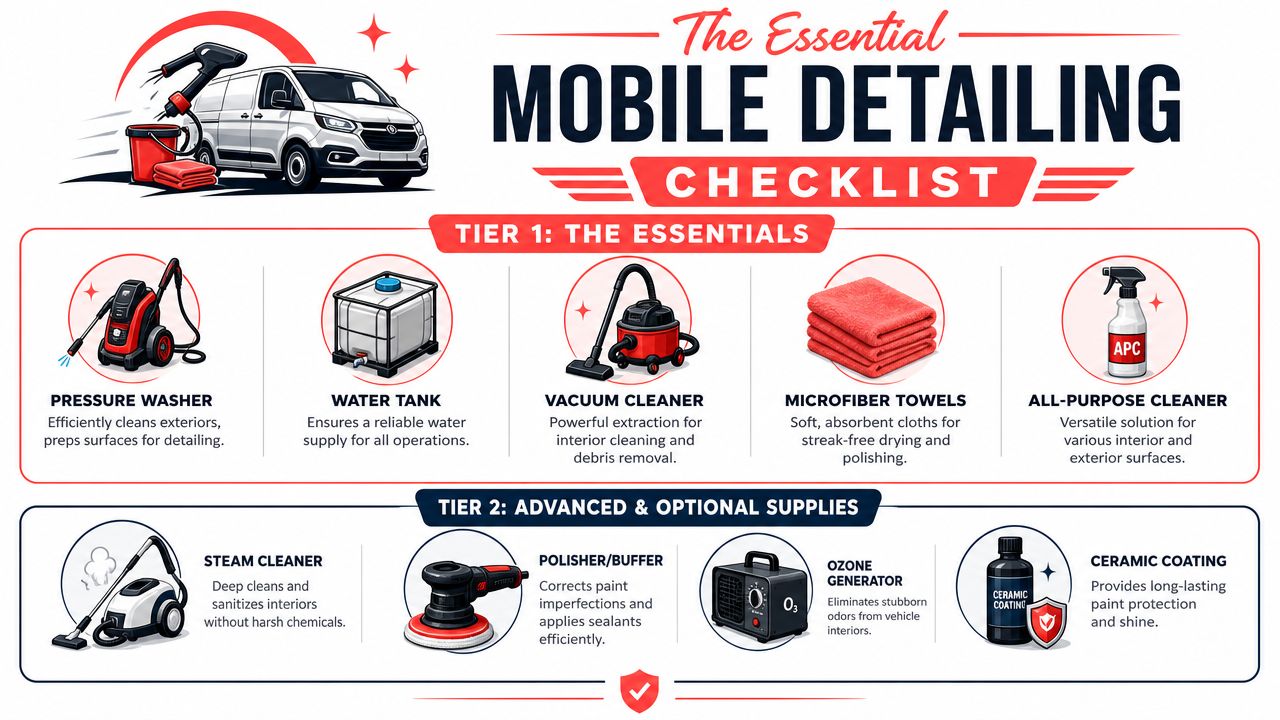
Tier 1 essentials
These are the supplies that make mobile work possible at a professional baseline.
- Pressure washer for efficient exterior cleaning and rinsing.
- Water tank so you're not dependent on the customer's spigot.
- Wet/dry vacuum or dedicated interior vacuum for dry soil, crevices, and trunk debris.
- Microfiber towels in separate groups for paint, glass, interiors, wheels, and dirty work.
- All-purpose cleaner for controlled interior and utility cleaning.
- Car soap and pre-wash products for safer wash stages.
- Wheel cleaner and wheel tools because wheels carry the heaviest contamination.
- Glass cleaner with dedicated towels that never cross over to greasy surfaces.
- Detail brushes in separate categories for interior vents, emblems, seams, and wheel faces.
- Buckets, sprayers, and applicators for wash and chemical handling.
One of the biggest beginner mistakes is trying to make one brush, one towel pile, or one pad set do everything. Professional guidance is clear that consumables should be standardized by function, and separate, color-coded brushes and pads for wheels, paint, and interiors help prevent cross-contamination that can lead to scratches and uneven results, as noted in Kleen-Rite's mobile detailing business checklist.
Dirty tools don't just slow you down. They transfer problems from one part of the vehicle to another.
Tier 2 upgrades
These aren't optional forever, but they usually come after the essentials are locked in.
- Dual-action polisher and pad system for paint enhancement and protection work.
- Extractor for fabric seats, carpets, and spill-heavy interiors.
- Steam cleaner for tight areas and selective interior cleaning.
- Air mover to speed interior drying and support odor work.
- Specialty chemicals like bug remover, dedicated wheel products, paint protectants, and targeted interior cleaners.
- Lighting for spotting residue, pet hair, and missed polish.
- Storage systems like bins, caddies, and labeled drawers.
If you're trying to build a supply list that matches the way pros think, this car detailing checklist from The Mobile Buff is a useful companion read.
Mobile detailing supplies essentials vs upgrades
| Item | Category | Tier | Why You Need It |
|---|---|---|---|
| Pressure washer | Exterior cleaning | Essential | Speeds up washing and improves pre-rinse consistency |
| Water tank | Water system | Essential | Lets you work independently on-site |
| Vacuum | Interior cleaning | Essential | Removes dry debris before deeper interior work |
| Microfiber towels | Consumables | Essential | Different towel groups protect different surfaces |
| All-purpose cleaner | Chemical | Essential | Handles many standard interior and utility tasks |
| Wheel brushes | Wheel cleaning | Essential | Reaches barrels, faces, lug areas, and tires safely |
| Spray bottles and pump sprayers | Chemical delivery | Essential | Gives controlled product application |
| Dual-action polisher | Paint correction | Upgrade | Expands into higher-value exterior services |
| Buffing pads | Paint correction | Upgrade | Different pad cuts are needed for different finishes |
| Extractor | Interior restoration | Upgrade | Helps with stains and heavily soiled fabric |
| Steam cleaner | Interior detailing | Upgrade | Useful in tight areas and selective deep cleaning |
| Air mover | Drying and odor workflow | Upgrade | Reduces downtime after interior wet work |
What works and what doesn't
What works is a kit built around task separation. Wheel tools stay with wheel tools. Interior brushes never wander into rocker panels. Polishing pads are grouped by cut level, not thrown together in a bin.
What doesn't work is the “all-purpose” fantasy setup. One bucket of random towels, one universal brush, one cleaner for every surface, and one pad for every polishing job usually creates more correction work later.
Building Your Mobile Power and Water System
The true backbone of mobile car detailing supplies isn't the soap shelf. It's the infrastructure that lets you perform the work without borrowing the client's setup.
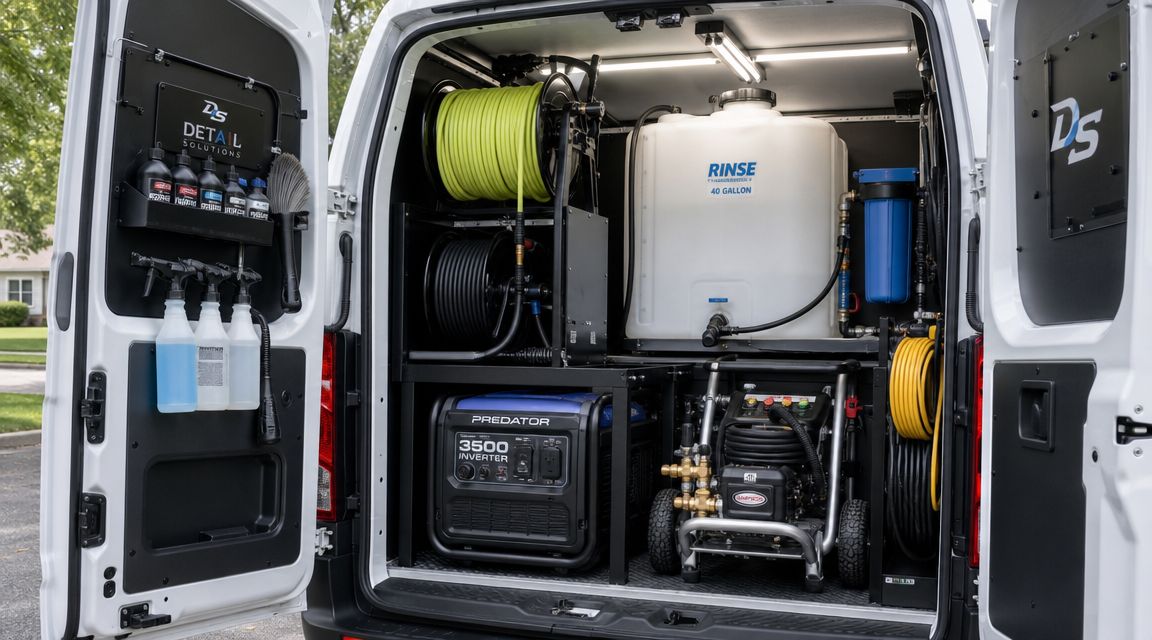
Water capacity changes the whole day
A self-contained mobile rig revolves around water storage. Industry guidance now treats a water tank as essential equipment, with common capacities ranging from 60 gallons to 200 gallons, and Grand View Research reports the global car detailing services market was valued at USD 41.40 billion in 2024 and is projected to reach USD 58.06 billion by 2030, as summarized in Mobile Tech RX's detailing equipment guide.
A compact setup can work with a smaller tank if the route is tight and the service menu is narrow. A larger rig gives you flexibility, but it also adds weight, takes up room, and affects how you organize the van. Bigger isn't always better if it creates a clumsy layout or cuts into tool access.
A useful way to think about it is this:
- Smaller tank setups fit lighter vehicles and shorter service routes.
- Larger tank setups support more independence and fewer refill interruptions.
- Poorly planned tank placement hurts balance, storage access, and safety.
For anyone comparing layouts, this guide for mobile detailers on water tanks is worth reading because it gets into practical setup considerations instead of just naming products.
Power is a route-planning decision
Pressure washers, vacuums, polishers, extractors, and lighting all place different demands on your system. The wrong power choice shows up as noise, heat, downtime, or tools that can't run together when you need them.
A gas generator can provide independence, but it adds noise and another machine to maintain. An inverter-based system can be cleaner and quieter if the load is planned correctly. Battery power stations are getting more attention because they reduce some of the friction of on-site work, but they still need to match the tool lineup and service length for the day.
Choose power based on the route, the service mix, and the longest job you actually perform. Not the shortest demo you watched online.
Here's a quick visual on what a compact self-contained rig can look like in practice.
The best setup reduces downtime
The strongest mobile systems aren't always the loudest or the most powerful on paper. They're the ones that let you work steadily. Less refilling. Less cord management. Less waiting on batteries. Less reshuffling gear to get to one hose.
That's what separates a product collection from an operating system.
Organizing Your Rig for Peak Efficiency
A messy van can ruin a good technician's pace. You might still finish the job, but you'll waste energy on every stage. Reach. Search. Move. Repack. Repeat. The customer only sees a clean car at the end, but the hidden cost is time and fatigue.
Industry commentary often misses this point. The best mobile detailing supplies are often the supplies that reduce downtime and keep the route moving, not just the ones with the most aggressive specs, as highlighted in Rightlook's mobile detailing setup coverage.
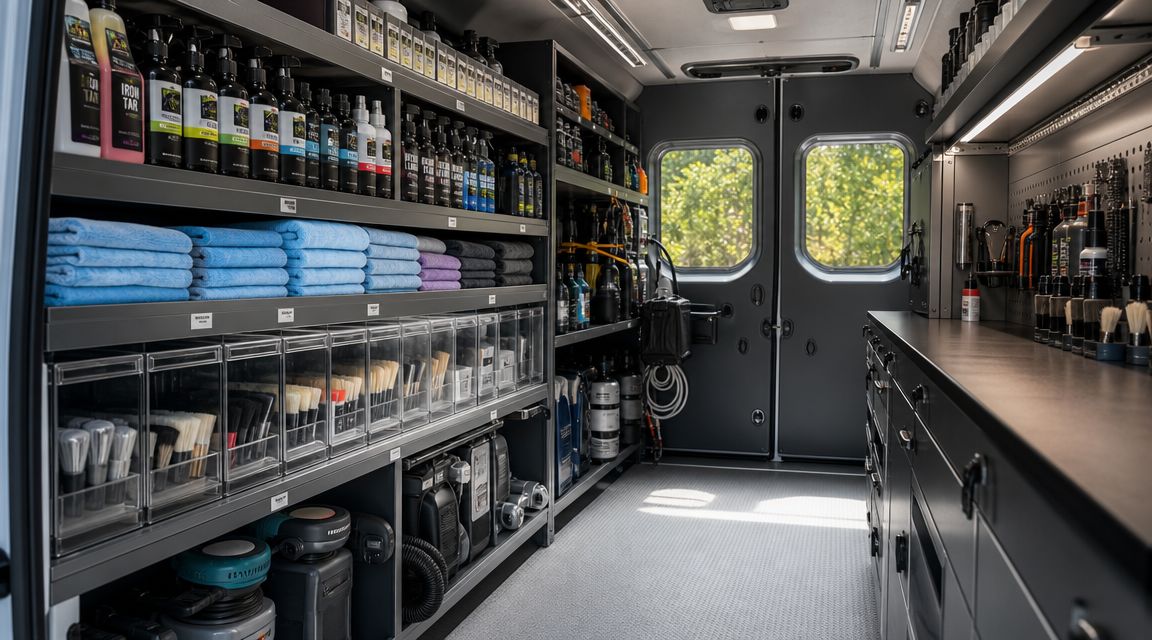
Build zones, not piles
The easiest way to organize a rig is by service zone.
- Front-access zone for frequently used items like towels, sprayers, APC, glass cleaner, and brushes.
- Wash zone for hose reels, pressure washer gear, wash media, and drying towels.
- Interior zone for vacuum attachments, interior brushes, extractors, drill brushes, and fabric tools.
- Correction and protection zone for polishers, pads, compounds, finishing polishes, panel prep, and applicators.
- Dirty return zone for used towels, spent pads, and contaminated brushes.
That last one matters more than people think. If you don't have a clear place for dirty items, they drift back into clean inventory.
Pack by job, not by category alone
A purely category-based layout sounds tidy but can slow you down. It's better to create compact service kits inside the larger system.
For example:
- Interior kit with brushes, towel stack, APC, glass towel, crevice tools, and a small trash bag.
- Wheel kit with tire brush, barrel brush, lug brush, wheel mitt, and dedicated wheel towels.
- Polishing kit with pad types separated by cut level, backing plate accessories, tape, inspection towel, and pad cleaning tools.
That approach cuts walking and repeated unpacking. It also makes restocking easier when the work is complete because you can see exactly what each kit is missing.
Secure the load and label everything
Mobile work means every item moves when the vehicle moves. Bottles tip. Pads get crushed. Machines slide. Hoses tangle. Good organization includes restraint, not just placement.
Use bins, shelves, straps, drawer units, and labeled containers that let you identify what's missing at a glance. Keep heavier equipment low and stable. Keep chemical lids checked. Keep towel categories separate enough that no one has to guess.
A professional rig should let another trained person find any core item without opening every box in the van.
When organization is done right, setup feels lighter. Teardown gets faster. You finish the last job with enough energy to prep for the next one instead of dreading it.
Your On-Site Setup and Teardown Workflow
Customers notice your process before they notice your polishing results. If you arrive flustered, drag hoses across landscaping, block walkways, and scatter bottles around the driveway, the service already feels less professional. A clean workflow protects the vehicle, the property, and your pace.
Arrival and staging
Start with a quick walk-around and a simple service confirmation. That avoids misunderstandings and helps you spot issues that affect the workflow, such as heavy interior debris, pet hair buildup, or limited space around the vehicle.
Then stage only what you need for the first phase. Don't unload the whole van. A crowded driveway slows you down and raises the chance of setting a clean towel on a dirty surface or tripping over a hose.
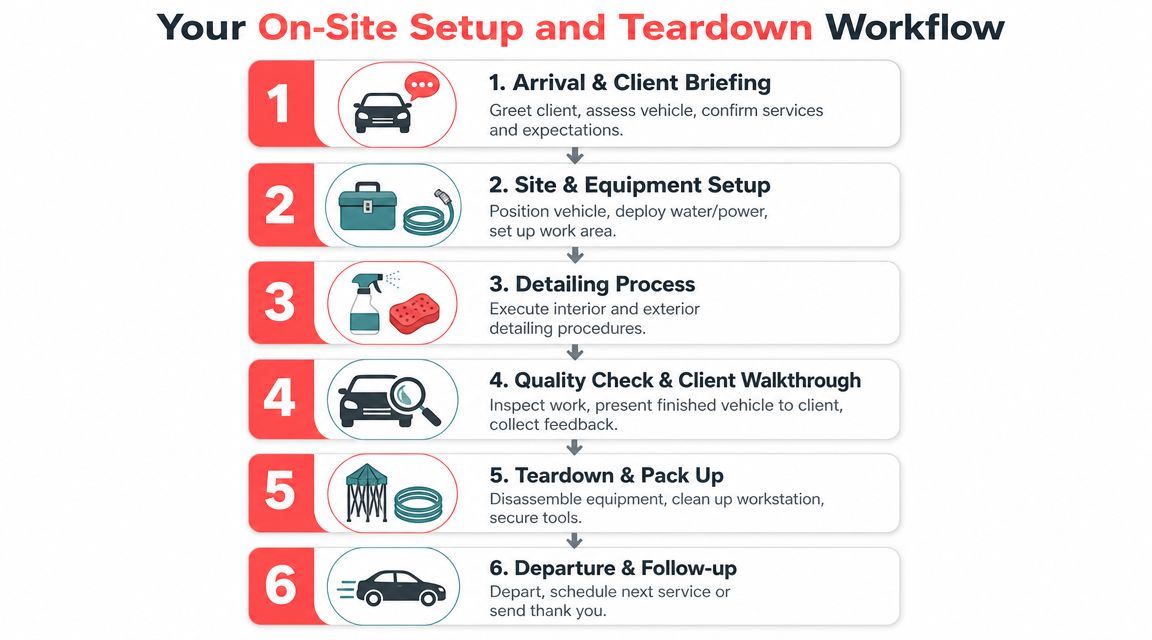
A clean arrival routine usually looks like this:
- Confirm the service and note any problem areas.
- Position the van for safe hose and cord routing.
- Deploy water and power with the shortest practical path.
- Stage the first tool set instead of the entire inventory.
Work the vehicle in a repeatable order
Repeatability is what keeps quality steady from one job to the next. Many pros work from the dirtiest areas with isolated tools, then move toward more delicate surfaces with cleaner media. Interiors also benefit from a set order so dry debris is removed before chemical work begins.
For sprayers and chemical application tools, a lot of cross-industry advice still applies. This marine detailing sprayer guide is useful because it highlights practical sprayer handling and distribution habits that carry over well to vehicle detailing.
Keep hoses and cords behind you when possible. If you have to step over your own setup all day, your layout is wrong.
Teardown is part of the service
A rushed teardown creates the next day's problems. Wipe down tools that need it. Separate used towels immediately. Empty debris. Recoil hoses without kinks. Return each item to its home so the next setup starts clean.
Before leaving, do a final visual sweep of the work area. Look for drips, towels, caps, brushes, or small tools. Then do a short client walkthrough. That last minute matters. It closes the job professionally and gives the customer confidence that the process was as polished as the result.
Advanced Supplies for High-Value Services
Basic wash equipment gets you in the game. Specialized tools are what let you solve the problems customers pay a premium to fix.
That's where many generic mobile car detailing supplies lists fall short. They focus on broad categories and skip the job-specific combinations that matter on difficult vehicles. One overlooked truth is that high-margin pain points like pet hair and odors usually require targeted chemistry, mechanical removal, and drying control together, not just one stronger chemical, as discussed by Black V Detail Supplies.
Supplies that open the door to better jobs
A few upgrades change your service menu in a meaningful way.
- Hot water extractor for fabric seats, mats, and carpets with spills, tracked-in dirt, or embedded grime.
- Steamer for selective interior cleaning in seams, cupholders, trim edges, and hard-to-reach areas.
- Air mover for drying support after extraction and for helping interior work finish cleanly.
- Odor treatment tools including targeted odor chemistry and controlled post-cleaning processes.
- Pet hair tools such as specialty brushes, rubber-style tools, crevice support, and strong vacuum pairing.
- Headlight restoration kit for oxidized lenses that need a dedicated correction process.
None of these tools is magic by itself. Results come from the combination. Odor work often fails because the technician tries to mask instead of remove. Pet hair work drags on because the vacuum is doing all the labor instead of working with the right brush and agitation tool.
Match the tool to the complaint
If a client says the car smells bad, the job might involve residue removal, fabric treatment, airflow management, and drying discipline before any final odor treatment. If a client says the interior is “just dirty,” the issue may be pet hair in carpet fibers, sticky buildup in contact points, and staining in seat seams.
That's why the best advanced supply purchases are the ones tied to real service demand.
- For stain-heavy family vehicles, extraction and drying support matter.
- For rideshare interiors, odor and touchpoint cleaning tools matter.
- For resale prep, headlight, interior presentation, and finish enhancement tools matter.
If you're comparing suction and attachment priorities before buying, this best vacuum for car detailing guide is a practical place to start.
What not to do
Don't buy high-ticket machines before your workflow can support them. A great extractor still slows you down if it doesn't fit your power plan, your storage layout, or your drying process. Don't overbuy chemicals either. More bottles rarely mean better outcomes. Better pairing does.
From Supplies to Professional Service
By the time you look at the full picture, mobile car detailing supplies don't look simple anymore. They're part of a working system that has to travel well, stay organized, avoid cross-contamination, manage water, handle power, support safe on-site movement, and deliver consistent results on vehicles that all show up in different condition.
That's why a professional setup is harder to copy than it appears. Anybody can buy towels, soap, and a vacuum. Building a reliable mobile operation takes more. It takes planning, maintenance, restocking discipline, and enough experience to know which tool belongs in your hand before the problem slows the whole job down.
For people considering the business side, there's a lot to think through beyond the supply shelf. This guide on how to start a mobile detailing business gives a broader view of what goes into building a working operation.
There's also the simple reality that most vehicle owners don't want to invest in a self-contained rig, learn the workflow, store the equipment, and troubleshoot all the little problems that come with mobile detailing. They just want the convenience of having it handled correctly at home or at work.
If you're in Central Pennsylvania and want that convenience without the trial-and-error, it makes sense to hire a team that already solved the logistics. You can also check local customer feedback on The Mobile Buff's Google Business Profile to see how that kind of system looks in real-world service.
If you'd rather skip the equipment costs, setup headaches, and time sink of building your own mobile detailing system, book a visit with The Mobile Buff. We bring the water, power, tools, and workflow to you, so you get professional results in your driveway without turning your weekend into a detailing project.

