


So, you're wondering if car detailing can actually get rid of those frustrating scratches on your paint. It’s a great question, and as professional detailers, we hear it all the time.
Let's cut right to the chase. Yes, professional detailing can permanently remove many types of scratches, but it's not a magic wand for every single bit of damage. The success all comes down to one thing: the scratch's depth.
The Truth About Car Detailing and Scratches
That gut-wrenching feeling you get when you spot a new scratch on your car's paint is something every owner has felt. Whether it's a mystery mark from a crowded parking lot or a faint scuff from a rogue branch, the first question is always, "Can this be fixed?"
For the vast majority of common blemishes, the answer is a resounding yes. A specific detailing service called paint correction is a professional, industry-approved process designed to safely and completely remove imperfections that are only in the top protective layer of your paint—the clear coat.
But it’s important to have realistic expectations. We believe in being straight with you. Our expertise lies in fixing surface-level damage. Some scratches are simply too deep for a detailer to handle safely. If a scratch has sliced through the color and into the primer or bare metal below, that’s a job for a body shop, and we'll be the first to tell you that.
Identifying the Damage
To figure out what you’re dealing with, you need to know how deep that scratch really is. This quick guide will give you a much better idea of whether a detailer can make it vanish.
Here’s a simple chart to help you diagnose the damage on your vehicle and determine the best course of action.
Scratch Severity Quick Reference Guide
| Scratch Type | How to Identify It | Can Detailing Remove It? | Best Solution |
|---|---|---|---|
| Light Scratches & Swirls | Visible in direct sunlight, feels smooth to the touch. Often looks like fine spiderwebs or light scuffs. | Yes | Professional Paint Correction |
| Moderate Scratches | You can feel it slightly with your fingernail, but it doesn't catch. The scratch may appear white or a lighter shade of your car's color. | Often | Multi-Stage Paint Correction |
| Deep Scratches | Your fingernail easily catches in the groove. You can see the lighter-colored primer or the bare metal underneath. | No | Body Shop Repair & Repaint |
This table is your starting point for understanding what's possible with professional detailing.
The Fingernail Test: A tried-and-true method detailers use to gauge scratch depth is the fingernail test. Gently run your nail across the scratch. If it glides over smoothly, it's almost certainly a clear coat scratch we can remove. If your nail catches in the groove, the damage has gone deeper and will need more than just polishing.
Understanding what’s possible is the first step toward restoring your car's pristine finish. It's why our clients from Harrisburg to Mechanicsburg trust our honest assessments, which you can see for yourself on our Google Business Profile.
Understanding Your Car's Protective Paint Layers
So, you've got a scratch on your car and you're wondering if a good detail can make it disappear. That's the million-dollar question, isn't it? Before we can answer that, we need to talk about what's actually protecting your car's body. It's not just a single coat of paint, but a surprisingly complex system of layers.
Think of it like armor. Automakers don't just spray on some color and call it a day. They build up a tough, multi-layered shield to protect the metal from the elements, and understanding this shield is the key to knowing what we can fix.
The Anatomy of Automotive Paint
Your car's finish is made up of four distinct layers, each with a critical job. When we're looking at a scratch, we're really trying to figure out how many of these layers it has broken through.
Let's peel them back, one by one:
- Metal Panel: This is the bare metal body of your car. It’s strong, but if it gets exposed to moisture, rust is right around the corner.
- E-Coat & Primer: Think of these as the foundation. They're applied directly to the metal to stop corrosion and create a smooth, stable base for the color to stick to.
- Base Coat (Color Coat): This is the fun part—the layer that gives your car its specific color. Whether it's a slick black or a candy apple red, it all happens here. But on its own, this layer is delicate and offers almost no real protection.
- Clear Coat: This is the invisible hero. It’s the thick, durable, and transparent top layer that takes all the abuse—sunlight, bird messes, road grime, and, you guessed it, minor scratches.
Key Takeaway: The clear coat is designed to be a sacrificial barrier. It's meant to take the hits so the important stuff underneath (your paint color and the metal) stays safe. When a detailer talks about removing scratches, we're almost always working on this top layer.
The Science of Safe Scratch Removal
Now, here's where it gets interesting. That all-important clear coat is tough, but it's also incredibly thin, usually measuring just 30–50 microns. To put that in perspective, a single human hair is about 70 microns thick. You can learn more about how we work with this razor-thin layer to achieve amazing results on OTSmobile.com.
This is why trying to buff out a scratch yourself with a store-bought product can go wrong so fast. As professionals, the first thing we do is grab a paint depth gauge. This little tool tells us exactly how much clear coat we have to work with, ensuring we can safely remove the scratch without burning through this vital protective layer.
Going in without that measurement is like a surgeon operating without an X-ray. You might get lucky, but you could also cause much bigger problems. This is not a risk we'd recommend anyone take with their vehicle.
This careful, measured process is what we call paint correction. We use special compounds and polishes to gently shave off a microscopic amount of the clear coat, leveling the surface down to the bottom of the scratch until it vanishes completely. We’re not filling it in or hiding it—we are permanently removing it.
When you understand these layers, it's easy to see why a one-size-fits-all scratch remover from a bottle is such a gamble. Our entire philosophy is built around preserving as much of your vehicle's factory finish as possible.
What Scratches Detailing Can and Cannot Fix
So, you’ve spotted a scratch on your car. The big question is, can a detailer actually get it out? The answer almost always boils down to one simple thing: how deep is the scratch?
Think of your car's paint as having multiple layers. The damage can be a minor annoyance that only sits on the surface, or it can be a deep gash that's gone all the way through. Knowing the difference is the first step to getting that flawless finish back.
Scratches We Can Definitely Fix
The good news is that most of the blemishes we see every day are completely correctable. We're talking about those annoying light scratches and swirl marks.
These are the fine, spiderweb-like lines you see when the sun hits your paint just right. They’re almost always caused by improper washing—think drive-thru car washes with their harsh brushes or using old, gritty towels to dry your car. These scratches are only in the clear coat, the topmost protective layer.
This is our bread and butter. Through a process called paint correction, we can carefully level that clear coat surface, making those imperfections disappear entirely. What’s left behind is a deep, glossy shine that looks better than new.
Scratches We Can Often Improve
Then you have what we call moderate scratches. These are a little more serious. They’ve cut through the clear coat and have just started to bite into the color layer underneath. You might notice them as a distinct line that looks lighter than your car’s paint.
These are the kind of scratches you get from a shopping cart bump, a key fob dragging across the door, or a run-in with a low-hanging branch. They sit right on the fence between what detailing can fix and what it can't.
The Fingernail Test: This is the oldest trick in the book for a reason. Gently run your fingernail over the scratch. If it glides smoothly across, you’re likely just dealing with a clear coat scratch. But if your nail catches in the groove, the scratch is deeper, and a simple polish won't be enough.
For these borderline cases, we can usually make a massive difference. While we might not be able to erase the scratch completely, a multi-stage paint correction can smooth out its sharp edges, making it far less visible to the naked eye. We’re always upfront with our clients in the Philadelphia area about what level of improvement they can realistically expect.
Here’s a quick visual guide to help you do the fingernail test and see what it means for your car.
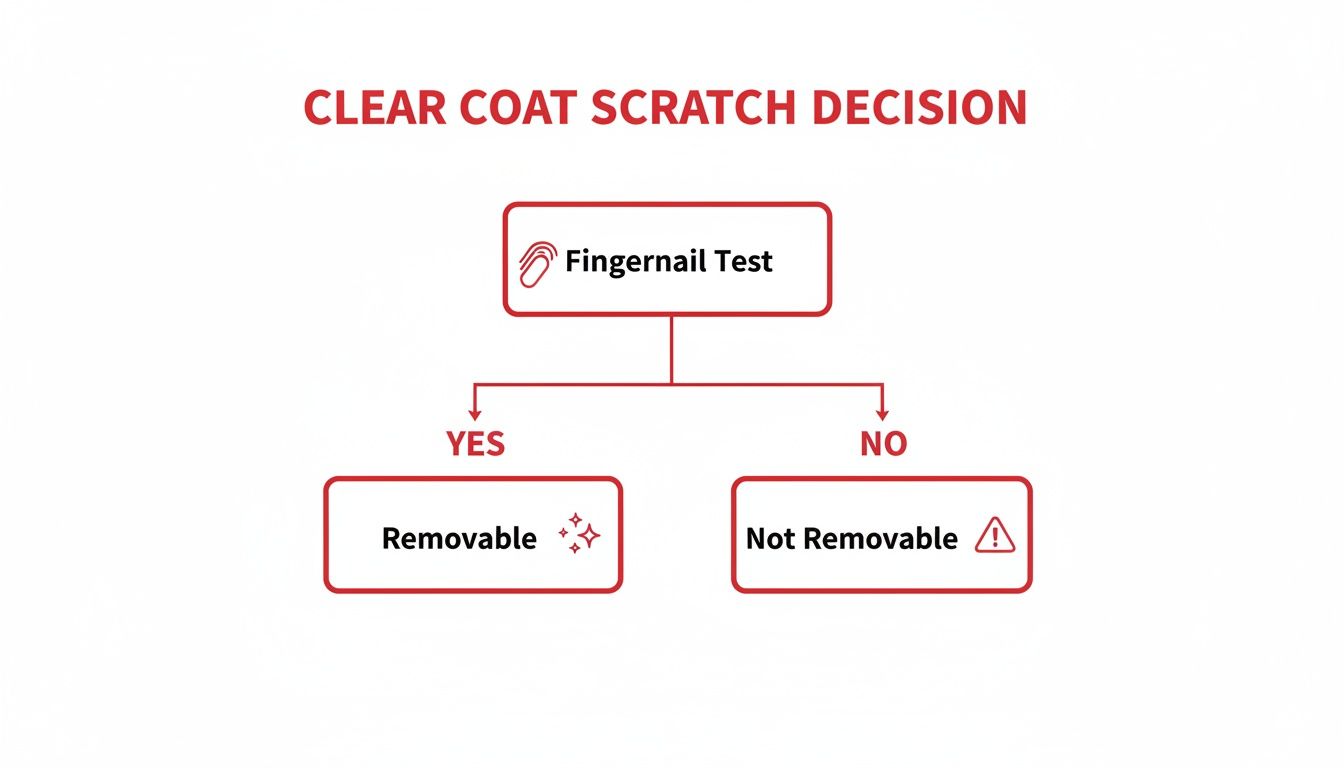
As the chart shows, if your fingernail gets stuck, the damage has gone past the clear coat, and it's outside the scope of what detailing can fully remove.
Scratches That Require a Body Shop
Finally, we have the worst-case scenario: deep scratches. These aren't just scratches; they're gouges that have torn through the clear coat, the color paint, and have exposed the primer or even the bare metal panel.
These are typically caused by vandalism (like a keying) or a minor collision. If you can see a different color like gray or white in the scratch, or worse, shiny metal, then detailing isn't the answer. Leaving these wounds exposed to the elements is a recipe for rust, which will lead to much bigger and more expensive problems.
For damage this severe, the only real solution is a trip to a professional body shop. They’ll need to sand the area down, re-apply primer, perfectly match and spray the paint, and then finish it with a new layer of clear coat. Part of our job is knowing our limits, and we believe in telling you honestly when a job is better suited for a body shop. If you want to dive deeper into the different kinds of paint imperfections, check out our guide on how to remove swirl marks from a car.
Our goal is always to get the best result for your vehicle, and that process starts with an honest, accurate assessment of the damage.
The Professional Process for Flawless Scratch Removal
Ever wonder how we make those frustrating scratches just disappear? It's not about slathering on some waxy filler that washes away after a few rains. True, professional scratch removal is a highly skilled process called paint correction, and it's what separates an expert detailer from a simple car wash.
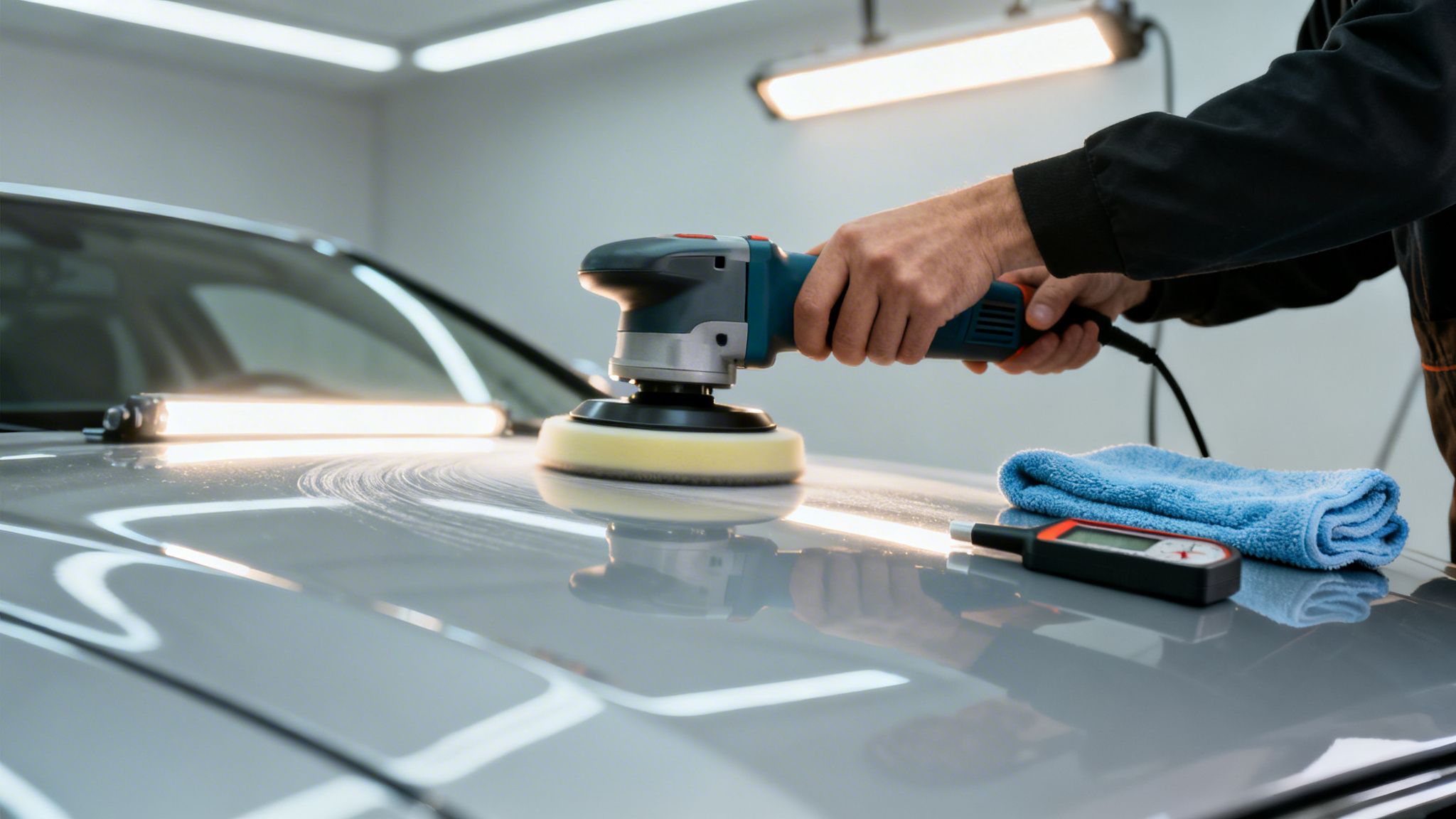
This isn't a DIY guide—it's a behind-the-scenes look into the professional, industry-approved methods we use to protect your investment and restore its finish. Honestly, trying to replicate this without the right tools and training often leads to more damage, like hazy paint or even burning right through the clear coat. It's why we always recommend leaving this work to trained professionals.
Step 1: Creating a Perfectly Clean Canvas
Before we can even think about polishing, the car's surface has to be absolutely spotless. We can't risk grinding existing dirt and grime into the paint, which would just create a whole new set of scratches to deal with. That's why everything starts with a meticulous decontamination wash.
This is way more than a quick soap-down. We use pH-neutral shampoos and specific chemical decontaminants to dissolve all the nasty stuff you can't see, like embedded iron particles and tar. Once it’s washed and dried, we bring out the clay bar.
A professional-grade clay bar glides across the paint, pulling out any stubborn contaminants that the wash left behind. The goal is to get the surface as smooth as glass, giving us the perfect, clean canvas we need for effective paint correction.
Step 2: Damage Assessment and Strategy
With a pristine surface, the true extent of the damage finally comes to light. This is where expertise really makes a difference. We use powerful, specialized LED lights that mimic direct sunlight, revealing every last swirl mark, micro-scratch, and faint imperfection that would otherwise be invisible.
Next comes a critical tool: the paint depth gauge. It precisely measures the thickness of your vehicle's paint—specifically the clear coat—down to the micron. This tells us exactly how much material we have to work with, allowing us to map out a safe and effective plan.
This careful measurement is non-negotiable for a pro. It's the only way to ensure we can remove scratches without compromising the long-term integrity of your car's protective clear coat.
Based on how deep the scratches are and what the paint gauge tells us, we can then select the perfect combination of compounds, polishes, and machine polisher pads for the job.
Step 3: The Magic of Multi-Stage Paint Correction
This is where you see the real transformation happen. The process is usually broken down into two main stages: compounding and polishing. Think of it as a delicate balance between abrasion and refinement.
Compounding (The Heavy Lifting): We start with a machine polisher and a more abrasive compound. This carefully shaves off a microscopic layer of the clear coat, leveling the surface down to the bottom of the deepest scratches. The scratches aren't just filled in; they are permanently removed.
Polishing (The Finesse): After compounding, the surface is scratch-free but might have a slight haze from the abrasive step. This is where we refine it. We switch to a much finer polish and a softer pad to clear up that haze, which brings out an incredible level of gloss, clarity, and depth in the paint.
This multi-stage approach ensures that we don't just get rid of the scratches, but we actually enhance the overall beauty of your car’s paint. It’s what brings back that jaw-dropping, mirror-like shine. To see more, feel free to explore our expert paint correction processes.
This professional method is the only way to safely and permanently remove clear coat scratches. When you see the results, you'll understand why it's worth it.
Why Choose a Professional Mobile Detailer Over DIY?
So, you found a scratch on your car. That sinking feeling in your stomach is instantly followed by a trip to the auto parts store, right? I've been there, and I know exactly how tempting it is to grab a bottle of "miracle" scratch remover and try to fix it yourself.
But here’s the honest truth from someone who’s seen it all: those quick fixes often create a much bigger headache. You can easily end up with a cloudy, dull spot that’s far more noticeable than the original scratch. Or worse, you might burn right through your car's clear coat, turning a minor issue into a major, expensive body shop repair. For busy folks here in Harrisburg, Mechanicsburg, and across Central PA, there's a much smarter, safer way to handle it.
Expertise That Comes Right to Your Door
Why spend your Saturday gambling with your car’s paint when you can have a professional solve the problem for you? As a mobile detailer, I bring the entire workshop—the right tools, the premium compounds, and years of experience—directly to your home or office. Sure, the convenience is a huge plus, but the real value is in the result.
At The Mobile Buff, we use the same techniques the pros do to safely correct scratches without damaging your paint or its long-term value. For the light to moderate scratches that show up on nearly every car, our service is worlds more convenient and affordable than a trip to the body shop.
Did You Know? You're not alone in this. A recent survey found that more than 65 percent of drivers spot scratches on their cars within the first year. It’s a frustratingly common part of owning a vehicle. You can read more about these findings on TopLine Auto Spa.
Your Local Pro, Built on Trust
Being a local business serving our neighbors from Carlisle to Newport means our reputation is everything. We’re not some faceless company; we're part of the community. Our entire business is built on honest work and results you can see.
When people ask, "does car detailing remove scratches," they're really asking if they can trust us with their investment. That's why we never make a promise we can't keep. We always start with a straightforward, transparent evaluation of the scratch, so you’ll know exactly what to expect before we even plug in the polisher.
Don’t just take my word for it—see what your neighbors are saying! The feedback we get from our clients is what pushes us to be the best. You can check out more reviews and see our work for yourself on our Google Business Profile.
Here’s what you get when you skip the DIY risk and call a pro:
- Total Safety: We use paint depth gauges and proven, delicate methods to preserve your car’s clear coat.
- Unbeatable Convenience: Why drive to a shop? We come right to you, saving you a ton of time.
- A Smarter Price: Get that body-shop-quality finish for clear coat scratches at a fraction of the cost.
- Permanent Removal: We don’t use fillers that wash away. We safely level the paint to make the scratch disappear for good.
Instead of taking a chance with your car’s finish, let us handle it the right way.
How to Keep Your Car Scratch-Free After Detailing
So, you've invested in a professional paint correction and your car looks absolutely flawless. The big question now is, how do you keep it that way? After all the effort that goes into removing every last swirl mark, the last thing you want is to see new ones appear a week later.
Protecting that perfect finish is actually easier than you might think. It really just comes down to breaking a few bad habits and using industry-approved methods.
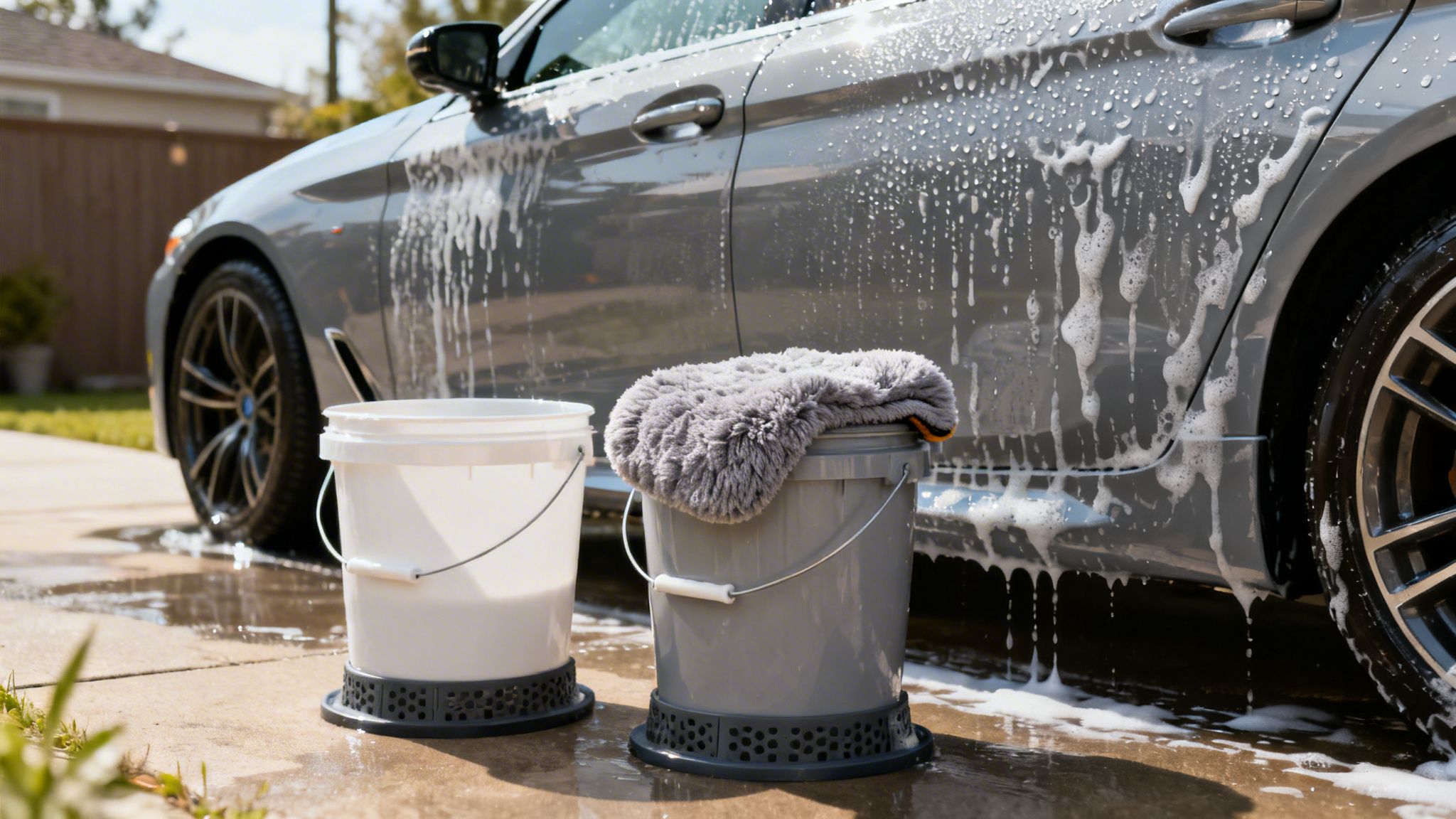
Believe it or not, the number one cause of new scratches and swirl marks is improper washing. Those drive-thru tunnel washes with the giant spinning brushes? They're basically giant scratch machines. Even washing at home with a dirty sponge or an old towel can do more harm than good.
Adopt Professional Washing Habits
Here’s the single best piece of advice we can give you: learn the two-bucket wash method. This is the technique every professional detailer uses, and it makes a world of difference in preventing scratches. One bucket is for your soapy water, and the other is just for clean rinse water.
The process is simple:
- Dip your soft, clean microfiber wash mitt into the soap bucket.
- Gently wash one panel of your car at a time.
- Now, here’s the key: rinse the now-dirty mitt in the clean water bucket to release all the grit and grime.
- Only then do you go back to the soap bucket for the next panel.
This simple habit stops you from dragging dirt from one panel all over the rest of your car. Combine this with a good pH-neutral soap and some plush microfiber towels for drying, and you’re already miles ahead of the game.
Add a Sacrificial Layer of Protection
For the ultimate defense, you’ll want to apply a protective layer over that freshly polished paint. Think of it as a screen protector for your car's clear coat—a tough, renewable shield that takes the abuse so your paint doesn't have to.
You've got a couple of options here. A traditional car wax will give you a great shine and a bit of protection, but it usually wears off in a few months. For truly long-lasting, durable protection, nothing comes close to a modern ceramic coating. These create a super-slick, hard shell that can last for years. If you're curious, you can learn more about what a ceramic coating is in our guide.
Protecting your investment in detailing is part of a bigger picture. To maintain your car's overall condition for years to come, it helps to understand how to make your car last longer through consistent care and smart habits.
We see ourselves as your partner in keeping your car looking its best. We’re always happy to talk you through the best protection package for your car and driving habits after we’ve restored its finish.
So, Where Do You Go From Here?
We’ve covered a lot of ground—from the layers of your car’s paint to the techniques we use to fix it. So, what's the bottom line? Can detailing actually get rid of scratches?
For the vast majority of blemishes that drive car owners crazy—those frustrating swirl marks, light scuffs, and other imperfections that haven't gone past the clear coat—the answer is a resounding yes. Professional paint correction is specifically designed to make them vanish.
The real trick is knowing what you're dealing with. Once you understand that a scratch is just a surface-level issue, you can breathe a sigh of relief. You don’t need an expensive trip to the body shop; you need a skilled detailer. It's simply about using the right tool for the job.
Your Path to a Flawless Finish
So, what should you do now? It all starts with taking a good, honest look at your car. Grab a coffee, head outside on a bright day, and really walk around your vehicle. Look at it from different angles.
What do you see? Are they those fine, spiderweb-like lines that only show up in direct sun? Or are you looking at a deeper, more distinct line left behind by a rogue shopping cart or a misjudged parking spot?
Our Promise to You: We're in the business of making cars look incredible, but our foundation is built on honesty. We’ll always give you a straight answer about what paint correction can fix and when a body shop is genuinely your best bet. Your trust means everything to us.
For our neighbors here in Central PA, from Carlisle to Newport, we make it incredibly easy. Our mobile service brings the entire shop right to your driveway. You don't have to deal with the hassle of dropping your car off or waiting around—we come to you, on your schedule.
Go ahead, find those marks that have been bugging you. Are you ready to see them gone for good? It’s time to stop wondering and find out for sure. We're proud to serve our local community, and our reputation is built on the results we deliver every day. You can see what your neighbors are saying on our Google Business Profile. Let's get that paint looking sharp and help you fall in love with your car all over again.
Ready to erase those frustrating scratches and bring back that showroom shine? Give The Mobile Buff a call today. We'll give you a professional assessment and a free, no-obligation quote. Let's make your car look its absolute best!

