


That musty smell in your car? It’s more than just a little annoying. It’s a tell-tale sign of mildew, and a cheap air freshener is just a temporary mask, not a real solution. To truly get rid of the mildew smell in your car for good, you have to find the source of the moisture, eliminate the mildew with professional-grade products, and dry everything out completely.
This is the only way to tackle the problem at its root and make sure that funky smell doesn't come creeping back.
Why That Musty Smell Is a Red Flag
When that earthy, damp odor hits you, it's easy to think an air freshener will do the trick. But that musty smell is a clear warning that moisture has gotten trapped somewhere inside your vehicle, creating the perfect home for mildew. Trying to cover it up with a pine tree air freshener is like putting a band-aid on a leaky pipe—it doesn't fix a thing.
Mildew loves dark, damp spots with poor airflow, which perfectly describes a car's interior. In the right conditions, mildew spores can start growing in just 24-48 hours. The real issue isn't the smell itself, but the moisture causing it, which can lead to some serious, long-term damage.
Where Is This Moisture Coming From?
So, how did this unwanted guest get in? Usually, it's something simple that gets out of hand if you don't catch it early. Figuring out the source is the first real step to kicking that mildew smell to the curb for good.
Here are the most common culprits we see all the time:
- Spills and Stains: That coffee you spilled last month, the water bottle that leaked, or even a damp gym bag left in the back can all soak deep into the carpets and seats.
- Leaky Seals: Over time, the rubber seals around your doors, windows, and sunroof get old and brittle. This lets rainwater sneak inside, often dripping down where you can't see it until the smell appears.
- Clogged AC Drains: Your car's A/C system is designed to pull moisture out of the air, and that water has to go somewhere. If the drain line gets clogged with leaves or debris, the water backs up and usually ends up soaking the passenger-side floor.
- High Humidity: Here in Central Pennsylvania, the humidity can be a real killer. If your car sits for a while, that damp air can settle right into the fabric, giving mildew a perfect place to start.
A lingering mildew problem isn't just about the bad smell. It’s a direct threat to your car’s interior. That trapped moisture will eventually lead to ugly stains, rusted floor pans, and will absolutely tank your car's resale value.
At the end of the day, that musty odor is just a symptom. Covering it up only lets the moisture keep doing its damage. The only real fix is to get rid of the moisture and neutralize the mildew at its source.
Here at The Mobile Buff, we've dealt with every kind of car odor you can imagine. Our team in the Harrisburg area knows all the sneaky places moisture likes to hide. If you're done with quick fixes that don't last, let us give you a permanent solution. Don't just take our word for it—check out the great reviews on our Google Business Profile and see why your neighbors trust us to get the job done right.
Finding the Source of That Musty Smell
Before you can truly get rid of a mildew smell, you have to play detective. I’ve seen it a hundred times: someone shampoos the carpets, hoping that’ll fix it, only for the smell to creep back a week later. A real pro knows the first, most crucial step is a systematic hunt for the source. You have to find where the moisture is getting in and letting mildew thrive.
This isn’t a quick peek under the seats. It’s a full-on investigation. We start by pulling the floor mats completely out of the car. Don't just lift a corner—get them out. The space underneath is the number one hiding spot for tracked-in water and spilled drinks. From there, we meticulously check every square inch of the carpet, pressing down firmly to feel for any lingering dampness in the padding below.
Digging Deeper for Hidden Moisture
Once the obvious spots are checked, the real search begins. We get into the less common areas, running our hands deep into seat crevices and along the upholstery seams where moisture can get trapped. The trunk is another prime suspect; we always lift the trunk liner to check the spare tire well. It's amazing how often water from a leaky seal will pool there, completely out of sight.
A few other usual suspects we always check include:
- Door and Window Seals: We carefully inspect the rubber seals on every door and window, looking for tiny cracks, brittleness, or gaps that let rainwater sneak in.
- Sunroof Drains: If you have a sunroof, the drain tubes can get clogged with gunk. When that happens, water overflows and soaks the headliner, often dripping down the pillars.
- AC Drain Lines: A clogged AC drain is a classic. It almost always causes water to back up and pool on the passenger-side floorboard. It's a dead giveaway.
This process highlights a simple but destructive cycle: moisture gets trapped, mildew starts to grow, and over time, it will ruin your car's interior.
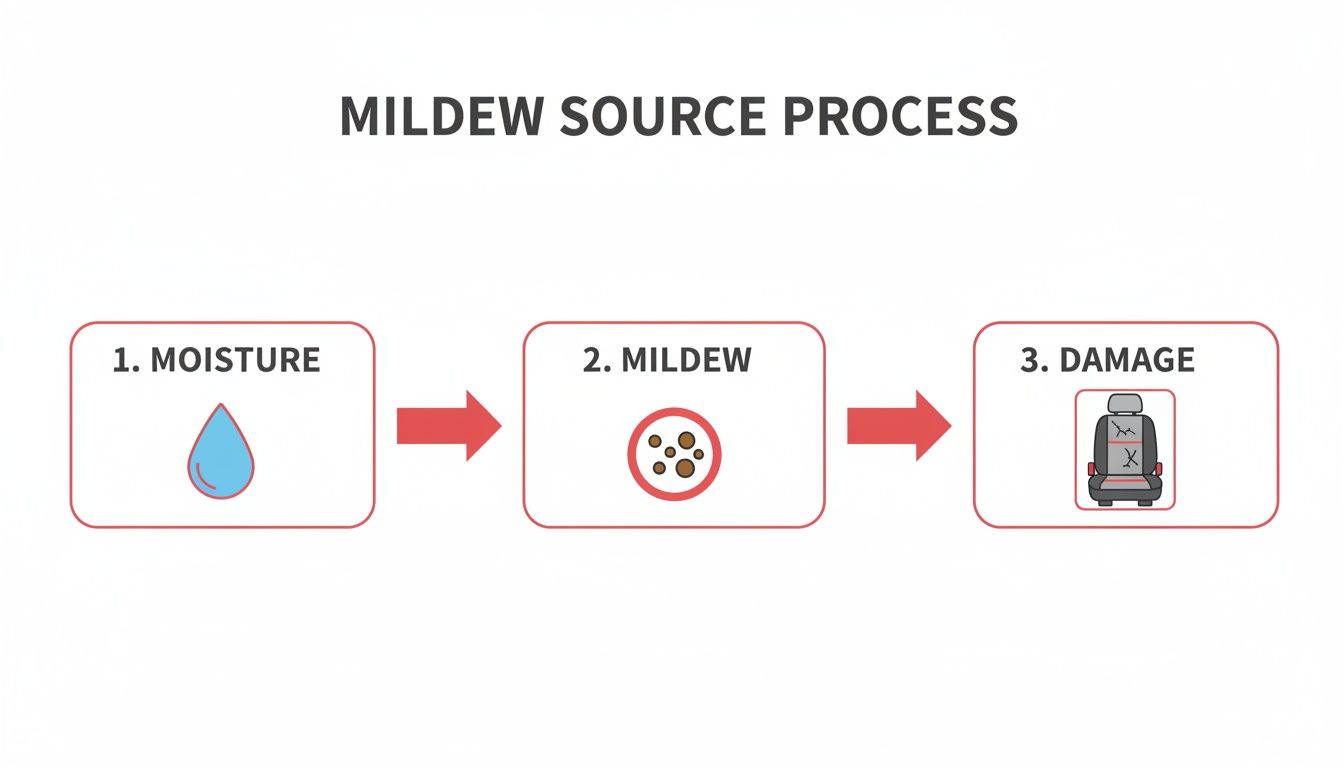
The image above breaks it down perfectly. Unchecked moisture is the fuel for mildew, and that growth will cause permanent damage if you don't stop it.
Prepping for a Professional-Grade Deep Clean
Once we've located the source, it's time to prep the car for a serious cleaning. This is where we separate the pros from the amateurs. First, everything comes out. We empty the glove box, the center console, the door pockets, the trunk—everything. Leaving personal items behind just gives mildew spores more places to hide.
Next up is a thorough, high-powered vacuuming of every single surface. And we're not talking about just getting the crumbs. We use commercial-grade vacuums armed with HEPA filters. This is non-negotiable. A HEPA filter is specifically designed to trap microscopic mold and mildew spores. Using a standard shop vac or your household vacuum can actually make things worse by blasting those spores back into the air, allowing them to settle somewhere new.
This prep work is all about setting the stage for a successful cleaning. It ensures we're not leaving any hidden mildew colonies behind to just grow back and bring that awful smell with them. If you're in the Harrisburg area and this sounds like a lot to tackle, our team at The Mobile Buff are experts at this level of detective work. You can see what our customers say about our attention to detail on our Google Business Profile!
Pro Tip: We use a crevice tool on our vacuums to get deep into the seams of the seats and along the edges where the carpet meets the plastic trim. We've found that an astonishing 65% of deep-seated mildew hides out under carpets and in these tight, hard-to-reach spots.
Ready to see how we attack the fabrics where mildew has made its home? The next section gets into the professional cleaning methods that actually work.
Deep Cleaning Carpets and Upholstery the Right Way
Alright, now that you've played detective and prepped the car, it's time to go after the real culprit. That musty mildew smell has wormed its way deep into your car's carpets and seats, and trust me, a quick spray and wipe isn't going to fix it. To truly kill that smell for good, you need to think like a pro and use industry-approved methods.
This is where a lot of DIY approaches fall short. Home remedies like vinegar or baking soda just put a temporary bandage on the problem. They don't have the chemical muscle to get down into the fabric padding where the mildew is actually living and growing. We rely on products specifically engineered to destroy the organic material that’s causing the smell in the first place.
Choosing Your Weapons: Pro-Grade Cleaners
The secret isn’t just elbow grease; it’s about using the right chemistry. We never just use one-size-fits-all soap. It’s a targeted, two-step attack designed to break down and lift out the source of the odor.
pH-Balanced Fabric Cleaners: These are your front-line soldiers. They're formulated to be absolute beasts on grime but surprisingly gentle on your car’s upholstery. Using the wrong kind of cleaner—something too acidic or too alkaline—can permanently stain or even damage the fabric. A proper pH-balanced solution lifts the dirt without harming the material itself.
Enzyme-Based Treatments: Now this is the heavy hitter. Mildew is organic, and enzyme cleaners are basically designed to eat organic matter for breakfast. These formulas release specialized enzymes that literally digest the proteins and bacteria causing that awful smell, neutralizing it on a molecular level. It’s the difference between perfuming over a problem and actually eliminating it.
Professional-grade enzyme cleaners don't just mask odors; they biologically destroy the source. This is why our results last, while DIY solutions often fail, allowing the smell to return within days.
The Magic of Hot Water Extraction
Once the cleaners have done their job breaking things down, you have to get all that junk out of the car. This is the most critical part. Attempting to shampoo the seats by hand often just shoves a soupy, dirty mess deeper into the foam. You’re essentially creating a perfect, damp breeding ground for even more mildew.
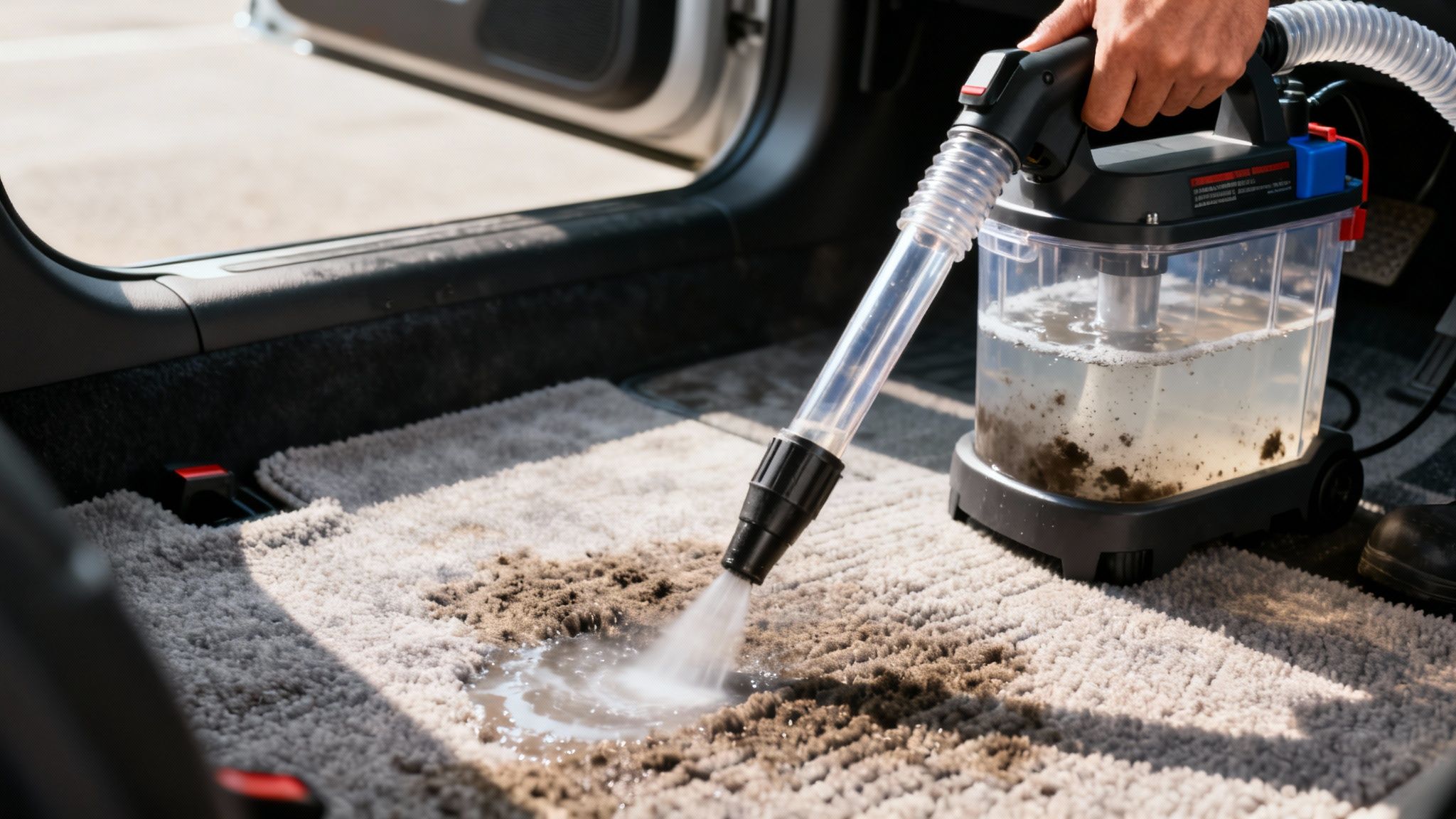
That's why we use hot water extraction. A professional extractor, which looks a bit like a shop vac on steroids, does two crucial things at once:
- It shoots a heated cleaning solution deep into the fibers, blasting apart embedded dirt, oils, and nasty mildew spores.
- Then, its powerful vacuum immediately sucks all of that dirty, contaminated water right back out.
This process truly flushes the fabric clean from the inside out. You're removing the problem, not just spreading it around. The heat helps kill off any lingering bacteria, and the powerful suction pulls out most of the moisture—which is absolutely key to preventing the mildew from coming right back. If you want a deeper dive on this, check out our guide on how to clean cloth car seats.
Don't Forget Leather and Vinyl
Mildew isn’t just a fabric problem. It loves to hide in the seams and textured surfaces of leather, vinyl, and plastic trim. You can’t just skip these spots, but you definitely can't use the same products.
Throwing an all-purpose cleaner on your leather seats is a one-way ticket to dry, cracked, and faded upholstery. It strips the natural oils right out. Instead, we use dedicated, pH-neutral leather and vinyl cleaners that get the job done without causing damage. And we always follow up on leather with a quality conditioner to put that moisture back and add a layer of protection.
It’s this attention to detail that separates a quick car wash from a true professional restoration. Every single surface gets the right treatment with the right product. If that’s the level of deep cleaning your car desperately needs, The Mobile Buff is ready to bring these tools and techniques right to your driveway here in the Harrisburg area.
Ever spent an entire weekend deep cleaning your car, only to have that damp, musty smell hit you in the face the moment you turn on the AC? It's incredibly frustrating. You start to wonder if you missed a spot, but the truth is, the problem probably isn't on your carpets or seats at all.
The real culprit is often hiding deep inside your car's heating, ventilation, and air conditioning (HVAC) system.
Your car’s air conditioner is designed to pull moisture out of the air, which creates condensation. This process turns the guts of your HVAC system into a dark, damp, and cool environment—basically a five-star resort for mold and mildew to set up shop. When you crank up the fan, it just blows those funky-smelling spores right into the cabin for you to breathe in.
This is the sneaky source that most DIY cleaning jobs completely miss. You can scrub the carpets until they look brand new, but if the mildew is growing in the vents, that smell is guaranteed to come back.
First Stop: Your Cabin Air Filter
Before you even think about treating the vents, you have to deal with the system's gatekeeper: the cabin air filter. Think of it like the furnace filter in your house. Its whole job is to trap dust, pollen, and—most importantly—mold spores before they can get into the system and start a party.
But over time, this filter gets absolutely caked with gunk. A dirty, clogged filter doesn't just stop working; it can become a source of the odor itself. As moisture from the AC system soaks that filthy filter, it becomes a breeding ground for mildew.
It’s no surprise that a staggering 70% of musty car odors can be traced back to a neglected cabin air filter choked with mold. One study of 10,000 vehicles found that in humid climates, just replacing the filter annually can slash mildew smells by 85%. After about 12 months, a filter's efficiency can plummet to as low as 40%—meaning it starts blowing the very contaminants it's supposed to be catching right back at you.
Getting the Gunk Out of the Vents
Okay, so replacing the filter is a solid first step. But what about the mildew that's already taken root deep inside the vent system? You need to go on the offensive.
Spraying a household disinfectant into the vents is a temporary fix at best. At worst, you risk damaging sensitive electronic components hiding in your dash. It's a band-aid on a bigger problem.
A professional-grade vent treatment isn't about masking the smell with a heavy perfume. It's about releasing a fine, targeted mist that travels through every single duct and crevice, neutralizing the mildew spores and bacteria right at the source for a truly lasting solution.
The professional approach uses a specialized enzyme fogger or aerosol cleaner designed specifically for automotive HVAC systems. The process involves running the car's AC on a specific setting (usually full blast on recirculate) to draw the cleaner deep into the system. This ensures it reaches the evaporator core and other hidden areas where mildew loves to hide. It's a thorough process that really works, and you can learn more about it in our complete guide on how to clean car air vents.
DIY vs Professional HVAC Odor Treatment
You've probably seen those DIY vent "bombs" at the auto parts store. While they can offer some temporary relief, they just don't have the power or the reach of professional-grade equipment. It really comes down to whether you want to mask the smell for a few weeks or get rid of it for good.
Here’s a quick comparison of what you can expect from each approach.
As you can see, the professional fogging method is designed to be a comprehensive solution, not just a quick fix.
Dealing with the HVAC system is simply non-negotiable if you want to permanently remove the mildew smell from your car. It’s the hidden source that keeps the problem coming back, no matter how much you clean the rest of the interior. If you’re tired of playing whack-a-mole with that musty odor, let the experts at The Mobile Buff handle it. Our team serves the entire Harrisburg area and comes equipped with the professional-grade tools needed to get the job done right the first time.
The Final Step: Professional Drying and Odor Elimination
Alright, you’ve put in the work. You've deep-cleaned, scrubbed every surface, and even tackled the HVAC system. Now comes the part that makes or breaks the entire effort: getting the car completely dry. This is where most DIY jobs go wrong, and it’s the single biggest reason that musty smell comes roaring back, sometimes worse than before.
I can't tell you how many times I've seen it. Someone spends a whole weekend cleaning their car, only to leave a little moisture behind in the carpet padding or deep in the seat foam. To the touch, it feels dry. But deep down, it’s the perfect breeding ground for a new batch of mildew.
Why Pro Drying is a Game-Changer
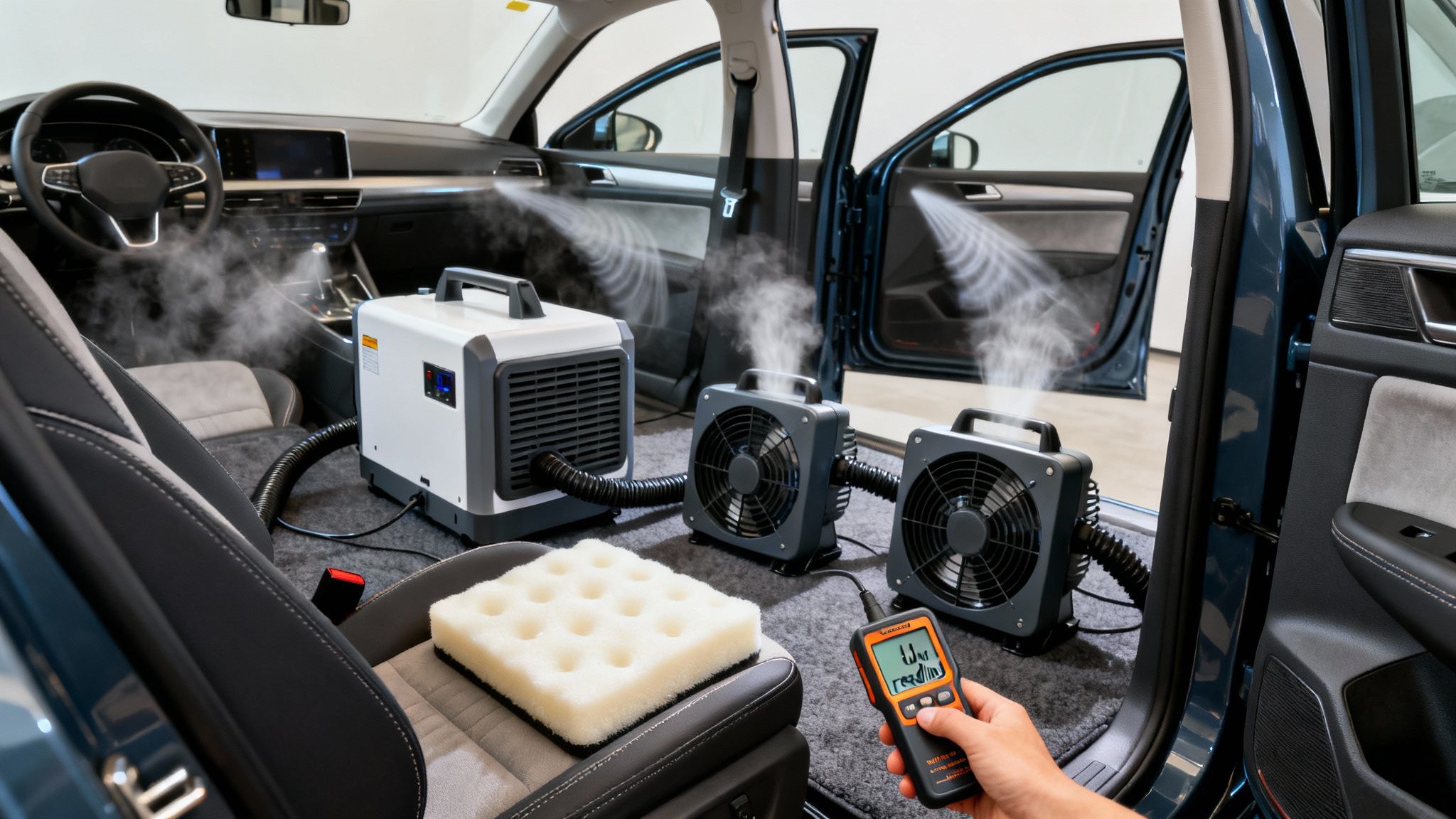
Leaving the windows cracked on a sunny day just isn't going to cut it after a real deep cleaning. We bring out the heavy-duty equipment to force every last drop of moisture out of your vehicle's interior.
- High-Velocity Air Movers: These aren't your typical box fans. They’re designed to blast powerful, targeted streams of air across all surfaces, speeding up evaporation and getting deep into those fabric fibers.
- Commercial Dehumidifiers: While the air movers get the air circulating, a dehumidifier is the real MVP. It actively sucks moisture out of the air inside the sealed car, creating an arid environment that literally pulls the dampness out of your carpets and upholstery.
This one-two punch is how we guarantee the interior is bone-dry. It’s a step that takes time and the right tools, but it's absolutely essential for getting rid of that smell for good.
Getting Rid of Odors, Not Just Masking Them
Once everything is perfectly dry, we can finally go after any stubborn smells that have soaked into the car's surfaces. This is where those little tree air fresheners and sprays fail miserably. They just cover up the odor with a stronger scent for a little while. The smell always comes back because the source is still there.
We use professional-grade treatments that eliminate odors at the molecular level. We’re not covering anything up; we're destroying it.
One of our most effective tools for this is our signature Bio Bomb service. It uses a thermal fogging system to create a super-fine vapor that works its way into every single crack and crevice of your car—the headliner, the vents, deep inside the seat cushions—neutralizing odor-causing molecules on contact.
The results speak for themselves. Professional detailing outperforms DIY methods by a staggering 80% when it comes to long-term mildew odor removal. While things like ozone generators have their place, they can be harsh on interior materials. In contrast, treatments like chlorine dioxide foggers succeed in 92% of cases by reaching into the A/C lines, where about 50% of stubborn smells love to hide. Our enzyme-based Bio Bomb fogger takes it a step further, biologically breaking down the odor molecules for a 99% success rate, all without harsh chemical leftovers. If you're curious, you can explore the fascinating science behind these professional treatments to see why they’re so effective.
It’s this commitment to a complete, science-backed process that sets a professional detailer apart. We don't just clean your car; we restore its interior to a fresh, healthy state.
If you’re tired of that musty smell that just won't quit, it's time to call in the pros. The Mobile Buff brings this professional-grade equipment and expertise right to your doorstep in the Harrisburg area. See what your neighbors are saying on our Google Business Profile and let us show you what a true, permanent solution smells like.
Let the Pros Handle It for You
Look, getting rid of a stubborn mildew smell can be a real headache. As we've covered, it's often way more than a quick wipe-down. It's a deep-dive process that demands the right equipment, powerful (and safe) chemicals, and a good bit of experience to make sure that musty funk is gone for good.
That's where we come in. Here at The Mobile Buff, we bring the whole operation right to your doorstep in the Harrisburg area. Forget spending your Saturday hunting down supplies and getting soaked, only to have the smell creep back in a week.
Your Complete Mildew Removal Solution
Our service is a top-to-bottom reset for your car's interior. We're not just spraying air freshener; we're using the heavy-duty techniques we've talked about. This includes things like hot water extraction to pull mildew out of the deepest carpet fibers and our advanced Bio Bomb treatment, which literally dismantles odor molecules.
We don't mask the smell—we eliminate the source.
Tackling a serious mildew problem without professional-grade tools often ends in frustration. You can waste a lot of time and money, or even worse, cause permanent damage to your interior fabrics while leaving harmful spores behind.
Our mobile team arrives ready for anything. We know exactly where moisture loves to hide in a car's interior, from under the seats to deep inside the vents, and we have the gear to force it all out. Don't just take our word for it—see what your neighbors are saying about our work on our Google Business Profile!
There's no reason to put up with that damp, musty odor for another day. Our dedicated professional car odor removal services are designed to bring your car back to that fresh, clean, and healthy state you remember.
Ready to finally breathe easy in your own car? Let us handle the dirty work. Book your mobile detailing service with The Mobile Buff today.
Got Questions About That Musty Car Smell? We've Got Answers.
Tackling a mildew smell always brings up a few questions. Over the years, we've heard just about everything, so let's clear up some of the most common things drivers ask when trying to get that funk out of their car for good.
So, Can't I Just Toss Some Baking Soda in There?
It’s the first thing everyone thinks of, right? Grab the baking soda or a spray bottle of vinegar. It's cheap, it's in your kitchen, and it seems like an easy win.
But here’s the thing: those home remedies are like putting a bandage on a broken arm. They might mask the smell for a day or two, but they don't have the chemical muscle to get to the root of the problem. Mildew isn't just on the surface; it’s living deep in your carpet fibers, your seat padding, and hiding out in your car’s A/C system. Baking soda just can't reach it.
The Bottom Line: Home remedies are a temporary fix, at best. To kill the smell for good, you have to kill the source with professional-grade treatments designed to break down the actual mildew spores.
How Long Does a Professional Treatment Actually Take?
This really boils down to how bad the problem is. If we're dealing with a simple spill that just happened, we might be in and out in a couple of hours. But if you've had a slow leak for months, that mildew has had time to set up a permanent residence. That’s going to take more work to fully treat and dry out.
The great thing about a mobile service like ours is that we fit into your schedule. We come to your home or office, so you don't have to kill your day sitting around a detail shop.
Is That Mildew Smell in My Car Actually Bad for Me?
That musty odor isn't just annoying—it's a sign of something that can affect your health. Mold and mildew spores are well-known irritants, and they can be a real problem for some people.
- Kids and the elderly are often more sensitive.
- Anyone with asthma or allergies can have their symptoms triggered.
- Even healthy adults can experience coughing, sneezing, or other respiratory issues from breathing in spores all day.
Getting the mildew professionally removed isn't just about making your car smell nice; it's about making sure the air inside is clean and healthy for you and your passengers.
Don't let a musty odor ruin your drive or compromise your car's air quality. If you're ready for a permanent solution that restores a fresh, clean, and healthy interior, let the professionals at The Mobile Buff handle it. Book your mobile odor removal service today and breathe easy again.

